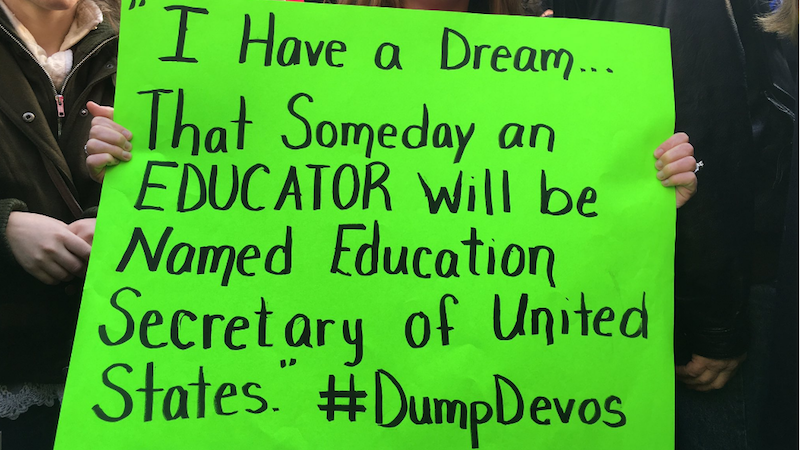
"The whole people must take upon themselves the education of the whole people and be willing to bear the expenses of it. There should not be a district of one mile square, without a school in it, not founded by a charitable individual, but maintained at the public expense of the people themselves." -- John Adams

"No money shall be drawn from the treasury, for the benefit of any religious or theological institution." -- Indiana Constitution Article 1, Section 6.

"...no man shall be compelled to frequent or support any religious worship, place, or ministry whatsoever, nor shall be enforced, restrained, molested, or burthened in his body or goods, nor shall otherwise suffer on account of his religious opinions or belief; but that all men shall be free to profess, and by argument to maintain, their opinion in matters of religion, and that the same shall in no wise diminish enlarge, or affect their civil capacities." – Thomas Jefferson

Showing posts with label Charters. Show all posts

Thursday, September 14, 2023

In Case You're Listening -- Annual Blogoversary Post


SEPTEMBER 14, 2006

I started this blog while I was still teaching, in 2006. I had just begun my 31st year as an educator.

Just like in previous years, however, I was stressed out and irritated about the standardized testing situation in Indiana. I needed to vent.

This was a place where I could express my frustration about the condition of public education in Indiana and the US. I didn’t care who read it…if anyone. I just wanted to put my thoughts down and complain. I suppose I should have titled the blog “The Complaint Department” or something like that since that’s what it mostly consisted (and consists) of...complaints about how public education, and education in general, is treated in the US.

I focused the blog on testing. 2006 was in the middle of the “No Child Left Behind” unpleasantness when schools were labeled good if they catered to wealthy, upper-middle, or middle-class students and bad if they were filled with children living in poverty. This is simply because, then as now, test scores mirror a family's economic status. Rich kids, with educated parents and well-staffed and well-supplied schools score high. Poor kids, with parents who work two or three minimum-wage jobs and understaffed and underfunded schools score low. Adding injury to insult, NCLB made punishment of the so-called bad schools part of the plan.

BAD TO WORSE

Things have gone from bad to worse in the last seventeen years. I’ve complained less, only because I’ve written less due to personal health problems (only 10 posts in 2022 and just one this year).

Testing is still misused and overused. The NAEP is regularly misinterpreted by folks who know nothing about education and testing and who conflate the terms “proficiency” and “grade level.” States still force schools to test for ranking purposes...in ignorance of the real purposes of educational testing.

Politicians, Indiana's included, still use every excuse to whine about the sad state of our public schools, how awful teachers (and their unions) are, and how our children are being shortchanged. All that public school bashing has led to a crisis of teacher shortages around the country. It turns out that it's hard to convince young people to enter a profession where they are insulted, their expertise questioned by people who don't know anything about education, underpaid, overworked, called names like "groomer," and blamed for all the ills of society.

Never mind that those same politicians are the main cause of most of the problems facing our public schools.

Never mind that the growth of vouchers and charters has sucked funding from real public schools.

Never mind that money is still inequitably spent so that the rich get richer and the poor still don't get enough.

Testing is still a problem. Teachers and schools are still judged by their test scores despite the fact that poverty is the real problem.

Vouchers and charter schools drain money from public schools at increasing rates despite the fact that their test scores also reflect the income of their students’ families.

Teachers are still undervalued and underpaid. My anecdotal reasons for this are 1) teaching is a predominantly female career and women don't get paid as well as men and 2) because we, as a nation, talk a good game but we really just don't give a damn about our children and their future.

It's almost like they (politicians, pundits, and privatizers) want to destroy public education...


MOVING FORWARD

I still regularly badger my local representatives about public education, but, being Republicans, they either are too afraid of their leadership to speak out in favor of public schools or, as I suspect is true, don’t really care about public schools. In their mind it’s “socialism” and we can’t have that, now, can we? I sometimes feel like they don't hear me either. My state representative is (or was, I can't recall) a board member for our local Lutheran schools (voucher recipients -- no conflict of interest there!), and my state senator is a doctor who introduced a bill (currently on hold pending litigation) forbidding parents from providing gender-affirming care for their children. So much for "parental rights."

Physically, I’m doing better so I’ll try to post more (I hope). And I’m not giving up. I’m hopeful that the young people of the nation take charge, insist that schools are fully funded, and insist that teachers are given the credit and pay they deserve.

With any luck, I’ll celebrate the successes of our nation’s support for public education over the next few years. In the meantime here are a couple of good posts to get your blood flowing...

Raising the Bar on Kindergartners: A Nation at Risk Lives On
Kindergarten has never been so high pressured, even after Covid, and it has been this way for years despite little proof children are born with evolved brains requiring faster instruction so they can grow up and beat their peers in other countries.

How must children feel while being made to carry the weight of the future economy, and if they don’t enter first grade learner ready, they could be marked for life!

And corporate remaking of kindergarten thus far, over forty years, with all its pressure, hasn’t produced a good enough child, or adult, for those who still worship A Nation at Risk.

Local Parents, Educators Face ‘Attack’ on Public Schools from Indiana Lawmakers - Limestone Post Magazine in Bloomington, Indiana
Republican legislators came to embrace the concept that state education funding should “follow the student.” If parents sent their child to a public school, a private school, or a privately operated charter school, that’s where the money would go.

This year, they expanded the private-school voucher program to families that make up to 400 percent of the limit for reduced-price school meals, $220,000 for a family of four; and they eliminated pathways that students had to follow to qualify. That makes it essentially a universal program, open to an estimated 97 percent of students.

“I’m excited to see Indiana once again stand behind our Hoosier families who want the ability to choose the best school that meets their child’s needs regardless of their zip code,” House Speaker Todd Huston, R-Fishers, said in a news release. “We’re now on our way to having the best school choice program in the country.”

As students leave public schools for private schools, however, state funding follows, leaving public schools with fewer resources. Instead of the “general and uniform system of common schools” prescribed by the state constitution, Indiana now funds three K-12 systems: traditional public schools; over 100 charter schools, most of them privately operated; and private schools that rely on vouchers.
🚌🚌🚌

Sunday, February 14, 2021

Indiana Vouchers Set to Expand Again

FOLLOWING IN THE FOOTSTEPS OF DANIELS, BENNETT, AND PENCE

Ten years ago the Indiana General Assembly established the state's voucher program to "provide children who attend failing schools grants to attend a school of choice." At that time, the state provided tuition help for low-income students to attend religious schools (it's actually "private" schools, but nearly all are religious). Families earning more than $60,000 were not included. The inflation rate over the last ten years has been about 16% so that $60,000 cap would be about $70,000 today. The General Assembly, however, wants to double that and the Indiana House will vote on the bill tomorrow (February 15).

We've spent more than half a billion dollars on vouchers since 2011. Has it helped poor students? Has it improved learning? Has it improved public schools as voucher proponents claimed it would? The state has yet to evaluate the program for anything other than political contributions. As with other voucher programs around the country, the voters have never directly chosen to spend all that money.

In 2011 the goal of the voucher program was to help poor students "escape" from "failing" [read: high-poverty] schools. Now the program goal is to provide "choice" for private and religious schools to accept middle-class families who would have sent their kids to their schools anyway.

The money for vouchers comes from the state's education budget, so the voucher students in one county are draining away public funds that could be used for public school students in other counties around the state. The money also goes to mostly religious schools despite the state constitution prohibition (Article 1, Section 6). How does that pass legal muster? The state Supreme Court agreed to allow the state to launder the money through parents. Parents choose the voucher recipient (assuming that the school accepts their child, of course), and the state sends the cash directly to the school -- state funds, directly from tax dollars to religious schools. It doesn't matter if the school discriminates against certain students, hires unqualified teachers, or teaches religious doctrine as scientific fact.

Meanwhile, funds for high poverty public schools are being capped, public school teacher salaries are ignored again, and charter schools are also getting a budget boost.

How does this keep happening? The Indiana electorate, including the parents and caretakers of the 90% of students who attend public schools, continue to vote for people who hate public schools.

Betsy would be proud.

Bill lavishes more money on favored private schools
Freshman state lawmaker Jake Teshka was incredulous. He had just listened to the president of the Indiana School Board Association criticize a sweeping expansion of the school voucher program as benefiting wealthy families.

“Do you believe, that in 2021, $140,000 in a family of four is considered wealthy?” the South Bend Republican asked Robert Stwalley during Feb. 3 testimony on House Bill 1005.

“I would certainly consider it to be wealthier than the original program was designed – for the low income. Absolutely,” the Purdue University engineering professor replied. “For a family of five, that brings you up to $160,000 a year in income. That's pretty wealthy, sir.”

Median household income in Indiana is $57,603, according to census data. For a family of four, it is $90,654.

Teshka isn't the only House Republican out of touch with Hoosier families. His colleagues on the House Education Committee, as well as all Republicans on the House Ways and Means Committee, voted unanimously to support HB 1005. The bill goes to the full House on Monday, where the super-majority caucus appears dead set on removing already-generous income limits on vouchers and adding education savings accounts, a costly program with an extensive record of abuse in other states.

Hoosiers should demand to know the justification for handing millions in tax dollars to high-income households and private and parochial schools. How many more ways can GOP lawmakers find to take money from the schools serving 90% of Indiana's students, including the neediest?


🚌💲🚌

Tuesday, January 26, 2021

2021 Medley #2 - Privatization, the Free Market, and Propaganda

Privatization and the Free Market
Truth, Lies, and Propaganda
PRIVATIZATION, AND THE FREE MARKET

Betsy DeVos might be gone from our federal government, but she and those who support her privatization schemes for public education are still around.

It’s “School Choice Week” & I Choose…

Stu Egan, who blogs at Caffeinated Rage wrote this about school choice week. In it, he reminds us that "Our public schools are better than many lawmakers and 'pro-choice' advocates portray them to be – many of whom have never spent time as educators." The privatizers define the parameters in order to place public schools in a poor light...and then claim that public schools are "failing."

Supporters of public schools must change the narrative.
With the constant dialogue that “we must improve schools” and the “need to implement reforms,” it is imperative that we as a taxpaying public seek to understand all of the variables in which schools are and can be measured, and not all of them are quantifiable.

And not all of them are reported or allowed to be seen.

Betsy DeVos’s March, 2018 assertion on 60 Minutes that America’s schools have seen no improvement despite the billions and billions of dollars thrown at them was a nearsighted, close minded, and rather uneducated assessment of public schools because she was displaying two particular characteristics of lawmakers and politicians who are bent on delivering a message that public schools are not actually working.

The first is the insistence that “they” know education better than those who actually work in education. DeVos has no background in statistical analysis, administration, or teaching. The second is the calculated spin of evidence and/or the squashing of actual truth.

The premise of DeVos’s argument was the performance of US students on the PISA exam. She was trying to control how the public saw the results. She framed the context to promote a narrative that her “reforms” were the only solutions.

Legislators propose expanded vouchers, ESA’s

What is the purpose of America's public schools?

Privatizers believe that education is an individual choice. They claim that all parents must be "in it for themselves" to get the best education for their child. Education, looked at this way, is a consumer good...something that one must shop for. If that's true, then there will be winners and losers. As a society, we can't afford to maintain an education system in which a large portion of our children end up as losers.

In the 2012 presidential campaign, Republican candidate Mitt Romney said [emphasis added], "...I want to make sure that we keep America a place of opportunity, where everyone has a fair shot. They get as much education as they can afford..." What about those who can't afford any education? Will we, as a society, have to support them if they're unhireable? It's in society's interest to make sure everyone is educated.

Public school advocates believe that public education is a common good. Let's change "in it for themselves" to "we're all in this together." As the late Minnesota Senator Paul Wellstone said, "We all do better when we all do better."
Under HB 1005, families that make up to three times the limit to qualify for reduced-price school meals – which is over five times the federal poverty level — would become eligible for vouchers in 2022-23. For a family of five, that’s $170,274 a year, more than three times the median household income in Indiana.

Families would also receive more generous voucher funding under the legislation. Currently, only the lowest-income families receive a full voucher, worth 90% of the per-pupil funding that their local school district gets from the state. Higher-income recipients get 50% or 70% of that amount.

Under HB 1005, all families with vouchers would receive 90% of local per-pupil state funding. In effect, families that make several times as much as the average Hoosier household could get about $5,500 per child from the state to pay private school tuition.

Constitutionally enshrined schools deserve our ongoing protection

The Indiana Constitution, Article 8, Section 1, states that,
...it shall be the duty of the General Assembly...to provide, by law, for a general and uniform system of Common Schools, wherein tuition shall be without charge, and equally open to all.
The only tuition-free schools, open to every child in the state, are the public schools. Private/Parochial schools can refuse students for a variety of reasons including, but not limited to, gender identification, sexual preference (as well as the sexual preference of the parents), and religious beliefs.

Charter schools can, and sometimes do, choose their students based on socio-economic status, academic achievement, physical/academic disability, and the ability to provide their own transportation.

Until charter schools and private/parochial schools accept all students regardless of academic ability, economic status, or any other limiting factor, they should not receive state support. Public education dollars should go to public schools.
I have no problem with parents choosing which school their children attend. They have the right to send their children to the school of their choice, be that public or private. I willingly pay taxes to support public school education.

However, I vehemently object that my taxes also are providing vouchers to pay for non-public schools. Every dime that goes to the non-public schools takes money away from education for public schools. At the expense of public schools, taxpayers are paying for a multi-education system instead of the one system, open to all, established by our Indiana Constitution.

These Textbooks In Thousands Of K-12 Schools Echo Trump’s Talking Points

In the Virginia Statute for Religious Freedom, Thomas Jefferson wrote,
...to compel a man to furnish contributions of money for the propagation of opinions which he disbelieves and abhors, is sinful and tyrannical; that even the forcing him to support this or that teacher of his own religious persuasion, is depriving him of the comfortable liberty of giving his contributions to the particular pastor whose morals he would make his pattern, and whose powers he feels most persuasive to righteousness; and is withdrawing from the ministry those temporal[ry] rewards...
So why are our tax dollars going to support schools which teach a "skewed version of history" and religion as science?
Christian textbooks used in thousands of schools around the country teach that President Barack Obama helped spur destructive Black Lives Matter protests, that the Democrats’ choice of 2016 nominee Hillary Clinton reflected their focus on identity politics, and that President Donald Trump is the “fighter” Republicans want, a HuffPost analysis has found.

The analysis, which focused on three popular textbooks from two major publishers of Christian educational materials ― Abeka and BJU Press ― looked at how the books teach the Trump era of politics. We found that all three are characterized by a skewed version of history and a sense that the country is experiencing an urgent moral decline that can only be fixed by conservative Christian policies. Language used in the books overlaps with the rhetoric of Christian nationalism, often with overtones of nativism, militarism and racism as well.


Free Market Facts And School Choice

"...the free market doesn’t foster superior quality; the free market fosters superior marketing."
...the last two months of U.S. history are more than sufficient to demonstrate why allowing citizens to make a free market selection of their own preferred facts is bad for us as a country. Free market fans like to argue that only the best products win in the marketplace. But the free market doesn’t foster superior quality; the free market fosters superior marketing. And in the free market of ideas, sometimes the most effective marketing is simply, “Wouldn’t you rather believe this?”

There is no benefit to society in encouraging parents to choose post-truth fact-impaired education for their children, certainly not enough benefit to justify spending taxpayer dollars to pay for it. Choosing your own preferred facts from a wide open marketplace simply enables willful ignorance, and that is never good for society as a whole.

TEACH YOUR CHILDREN WELL

Our founders were not perfect. The US Constitution excused slavery. The Civil War ended the legal practice of slavery, but was followed by a failed "reconstruction" which ushered in an era of Jim Crow laws, punishment, and death for former slaves. The "second reconstruction" yielded some relief, but law and social pressures still worked against the advancement of political, economic, and social equality.

The first century and a half of the country's existence were also dedicated to the subjugation, through lies and deceit, of the people native to the land. The so-called treaties made in the name of the United States were ignored. The payment for the land taken was often reneged upon. Entire communities were uprooted and moved, often at the cost of human lives.

Now, nearly 250 years after our founding, we're still grappling with racism, inequality, and white supremacy. Should we lie to our students and tell them that nothing has ever been wrong with the nation or should we tell them the truth?

The following three articles from Kappan deal with teaching students the truth, how to differentiate the truth from lies, and how to protect themselves from propaganda.

The silence of the ellipses: Why history can’t be about telling our children lies
In September 2020, President Donald Trump stood in the great hall of the National Archives to denounce what he called a leftist assault on American history: “We must clear away the twisted web of lies in our schools and classrooms,” he said, and teach our children a kind of history that will make them “love America with all of their heart and all of their soul.”

Love built on a lie is false love. It achieves its mirage by making truth its victim. The goal of historical study is to cultivate neither love nor hate. Its goal must be to acquaint us with the dizzying spectrum of our humanity: lofty moments of nobility mixed in with ignominious descents into knavery. When history’s mirror intones a single phrase — that we’re the fairest of them all — it freezes us in childhood and stunts our growth. History that impels us to look at the past, unflinchingly and clear-eyed, does not diminish us or make us less patriotic. The opposite, in fact, is true: It makes us grow up. Understanding who we were allows us to understand who we are now. Only then can we commit to doing something about it.

That should be the goal of history education. Our children deserve nothing less.

Taking a reasoned stance against misinformation
In this time of widespread dissemination of alternative facts and misinformation, teachers have a responsibility to turn classrooms into spaces where reason and inquiry trump ignorance and hyperbole. But doing so often requires teachers to take a stance regarding what issues are worthy of deliberation and what information warrants consideration, and the decisions teachers make may be risky, as teachers are generally expected to be politically neutral, and expressions of their political beliefs can expose them to accusations of bias (Journell, 2016). That’s why it’s important for teachers to follow established criteria for making pedagogical decisions.

Having a clear framework that enables them to justify their decisions to students, parents, and administrators will hopefully mitigate the risks that come with opening the floor to discussion of controversial topics. More important, modeling thoughtful discernment and being transparent about which topics are open for deliberation and what information is acceptable to bring to a discussion is a valuable lesson unto itself, one that students can use outside the classroom and into their adult lives.

Understanding propaganda: A conversation with Renee Hobbs
Renee Hobbs is professor of communication studies at the Harrington School of Communication and Media at the University of Rhode Island...

...when I started offering college courses about propaganda, many years ago, a lot of students thought this meant I’d be teaching history classes. In most secondary schools, the only time anybody talks about propaganda is in the context of the Second World War, so students tend to associate it with the Nazi era. I often have to explain that propaganda isn’t some bygone issue from long ago and far away. Actually, it’s something we’re all swimming in every day...

In 2019, for instance, the National Council of Teachers of English passed a resolution calling for a renewed emphasis on teaching ”civic and critical literacy,” including efforts to “enable students to analyze and evaluate sophisticated persuasive techniques in all texts, genres, and types of media” and to “support classroom practices that examine and question uses of language in order to discern inhumane, misinformative, or dishonest discourse and arguments.” Well, that sounds like propaganda analysis to me.

Plus, I think we’re seeing a lot of young people becoming more eager than they have in years to embrace civic life — whether they’re interested in politics, racial justice, the environment, you name it. And to participate in civic life effectively, they need to be able to speak persuasively, activate emotions, simplify information, appeal to people’s deepest values, respond to attacks from opponents, and so on. In short, they need to learn about rhetoric and propaganda. So, our students are certainly ready for this kind of instruction, and they may begin to demand it, too.
🚌🚌🚌

Friday, January 8, 2021

2021 Medley #1: Bye, Bye Betsy and other stories

DeVos Resigns, End wasteful testing,
COVID and education, Choice for schools,
Blaming teachers, The "Science of Reading"
BYE, BYE BETSY

Betsy DeVos Resigns

I was ready to publish the rest of the articles in this post on Wednesday, but I got sidetracked by the horrible events in Washington D.C. Since then I have paused, while I figured out what I wanted to say. Then, last night, Betsy DeVos resigned...

I am against nearly everything DeVos has done during her term as Secretary. She has pushed her agenda of privatization and has rejected pleas to support students overwhelmed by debt. She has ignored racist education policies and neglected the students who need the most help. She hates public education and public educators. I doubt that she cares much for public school students, either. She was never qualified for her job. She never attended a public school. She never worked in a public school. She never sent her children to a public school. She's an elitist billionaire who cares only about what she can control with her money.

I'm sure she will now return to private life and continue to wreak havoc on public education by buying legislators and using her billions to support private, religious education.

There are a lot of articles discussing DeVos's resignation -- the nation's worst Secretary of Education appointed by the worst President. Mitchell Robinson verbalizes how I feel about her. After all the terrible things her boss has done over the last four years, she has finally had enough, apparently...
I wish I could find more satisfaction in something I’ve hoped would happen for 4 years.

But as usual, Ms. DeVos did the absolute least she could do (resign), well past the time when it could have made a difference (with 13 days left in her lamest of all duck terms), and is probably only doing it to avoid doing something she doesn’t want to do (invoke the 25th Amendment).

DeVos resigned, allegedly, because her boss’ insurrection attempt was an “inflection point” she simply couldn’t ignore.

TIME FOR TEST WITHDRAWAL

The Tests Are Lousy, So How Could the Scores Be Meaningful?

If anything good can come out of the devastating pandemic still terrorizing the nation, then it's that there is absolutely no reason to continue our overuse and misuse of standardized tests. Alfie Kohn pens another excellent, thought-provoking piece...
Standardized tests are so poorly constructed that low scores are nothing to be ashamed of — and, just as important, high scores are nothing to be proud of. The fact that an evaluation is numerical and the scoring is done by a computer doesn’t make the result “objective” or scientific. Nor should it privilege those results over a teacher’s first-hand, up-close knowledge of which students are flourishing and which are struggling.

Sadly, though, some educators have indeed come to trust test scores more than their own judgment. One hears about parents who ask a teacher about problems their child is having in school, only to have the teacher reach into a desk and fish out the student’s test results. Somewhere along the way such teachers have come to discount their own impressions of students, formed and reformed through months of observation and interaction. Instead, they defer to the results of a one-shot, high-pressure, machine-scored exam, attributing almost magical properties to the official numbers even when they know those exams are terrible.

SCHOOLS AND COVID-19

COVID and Schools: The Data and Science Then and Now

The conventional wisdom is that it's safe to send kids back to school. The need for students to be in face-to-face school situations is so important that we should not worry about adults in the building and their susceptibility to COVID, but send the kids so they can get an education (Note: this is often said by the same people who lobby for online charter schools!).

It turns out that the conventional wisdom is wrong. Schools are not always the safest place for kids or adults.
...internationally, they have already figured out in the public consciousness that schools are platforms for superspreading. It is very clear that Covid has taken advantage of some of American’s most challenging traits— denial and hubris— in the debate about reopening schools.

So what does the national data reported in early December by US News tell us about the situation with communities, schools, and Covid?
  • Their analysis of their national data shows that the high school student case rate (13 per 1,000 students enrolled for in-person classes) is nearly three times that of elementary school students (4.4 per 1,000).
  • They observed that the higher the community case rate, the higher the school district case rate...

THE MYTH THAT TURNS OUT TO BE TRUE

Can charter schools pick the best students? No, but many believe the myth.

Jay Matthews, the reformist Washington Post education writer without any educational training, writes this article about how it's not true that charters can pick and choose their students...and then proceeds to tell us how charter schools pick and choose their students.
So it’s wrong to say that charters are allowed to pick whatever students they want. But that’s not to say some of them haven’t skirted those rules.

In 2016, the American Civil Liberties Union of Southern California and the Public Advocates civil rights law firm found that at least 253 of California’s roughly 1,200 charter schools maintained policies that illegally prevented students from enrolling or remaining at their schools.

A school in Hemet, Calif. said that to apply as a sophomore a student “must be earning an ‘A’ or ‘B’ in both Geometry and Biology.” A school in Redlands said “only students who show steady academic progress . . . will be eligible for enrollment.” Within a few months of the report’s publication, more than 100 charter schools contacted the authors to say they were correcting their policies to get off the bad list...

IT'S ALL THE TEACHERS' FAULT

The New York Times Adds One Plus One And Gets Three

When the pandemic hit and schools closed, teachers were lauded for their heroism...changing their entire jobs overnight and taking care of their students online. As the public has tired of the pandemic, however, the inconvenience of not having all schools open -- despite the danger to those who work in education -- has opened teachers up for derision. The very fact of teachers as essential workers has given many the opportunity to blame teachers for inconveniencing their lives.

Peter Greene, in the following two posts, explains some things about education and teaching...
...what the heck do people think teachers do every fall? Seriously. Do they imagine that teachers just assume that all their new students know X, Y and Z because it's in the curriculum. Do folks imagine that teachers spend the weeks before school poring over BS Test results to learn where their students are? Because, no-- mostly the test results aren't available yet and because teachers are forbidden to see the actual question, all they get is the test manufacturer's "analysis" of the results, which is mostly hugely broad and unhelpful.

No, in the fall, teachers use a large array of formal and informal assessments to figure out student's individual weaknesses and strengths. Teachers do this daily, and then they keep doing it all year. This remains one of the great, silly fictions of the BS Test--that the results are useful to teachers who would be lost without them. In reality, the BS Test is like a guy who shows up at the office of a general who is commanding thousands of troops on dozens of fronts and this guy--this guy shows up with a pop gun and announces, "I am here to win this war for you."

Another Round Of Teacher Bashing
The level of bash, of demeaning insult, in this "selfish teachers close our schools" argument is huge. Because there are only a couple of possible explanations for the picture critics like FEE [Foundation for Economic Education] paint:

Teachers are stupid people who don't understand the settled science.

Teachers are stupid and also lazy people who went into teaching hoping they would have to never actually work and the pandemic shut-downs are their idea of a gift from God, and they want to stretch out this paid vacation for as long as possible.

Teachers are big fat liars who are pretending not to understand the settled science so they can milk the taxpayers while providing nothing in return.

Teachers should be martyrs who want to give up their entire lives for their students, and if they don't want to do that (or, incidentally, want to be well-paid for it), they're lousy teachers and terrible human beings.

Note that all of these include the assumption that distance learning is a big fat vacation. Also, people who chose teaching as their life's work don't actually want to teach. Also, as FEE makes explicit, teachers do not have students' interests at heart. They don't care about the kids at all (which adds to the assumption of their stupidity, because if you don't care about children, teaching seems like a pretty dumb career choice, but hey--maybe you became a teacher because you couldn't manage a real job).

A TAKE ON THE "SCIENCE OF READING"

The Critical Story of the “Science of Reading” and Why Its Narrow Plotline Is Putting Our Children and Schools at Risk

Last one for today, an essential article for teachers of reading and literacy.
#1. Hijacking Terminology
Words have power. The term science connotes credibility, but it also represents evolution and diversity. The “science of reading” has stripped away the dynamic interplay of experiences that grow a child into a reader and a writer and centered the literacy process solely atop phonics. This narrow plotline disregards the impact of writing, comprehension, culture, play, mentor texts, family, and the power of a teacher-researcher to individualize instruction...

#2. Reframing the National Reading Panel...

#3. Attacks on Higher Education and the Problems with NCTQ...

#4. “The Sky Is Falling” atop Declining NAEP Scores...
🚌🚌🚌

Wednesday, December 9, 2020

Listen to this - 2020 #5

SCHOOLS AS A COMMON GOOD

The End of Public Schools Would Mean the End of the Common Good

What is the purpose of public education? Is it a "factory for human capital" or a place to raise citizens in a democracy?

The "business model" of education supported by many "reformers," focuses on churning out workers from the public schools. The idea that public education is a Common Good like libraries, roads, and municipal water systems, seems to be ignored by those who have tried to make a profit on public education.

From Jon Shelton in Jacobin Magazine
If education is nothing but the “capital” that helps one get a job, then the argument to make it a private commodity is far too convincing. If we want to save our schools, then we have to stop looking at them as factories for human capital and instead as serving to educate our kids to be citizens in a democracy with expectations for better lives. When we talk about the purpose of education, we have to see it as only one part of a broader series of social-democratic rights that includes the right to a secure job, good housing, and quality health care — no matter what kind of education credential you have.

END PRIVATIZATION OF PUBLIC EDUCATION

The Foundational Fallacy Of Charter Schools

Do we save the public money with charter schools or do we duplicate services and spend more of our communities' resources?

The idea that we need charter schools as "competition" for public schools implies that teachers and schools aren't putting forth the effort to educate their students -- and competition makes everything better (spoiler: it doesn't). Higher achievement is frequently promised by education "reformers," most of whom have little or no educational experience, but rarely delivered. Research into charters show that some do better than public schools, some do worse, and most do about the same.

One thing is for sure...duplicating services doesn't save money.

From Peter Greene in Forbes

You cannot run multiple school districts for the same amount of money you used to spend to operate just one.

This really should not come as a surprise to anyone. When was the last time you heard of a business of any sort saying, "The money is getting tight, and we need to tighten our belts. So let's open up some new facilities."

Opening up charter schools can only drive up the total cost of educating students within a system, for several reasons.

Let's imagine a school district that serves 1,000 students. Five charters open up in the district, so that now the public system serves 500 students, and each of the charters enrolls 100.

END HIGH STAKES TESTING

Does Your School Suffer From Advanced Testivitis

An interesting question from Peter Greene: Do standardized tests serve the needs of students, or the needs of schools to "prove" themselves?

From Peter Greene at Curmudgucation
...a school in the grip of testivitis is upside down. It is not run to serve the needs of students; it is run to get the students to serve the school's need for certain scores. And it will beat on those students like test-taking pinatas in an attempt to get the "right" scores to fall out. This apparently includes considering actions like requiring students to break pandemic distancing in order to come to school and take the test.

TEACHING DURING A PANDEMIC

Teaching in the Pandemic: ‘This Is Not Sustainable’

Teachers have faced challenges since the nation-wide shut-downs in March 2020. The conflict is between keeping schools open, which we know is better for students, going to hybrid teaching, which essentially doubles teachers' workload, or going completely virtual which contributes to other issues such as keeping students on task and the difficulties for parents who work outside the home. All the research into COVID-19 up to now has shown that children are generally not as susceptible to the effects of the disease as are adults, but schools aren't just where children learn. They are also places where adults work. Schools have to weigh the difference between the dangers their students and staff face in meeting in person against the difficulties in distance learning.

Because of COVID-19, teachers are leaving the profession in higher numbers than ever, exacerbating the already severe teacher shortage the nation is faced with. When the pandemic ends, when vaccines have given the nation herd-immunity, who will be left to staff the nation's classrooms?

From Natasha Singer in the New York Times
“Three years ago, we started to learn how to run from armed intruders,” said Amanda Kaupp, a high school psychology teacher in St. Louis. “Last year we learned how to pack bullet wounds. This year, we’re trying to figure out how to bring back learning in a pandemic.”

700 Epidemiologists Were Surveyed. This Many Were Sending Their Kids Back To School.

Interesting fact for teachers, parents, and policy-makers.

From Stu Egan at Caffeinated Rage
"...only one-quarter of epidemiologists surveyed say they would send kids to school, or even on outdoor playdates."

Ten Things I Used to Think

As usual, teachers are to blame because they are lazy, only in it for the money, selfish, or they hate children. Because we know that all teachers go into the field because of the huge salaries, all the free time, and they love to hang out with the children they can't stand. [/sarcasm]

From Nancy Flanagan at Teacher in a Strange Land
I used to think that teachers, in spite of their lousy pay and lack of control over their own work, were regarded as community heroes and helpers. But now—there’s this. This. This. And thousands more. Today, I read an outrage-inducing piece claiming that yeah, teachers are getting sick and dying (isn’t everyone?) but there’s no way to prove they actually caught the coronavirus at school—so hey, everybody into the water. The negative repercussions on this entitled attitude—teachers are so selfish when it comes to their own health!—will last for decades.

🚌🚌🚌

Wednesday, November 4, 2020

2020 Medley #24: No More Political Ads Issue

The 2020 Election, Racism, Online learning,
Kids in high poverty schools, School "choice",
Discrimination using public funds

As of this writing (11 AM ET, Nov 4, 2020), the 2020 election is not completely over. Ballots are still being counted in the swing states of Michigan, Wisconsin, Pennsylvania, North Carolina, and Georgia. The Democrats have likely flipped two Senate seats (Colorado and Arizona), but lost one (Alabama). Other Republican Senate races are not called but are likely to remain the same. So with a net gain of one seat, the Senate will remain under the control of Mitch McConnell.


HEALING WILL TAKE TIME

The Racist Genie is Out of the Bottle (again)

This post by Russ Walsh was originally published on November 11, 2016. Even if Joe Biden eventually gains enough electoral votes to become president, the rise of white supremacy during the last four years is not likely to disappear quickly.

Read the whole post. Not much has changed since 2016.
This morning the New York Times published an editorial asking that the President-elect directly and immediately denounce the hate and let his supporters know that this targeting behavior is not OK. But once you let the hate genie out of the bottle, it is devilishly difficult to put it back in. Racism, xenophobia, and misogyny are never far from the surface in this country and when these baser instincts of humans seem to have the imprimatur of the leader of the country, it may take a lifetime to tame them.

As teachers, we need to be on guard and vigilant. We must re-double our efforts to make sure the classroom, the hallways, the cafeteria, the locker room, the campus are safe for all people, including Trump supporters, who will almost certainly be the targets of backlash as well.

In 1992, Rodney King, the African-American victim of a brutal police beating in Los Angeles asked, “Can we all get along?” Apparently not, Rodney. Not yet, anyway. There is still a lot of work to be done.

EARLY CHILDHOOD EDUCATION IN THE TIME OF COVID-19

Kindergarten Pandemic Learning Fears Should Not Be Tied to Screen Time and Rigid Drilling

Play is children's work and it is the way in which children learn, make sense of the world, and acclimate themselves to their culture. Online instruction can't reproduce the benefits of play.
Online learning is a relatively new phenomenon, and drilling five-year-olds, making them sit and face screens for long periods, can’t be good for them or instill a love for learning.

Most childhood specialists are not excited about online learning, and they discourage formal reading instruction in kindergarten. They disapproved of this push before Covid-19, so why would they like it now?

The benefit of online connection for kindergarteners is being linked to a kindergarten teacher and other children, to feel some semblance of a kindergarten class during a lonely time. Teachers who demonstrate love and kindness, introducing children to exciting and funny information they will find memorable, create the best foundation.


WASTING PUBLIC MONEY

Instead of Funding Public Education, Oklahoma Bankrolled a For-Profit Virtual Charter School

The pandemic has given privatizers permission to defund public education. Sometimes the money diverted from public schools ends up in the hands of charlatans.
Back in May, as Oklahoma state leaders sent traditional public schools contradictory messages on online, hybrid, and in-person learning during the fall semester, families flocked to Epic as an alternative. Now, Epic has about twice as many students as the Oklahoma City Public School System.

This shift amounts to a massive drain on traditional public schools, which receive funding based on student numbers, as they face the increased costs of adhering to health and safety guidelines.

Epic, while currently experiencing a surge in enrollment, has been mired in controversy since 2013, when it first came under scrutiny for financial irregularities by the Oklahoma State Bureau of Investigation, the state’s education board, and the legislature. Throughout the investigation, Epic refused to cooperate, and used expensive lobbying and advertising campaigns to delay the process.

Much of the Epic scandal was predictable, as Oklahoma funded a for-profit charter without creating an accountability system with the power to oversee its financial practices or education outcomes.

PUBLIC SCHOOLS AREN'T FAILING

Kids in poor, urban schools learn just as much as others

Test scores of children in high poverty schools are generally lower than those of wealthier children. However, the scores are more a reflection of what happens outside of school.

"Martin Luther King Jr. said, ...we are likely to find that the problems of housing and education, instead of preceding the elimination of poverty, will themselves be affected if poverty is first abolished."
Instead of being “engines of inequality” – as some have argued – this new research suggests schools are neutral or even slightly compensate for inequality elsewhere.

Disadvantaged kids start with poorer home environments and neighborhoods and begin school behind students who come from wealthier backgrounds, Downey said.

“But when they go to school they stop losing ground. That doesn’t agree with the traditional story about how schools supposedly add to inequality,” he said.

“We are probably better off putting more energy toward addressing the larger social inequalities that are producing these large gaps in learning before kids even enter school.”

Downey emphasized that the results don’t mean that school districts don’t need to invest in disadvantaged schools.

“As it stands, schools mostly prevent inequality from increasing while children are in school,” he said.

“With more investments, it may be possible to create schools that play a more active role in reducing inequality.”


SCHOOL "CHOICE" IS NO CHOICE

Two posts by Peter Greene (Curmudgucation) on how school choice is being used to discriminate, and who really benefits from school "choice."

School Choice Is Not For Those People
The message to LGBTQ students could not be clearer--"we don't want your kind here."

And if that wasn't clear enough, Alabama has been making it clearer. Back in January, an application from Birmingham AIDS Outreach to open up an LGBTQ charter school was turned down by the Birmingham school board. Alabama has a Public [sic] Charter School Commission that stands ready to overrule local school boards in case the charter is turned down, but the board has now shot down Magic City Acceptance Academy twice--first last May, and again just last week. Last week four of the eight board members abstained, three voted in favor of the school, and one against, which adds up to no.

So school choice is only for some students, and those decisions are not going to be made by elected officials are answerable to the public, nor are choice schools going to be bound by the same rules that operate in the public school world.

School Choice Disempowers (Almost) Everybody
With no collective or empowered group to stand against them, privatizers get that much closer to living in the land of Do As They Please. It's not better for students, for families, for education, for the country; it's better for them.

This is a unifying them for the "democracy is not the point--liberty is" crowd-- collectivism is bad. Well, bad in the sense that in order to be part of a collective, like a team or a board or a democracy or a functioning society, you have to give up some of your individual liberty. But the rich and powerful have accumulated a huge amount of liberty for themselves, and they would like to give up as little as possible. A publicly owned and operated school system is just one more obstacle to their perfect liberty state. Disempowering all the Lessers just helps them get closer to that fabled state.

PUBLICLY SUPPORTED PRIVATE SCHOOLS DISCRIMINATE

Another gay teacher fired. LGBTQ students face expulsion. Discrimination continues in Florida schools | Commentary

Once you accept tax money you should follow the laws made on behalf of the taxpayers. Firing someone because of who they are is not allowed in this country.
...discrimination against teachers is just the tip of this intolerance iceberg. Dozens of publicly funded voucher schools in Florida have policies that blatantly discriminate against LGBTQ students and families.

Many schools spelled them out in writing on their websites — until the Orlando Sentinel started reporting on them. Then, some of these faith-based schools started scrubbing their sites. Few came out to say they were no longer discriminating; they just wanted to erase the evidence.

One Volusia County school that received more than $1 million a year told students that simply uttering the words “I am gay” was “basis for dismissal.” A Merritt Island school that received more than $700,000 told students they could be suspended for five days for lying or cheating but expelled for being gay.

All told, the Sentinel found more than 80 schools with blatant, written policies — against students and their parents.


🚌🚌🚌

Tuesday, October 20, 2020

2020 Medley #23

Everything has changed,
It's not that simple,
Teachers are still disrespected,
Do we need charter schools?


TEACHERS, EVERYTHING HAS CHANGED

Everything about teaching has changed.

We were already in the midst of a teacher shortage before the pandemic began. Now, when things are harder than ever for teachers, we're going to lose more if we don't take care of the teachers we have.

The current pandemic has an impact on everything we do. It impacts shopping, medical appointments, and school attendance. It affects children and their teachers...and, by extension, everyone who lives with, or interacts with, a child or a teacher. That might include infants and grandparents. It includes people with high-risk conditions like obesity, kidney disease, COPD, heart conditions, diabetes, and sickle cell disease. Just because a child doesn't have a high-risk condition doesn't mean they couldn't transmit COVID-19 to someone in their family with a high-risk condition. Just because a teacher doesn't have a high-risk condition doesn't mean that they couldn't transmit COVID-19 to someone in their family with a high-risk condition.

Everything about teaching has changed...from attendance (face to face, virtual, or both), to eating a meal with students, to loss of planning and instructional time due to more time spent on keeping students and teachers safe. Teachers can no longer sit close to a student to help them read a passage, or hold a pencil, or search for a topic online or in a book. Teachers can no longer talk to a student privately if they're in a Zoom classroom, or if social distance has to be maintained. No more pats on the back, high fives, or fist bumps.

Everything about teaching has changed and teachers are expected to change everything they do with little or no help, with little or no additional resources, and with students who are traumatized beyond what they might have been before, by forced isolation, loss of loved ones to COVID-19, or lack of home stability.


OPENING SCHOOLS DURING A PANDEMIC ISN'T SIMPLE

John Thompson Reviews “School’s Out” About Pandemic

Most readers will label this article tl;dr. Still, it's important if only to document how difficult it is to come to a consensus about opening schools during a pandemic.

Politicians will holler "Open the schools," but it's not so simple. Parents have to get back to work. Kids should have a chance to be around other kids. Teachers need to be face to face with kids to build relationships. Those things are all true, but there are conditions that must be met to keep everyone safe. The hollering politicians often ignore local coronavirus numbers, calls to provide PPE for staff and students, and additional funding that returning to school with various safeguards in place will cost.

Did you know, for example, that the speed with which schools opened during the pandemic had more to do with a community's voting record than with the safety of the students, students' families, and staff?

Simple solutions don't work for complex problems.
When I first read Alec MacGillis’ School’s Out, I worried that he reached conclusions that were too optimistic, but it made me hopeful. After all, it was a co-production by ProPublica and New Yorker, and MacGillis had listened to numerous top public health experts. Upon rereading, and following his links, I’ve reached a more discouraging appraisal. The published research he cites actually makes the case for more caution, and against MacGillis’ implicit call to reopen schools more quickly for in-person instruction...

The big problem, however, wasn’t teachers’ new fearfulness. The problem was the realities created by Trump, “governors and everybody else” who made it impossible to safely reopen many schools. For instance, a Brookings Institution study “found that districts’ school opening decisions correlated much more strongly with levels of support for Trump in the 2016 election than with local coronavirus case levels.” That reality was bad enough. But, School’s Out didn’t to seem fully consider how much schools in urban areas which voted against Trump are poorer and, often, politically powerless.


TEACHERS - STILL DISRESPECTED

How Are American Teachers Doing, Really?

Teachers are used to being ignored, underfunded, and generally treated with disrespect. The COVID-19 pandemic has not changed that.
What seems very wearing for a large number of teachers is the lack of support—doubly wearing because none of it is unexpected. We knew that pandemic schooling would be very expensive, but few additional resources have been forthcoming. We knew staffing would need to be expanded, but mostly it has not been. We knew that pandemic schooling would create whole new kinds of problems, but teachers have been left to solve those issues themselves. We knew that district leaders who had failed to build and maintain trust with their staffs would have extra trouble. We feared that too many teachers would be tossed into this storm and left to sort things out on their own, and in too many districts, that has come true. Disempowering teachers while offering a thin dose of toxic positivity doesn’t help. And through it all, far too many states and districts stick with the old top-down management model, failing to include teacher voices or insights in the crafting of policies, and in some cases deliberately silencing teachers who try to ask, “But what about—?” None of this is a surprise to classroom teachers, but it’s still discouraging.

Across the nation, a thousand odd contingencies have emerged, none of them planned for. Who’s responsible for reporting a child’s exposure, and how many degrees of exposure call for isolation? Parents have been more than willing to send symptomatic students to school. There are districts that forbid teachers to get a Covid test, because a test means automatic two-day isolation. Florida’s governor has forbidden the reporting of school Covid stats, and some schools have defied his order. In other districts, teachers are scolded for posting data from their school. In other districts, teachers are scolded if they try to provide more substantial classroom barriers. And some districts are delivering ultimatums to teachers—show up and risk exposure, take unpaid leave, or lose your job.

WE DON'T NEED CHARTER SCHOOLS

The Foundational Fallacy Of Charter Schools

Peter Greene brings up an important argument against charter schools. They're not needed.

If you have a public school with room for 1000 students, serving 800, what's going to happen when a charter school opens down the block. Will there be enough students for both schools? Will the community save money? The answer to both questions is no.

Fix public schools that need to be fixed. Fund underfunded communities and schools. Stop expensive and needless privatization.
Before we talk about the quality of education or the importance of [free ed], when it comes to charter schools, there's a much more fundamental fallacy that we must address first, a fallacy that addresses a premise of virtually every charter program launched in this country.

You cannot run multiple school districts for the same amount of money you used to spend to operate just one.

This really should not come as a surprise to anyone. When was the last time you heard of a business of any sort saying, "The money is getting tight, and we need to tighten our belts. So let's open up some new facilities."


UPDATE: What it's like teaching during a pandemic: Article and video.


🚌🚌🚌

Tuesday, August 25, 2020

2020 Medley #18 - Non-pandemic issue

Teacher retirement, A courageous 13-year-old, Charter school failure rate, 
Facing white discomfort

I only have four articles to share today. I had dozens, but most dealt with the ongoing problem of teaching during a pandemic. I also found that I had a lot to say about each of the four articles I chose, so fewer seemed better.


GUILT AND LOSS IN RETIREMENT

To Teachers Contemplating Retirement

I read once that the most common cause of death for men in America is retirement. Since I've made it ten years past my retirement date, I think I'm relatively safe, but retirement isn't always easy and, for some, it's hard to let go.

Peter Greene, who blogs at Curmudgucation, has been retired from teaching for about three years. In this post, he discussed the guilt he felt about not being in the classroom...leaving unfinished business when he retired...and some implied feelings of abandoning his fellow teachers.

For me, as an elementary teacher, there was something else, though the guilt he talked about was surely a part of it. As an elementary classroom teacher, each year was a new start. Everyone started fresh. At the end of the year, we said goodbye to our kids knowing that we did what we could; we'd taken them as far as they could go. The end of each year came with a sense of loss for the students who moved on.

I felt the same sort of loss when I retired, which is why I returned to school the following school year as a volunteer. I missed working with children. I missed reading to them. I missed the daily problem solving and the challenge of dealing with students' learning issues.

The emotions brought on by retirement don't always fade away.

This is a must-read for those teachers who are thinking about retirement.
One of the hard parts of retirement is managing the guilt. You're leaving your friends and colleagues to continue the work. And it's important work, work you value. And they're going to keep doing it while you walk away.

This is unavoidable, because the work in schools is never done, ever. Every year some stories end, and some other stories begin, and most of the stories continue somewhere in the middle. There will never be a moment when you can brush your hands together and declare, "Okay, everything's wrapped up, so this is the perfect moment for me to peace out." Never going to happen.

So to retire, you have to shake the notion that you should really stick around and help (it took me months to shake the notion that I should run for school board). You know, intellectually, that you are not indispensable or irreplaceable. You moved into someone's spot, and someone will move into yours. In the meantime, your actual legacy is out in the world. You taught a bunch of students, and now someone else will teach another bunch 

PROFILE IN COURAGE

I saw myself in Brayden Harrington’s story of stuttering. He showed us the power of sharing it openly.

I saw myself in Brayden Harrington's story of stuttering, too.  As a child, it was hard for me to talk without blocking, especially if I was excited or upset. I was, like others with similar problems, mimicked, teased, and bullied and told things like, "spit it out," or "c-c-can't you t-t-t-talk?"

I had speech therapy when I was a child for dysfluency and articulation problems and that helped. When I was in college, studying to be a teacher, I came across and purchased a textbook on stuttering for speech and language pathologists in training. I wasn't in the SLP program, but I read the book carefully and learned a lot about what stuttering was, who is affected, and how it's controlled. I also got help from the speech and language pathologists I worked with during my thirty-five years in the classroom.

The teasing doesn't always end in childhood. The last time it happened to me was by a co-worker after I had been teaching for 20+ years...a person who dealt with children every day...who never would have teased a child with a stutter...who probably doesn't remember the incident at all. I remember, though. Being humiliated is traumatizing no matter what your age. It helped a little that I was old enough to call her out on it...though I doubt it sank in.

If you can read this article (it's behind WAPO's paywall) you'll learn that there are "covert PWS" (people who stutter), like me, who hide their dysfluency by avoiding certain initial sounds of words, or who pause before speaking, as if thinking of a response to a comment.

When I watched the video of Brayden giving his speech...the video of him continuing even after getting "stuck," I was impressed. Dan Rather called it "pure unvarnished courage." I agree. Stuttering is frustrating and can be embarrassing and humiliating. Cheers to this young man for having the courage to speak so that the entire world could hear him.

His was by far, the best speech at the 2020 Democratic Convention.
My favorite part of this year’s Democratic National Convention was 13-year-old Brayden Harrington speaking about how former vice president Joe Biden helped him with his stuttering.

For me, it was deeply personal. I cried as I watched Brayden tell his story. Growing up as a person who stutters (PWS), I never imagined that I’d ever see someone stuttering openly and comfortably in front of millions of people.

Stuttering affects approximately 3 million Americans. It’s most common in kids, with 5 percent of children struggling with this speech impediment at some point in their childhoods.


CLOSING CHARTERS IS A FEATURE, NOT A BUG

Charter School Experiment FAILURE Documented Again

For the charter industry, failure and closures of schools are a feature, not a bug. When a school is bad it will attract fewer students and then close. The market rules all.

Unfortunately, students from closed charters get bounced around from one school to another as parents try to find one that will stay open. This can be traumatic for students. They become an "outsider." They miss their friends. The academic requirements might be different.

Frequently, children from closed charter schools end up at the local public school (and no, I don't consider charter schools, paid for with public tax dollars, to be public schools).

Public schools are the only schools mandated by most state constitutions. Diverting public money to support privately run schools wastes taxpayer dollars and shortchanges the vast majority of students who go to public schools.

The current Republican Party platform (unchanged from 2016) calls for increases in school "choice" -- meaning more charters and more vouchers -- more tax dollars into private pockets because, to them, the private sector does everything better (it doesn't).

The 2020 Democratic Party platform is against vouchers as a violation of the separation between church and state. It also calls for banning for-profit charters. Unfortunately, there's not much difference between "non-profit" charters and for-profit charters.
Marketing and lack of oversight have obscured the failure of the charter school industry. The latest research reported by Carol Burris and her team at the Network for Public Education (NPE) documents the atrocious going out of business rate among charter schools.

The United States Education Department (USED) has invested more than $4 billion promoting the industry but has not effectively tracked the associated fraud, waste and failures. After 25-years of charter schooling, Broken Promises is the first comprehensive study of their closure rates.

IT'S TIME TO FACE OUR WHITE DISCOMFORT

In Praise of Discomfort: An Open Letter to White Educators

Talking about race can be uncomfortable. As a white male, I will never truly understand how it feels to be a Black man in America. As a white teacher, I was never able to know what the world looked like to my students of color. Open discussion -- at a level appropriate to students' maturity -- is important for students and teachers. It's especially important for white students and teachers. It's time we faced the discomfort and listened.
Let’s take Lee’s lesson — and my professor’s — to heart. Let’s not just accept discomfort as part of the educational process. Let’s create the structures that encode discomfort into the educational process where necessary — doing so, of course, with the emotional (and physical) safety of young people in the forefront of our minds.

There is a huge body of research that demonstrates that learning is impeded by feeling unsafe. But feeling uncomfortable is not the same as feeling unsafe. Schools are often among the most psychologically and emotionally “safe” spaces in the United States, for their white teachers and students. It is people of color who are far more likely to feel and be unsafe in our schools. We white educators have to demonstrate our willingness to make ourselves — and, yes, our white students — uncomfortable if we want to do anything tangible about that fact.

How, precisely, can this be done? Any given department or division must ask that question in the context of its students, faculty, and program. I’ve worked for more than two decades in literary and cultural studies, so the first examples that come to my mind are in that arena.

...work across the curriculum to create the kind of discomfort that breeds thoughtful self-awareness. So often, we talk about finding ways to engage our white students with whiteness without, you know, making them “feel bad.” This is a mistake. In an educational context, discomfort is a powerful tool.

🚌🚌🚌