"The whole people must take upon themselves the education of the whole people and be willing to bear the expenses of it. There should not be a district of one mile square, without a school in it, not founded by a charitable individual, but maintained at the public expense of the people themselves." -- John Adams

"No money shall be drawn from the treasury, for the benefit of any religious or theological institution." -- Indiana Constitution Article 1, Section 6.

"...no man shall be compelled to frequent or support any religious worship, place, or ministry whatsoever, nor shall be enforced, restrained, molested, or burthened in his body or goods, nor shall otherwise suffer on account of his religious opinions or belief; but that all men shall be free to profess, and by argument to maintain, their opinion in matters of religion, and that the same shall in no wise diminish enlarge, or affect their civil capacities." – Thomas Jefferson

Showing posts with label asimov. Show all posts

Saturday, January 2, 2021

Isaac Asimov, January 2, 1920


On the occasion of Isaac Asimov's 101st birthday, I offer some quotes relevant to today's political and cultural environment.

ON IGNORANCE

A Cult of Ignorance by Isaac Asimov. Newsweek, January 21, 1980
It’s hard to quarrel with that ancient justification of the free press: “America’s right to know.” It seems almost cruel to ask, ingenuously, ”America’s right to know what, please? Science? Mathematics? Economics? Foreign languages?”

None of those things, of course. In fact, one might well suppose that the popular feeling is that Americans are a lot better off without any of that tripe.

There is a cult of ignorance in the United States, and there always has been. The strain of anti-intellectualism has been a constant thread winding its way through our political and cultural life, nurtured by the false notion that democracy means that “my ignorance is just as good as your knowledge.”
The complete article, A Cult of Ignorance, by Asimov, may should be read here.


ON DENIAL

From The Gods Themselves
The easiest way to solve a problem is to deny it exists.

From Isaac Asimov’s Book of Science and Nature Quotations
It is the easiest thing in the world to deny a fact. People do it all the time. Yet it remains a fact just the same.

ON WISDOM

From Isaac Asimov's Book of Science and Nature Quotations
The saddest aspect of life right now is that science gathers knowledge faster than society gathers wisdom.


ON SCIENTIFIC LITERACY

From Combatting U.S. Scientific Illiteracy in The Los Angeles Times, March 31, 1989
Increasingly, our leaders must deal with dangers that threaten the entire world, where an understanding of those dangers and the possible solutions depends on a good grasp of science. The ozone layer, the greenhouse effect, acid rain, questions of diet and heredity. All require scientific literacy. Can Americans choose the proper leaders and support the proper programs if they themselves are scientifically illiterate? The whole premise of democracy is that it is safe to leave important questions to the court of public opinion—but is it safe to leave them to the court of public ignorance?

ON RIGHT AND WRONG

From Foundation
Never let your sense of morals prevent you from doing what is right.

ON VIOLENCE

From Foundation
Violence is the last refuge of the incompetent.


ON SCIENCE, EVIDENCE, AND TRUTH

From an Interview by Bill Moyers on Bill Moyers' World Of Ideas
Science doesn't purvey absolute truth. Science is a mechanism. It's a way of trying to improve your knowledge of nature. It's a system for testing your thoughts against the universe and seeing whether they match. And this works, not just for the ordinary aspects of science, but for all of life. I should think people would want to know that what they know is truly what the universe is like, or at least as close as they can get to it.

From The Roving Mind
I believe in evidence. I believe in observation, measurement, and reasoning, confirmed by independent observers. I'll believe anything, no matter how wild and ridiculous, if there is evidence for it. The wilder and more ridiculous something is, however, the firmer and more solid the evidence will have to be.


πŸ“‘πŸ“πŸ“–

Monday, September 14, 2020

The Fourteenth: We all do better when we all do better.

Today marks the fourteenth blogoversary of this blog. When I began it on September 14, 2006, I was in my late 50s and teaching Reading Recovery in a small public school in northeast Indiana (which has since closed), the US was at war in Iraq, there had just been a mass shooting at Dawson College in Montreal, and George W. Bush was the US President.

In September of 2006, BeyoncΓ© and Justin Timberlake released their second albums and Elton John released his 29th; naturalist Steve Irwin and former Texas governor Ann Richards died; the Cubs finished last in the National League Central (a year later they would finish first); and Star Trek celebrated 40 years of television and movies (premier Sept 8, 1966).

Public education in the US was deep into the mess of No Child Left Behind. Testing defined (and still defines) everything taught in America's public schools. In Indiana, we weren't yet spending huge amounts of tax money on vouchers and charter schools, and Hoosier teachers still had seniority rights, the right to due process before getting fired, and collective bargaining for things like prep time and class size.

My blog's focus was on 1) the overuse and misuse of standardized testing, 2) the overwhelming intrusion of politics and politicians into public education, and 3) my students. I was reading education authors like Richard Allington, Gerald Bracey, Susan Ohanian, and Alfie Kohn.

Since then I've taught part-time before I retired; volunteered in three different elementary schools after retirement; joined with others to advocate for public education; moved to a new house; made a couple trips to the hospital; voted in six elections; watched the Cubs win the World Series (Bucket List item #1); signed up for Social Security and Medicare; welcomed two more grandchildren, a grandchild-in-law, and a great-grandchild into my life; made new friendships and said good-bye to some old friends and family members; drove Route 66 from California to Illinois; celebrated a fiftieth wedding anniversary; reached half-a-gross years in age; and written 1370 blog posts (this one is #1371).

Here are some thoughts about life and education that I've gathered over the last year.


LIFE: LIVING AND UNDERSTANDING

The Earth is ours, not mine or yours. We're all in this together so we need to work together. "We all do better when we all do better." -- Paul Wellstone

From The Tris Speaker speech in The Sporting News (February 20, 1971), p. 44.

Roberto Clemente, Feb 20, 1971
We must all live together and work together no matter what race or nationality. If you have an opportunity to accomplish something that will make things better for someone coming behind you, and you don't do that, you are wasting your time on this earth.

Why Are Poor Countries Poor?

Media creator and author, John Greene argues for "us," not "them." We're all in this together.
If these problems aren't "our" problems, I'm troubled by how we're defining "us." I don't want to be part of an "us" that makes a "them" of the world's most vulnerable people.

Ricky Gervais' funniest ever interview | 60 Minutes Australia

Success in life is at least partly a matter of perspective. Once we realize that most of the world's (or the nation's, or of the family's) history happened without us, we can let go and start treating our lives as a holiday. This is our chance. Let's enjoy it.

Ricky Gervais
Why are we here? Well, we just happen to be here. We couldn't choose it. The chance of us being born - that sperm hitting that egg - is 400 trillion to one. We're not special, we're just lucky. And this is a holiday. We didn't exist for 14 and a half billion years. Then we've got 80 or 90 years, if we're lucky, and then we never exist again. So, we should make the most of it.

Nightfall, A Novel

The "Us vs. Them" mentality has reared its ugly head in the US and has been exacerbated by the combined health and economic crises, and lack of competent leadership that are now challenging us.

Why don't we do what science tells us to do to end the pandemic and heal the climate crisis?

Why is there a growing distrust of intelligence and rational thought?

We're living in a time of "medieval emotions."

Isaac Asimov
It's the old hatred of the intellectual that crops up whenever medieval emotions start surfacing.

EDUCATION: TEACHING AND LEARNING

Martin Luther King Jr., The Southern Christian Leadership Conference Presidential Address, 8/16/1967

Societal bandaids like vouchers and charter schools won't solve the problems of inequity and poverty. Poverty is like gravity...it has an impact on everything that happens. It has an impact on student health and it has an impact on student learning.

It's not enough to say, "The poor will always be with us." We have an obligation to work to eliminate poverty, if not for those who are living in poverty, then for our children and grandchildren, so that we leave them a happier, healthier world.

We all benefit from an equitable society. We must stop thinking in terms of what "I need" and start thinking about what "we need."

"We all do better when we all do better."

Martin Luther King, Jr.
...we are likely to find that the problems of housing and education, instead of preceding the elimination of poverty, will themselves be affected if poverty is first abolished.

Kids will need recess more than ever when returning to school post-coronavirus

Relationships are important in the learning process. Teachers must build relationships in their classrooms. Students won't remember that you taught them the times table, the Preamble to the Constitution, or what carbohydrates are. They will remember who you are.

Students will need those relationships more than ever to heal from the trauma of the pandemic while it continues and once it ends.

Lauren McNamara (Ryerson U) and Pasi Sahlberg (UNSW)
What matters to students, first and foremost, is friendships, social connections and feelings of acceptance and belonging. And this happens through play, recreation and leisure activities — at every age.

I. Asimov

Can you learn anything outside of school?

Isaac Asimov
I received the fundamentals of my education in school, but that was not enough. My real education, the superstructure, the details, the true architecture, I got out of the public library. For an impoverished child whose family could not afford to buy books, the library was the open door to wonder and achievement, and I can never be sufficiently grateful that I had the wit to charge through that door and make the most of it. Now, when I read constantly about the way in which library funds are being cut and cut, I can only think that the door is closing and that American society has found one more way to destroy itself.

The Good Neighbor: The Life and Work of Fred Rogers

As a teacher, if you don't care about what you teach, your students won't care either.

The Good Neighbor: The Life and Work of Fred Rogers by Maxwell King
Fred Rogers remembered that when [Margaret Beall] McFarland wanted to expose the little children at the Arsenal Center to the work of a sculptor, she gave these instructions to the artist she invited to her classes: "'I don't want you to teach sculpting. All I want you to do is to love clay in front of the children.' And that's what he did. He came once a week for a whole term, sat with the four- and five-year-olds as they played, and he 'loved' his clay in front of them. The children caught his enthusiasm for it, and that's what mattered. Like most good things, teaching has to do with honesty."


POLITICS, GOVERNMENT, AND DEMOCRACY

I found the following quote in a comment somewhere on the internet. I don't have a link to the original article or the author's name, but it speaks to the current threat to the US Postal Service. The Post Office is a government service, not a profit-making business. It's not supposed to make money anymore than roads are supposed to make money. It's supposed to be there for us when we need it. If we insisted that it make a profit then our neighbors in rural areas won't have mail-service -- just like they don't have internet service.

Us...not me.

Anonymous
The Government isn't SUPPOSED to make money. It's supposed to provide services for citizens and promote the general welfare. If you only have services that are profitable, then the rural areas of this country will have no public transportation, no electricity, no roads. And therefore, no town. The horrible money-wasting Government laid the Interstate. Developed radar. Built huge hydroelectric dams that powered our rural regions. Landed on the moon. Split the atom. Created the Internet. Since convincing ourselves that the Government can't do anything, we can't fix a bridge. Because some billionaire would lose his Almighty Tax Cut. While the nations of Europe - that we call "Socialist" - have shot ahead of us in innovation and technology.


Kindness is the foundation for peace and happiness.

πŸŽΌπŸ“šπŸ”¬

Monday, September 23, 2019

"...you are still not mature enough..."

ADULTS GET A SCOLDING

Sixteen-year-old Swedish climate activist Greta Thunberg scolded the world's adults today at the U.N. Climate Action Summit.

Unfortunately, the American President didn't listen to Ms. Thunberg's speech. He dropped by the summit...but didn't stay. He also hasn't read the 2015 Department of Defense report on the national security risks caused by climate change. Instead, the current occupant of the White House has spent the last two and a half years dismantling the nation's environmental protections.

I doubt he would have understood why she was upset since he believes that "...the concept of global warming was created by and for the Chinese..."

MORE THAN THIRTY YEARS AGO?

In her speech, Thunberg said that it's been more than thirty years since the science became "crystal clear." In 1971, Isaac Asimov wrote an essay called, The End. In it, he wrote about the inevitable damage to the Earth from the use of fossil fuels.
If the present carbon dioxide content of the atmosphere were merely to double, the average temperature of the Earth would increase by 3.6° C. We might be able to stand the warmer summers and the milder winters but what of the ice caps on Greenland and Antarctica?

At the higher temperatures, the ice caps would lose more ice in the summer than they would regain in the winter. They would begin to melt year by year at an accelerating pace and the sea level would inexorably rise. By the time all the ice caps were melted, the sea level would be at least 200 feet higher than it is and the ocean, at low tide, would lap about the twentieth floor of the Empire State Building. All the lowlands of Earth, containing it's most desirable farmland and its densest load of population would be covered by rolling waters.

At the rate at which fossil fuels are being increasingly used now, the ice caps will be melting rapidly about a century from now...
It didn't take a century...the ice caps are melting now...less than fifty years later.

Thirty years ago -- in 1989 -- Asimov again warned us about the Greenhouse Effect. This time he said there was a need for the world to cooperate and work together to solve what he saw as a threat to our civilization.

We didn't listen to the science in the 70s and 80s. We continued to play with our toys fueled by coal and oil. Now we have to face the consequences of our actions...the consequences our children and grandchildren will be forced to live with after we're gone. Are we mature enough yet to solve the problem?

SPEECH TO THE U.N. BY GRETA THUNBERG


This is all wrong. I shouldn't be up here. I should be back in school on the other side of the ocean. Yet you all come to us young people for hope. How dare you!

You have stolen my dreams and my childhood with your empty words. And yet I'm one of the lucky ones. People are suffering. People are dying. Entire ecosystems are collapsing. We are in the beginning of a mass extinction, and all you can talk about is money and fairy tales of eternal economic growth. How dare you!

For more than 30 years, the science has been crystal clear. How dare you continue to look away and come here saying that you're doing enough, when the politics and solutions needed are still nowhere in sight.

You say you hear us and that you understand the urgency. But no matter how sad and angry I am, I do not want to believe that. Because if you really understood the situation and still kept on failing to act, then you would be evil. And that I refuse to believe.

The popular idea of cutting our emissions in half in 10 years only gives us a 50% chance of staying below 1.5 degrees [Celsius], and the risk of setting off irreversible chain reactions beyond human control.

Fifty percent may be acceptable to you. But those numbers do not include tipping points, most feedback loops, additional warming hidden by toxic air pollution or the aspects of equity and climate justice. They also rely on my generation sucking hundreds of billions of tons of your CO2 out of the air with technologies that barely exist.

So a 50% risk is simply not acceptable to us — we who have to live with the consequences.

To have a 67% chance of staying below a 1.5 degrees global temperature rise – the best odds given by the [Intergovernmental Panel on Climate Change] – the world had 420 gigatons of CO2 left to emit back on Jan. 1st, 2018. Today that figure is already down to less than 350 gigatons.

How dare you pretend that this can be solved with just 'business as usual' and some technical solutions? With today's emissions levels, that remaining CO2 budget will be entirely gone within less than 8 1/2 years.

There will not be any solutions or plans presented in line with these figures here today, because these numbers are too uncomfortable. And you are still not mature enough to tell it like it is.

You are failing us. But the young people are starting to understand your betrayal. The eyes of all future generations are upon you. And if you choose to fail us, I say: We will never forgive you.

We will not let you get away with this. Right here, right now is where we draw the line. The world is waking up. And change is coming, whether you like it or not.

Thank you.

ASIMOV ON THE GREENHOUSE EFFECT


🌍☀️🌎

Tuesday, January 2, 2018

Isaac Asimov, January 2, 1920


On the anniversary of Isaac Asimov's 98th birthday, I offer some quotes relevant to today's political and cultural environment.

ON IGNORANCE

A Cult of Ignorance by Isaac Asimov. Newsweek, January 21, 1980
It’s hard to quarrel with that ancient justification of the free press: “America’s right to know.” It seems almost cruel to ask, ingenuously, ”America’s right to know what, please? Science? Mathematics? Economics? Foreign languages?”

None of those things, of course. In fact, one might well suppose that the popular feeling is that Americans are a lot better off without any of that tripe.

There is a cult of ignorance in the United States, and there always has been. The strain of anti-intellectualism has been a constant thread winding its way through our political and cultural life, nurtured by the false notion that democracy means that “my ignorance is just as good as your knowledge.”
The complete article, A Cult of Ignorance, by Asimov, may should be read here.


ON DENIAL

From The Gods Themselves
The easiest way to solve a problem is to deny it exists.

From Isaac Asimov’s Book of Science and Nature Quotations
It is the easiest thing in the world to deny a fact. People do it all the time. Yet it remains a fact just the same.

ON WISDOM

From Isaac Asimov's Book of Science and Nature Quotations
The saddest aspect of life right now is that science gathers knowledge faster than society gathers wisdom.


ON SCIENTIFIC LITERACY

From Combatting U.S. Scientific Illiteracy in The Los Angeles Times, March 31, 1989
Increasingly, our leaders must deal with dangers that threaten the entire world, where an understanding of those dangers and the possible solutions depends on a good grasp of science. The ozone layer, the greenhouse effect, acid rain, questions of diet and heredity. All require scientific literacy. Can Americans choose the proper leaders and support the proper programs if they themselves are scientifically illiterate? The whole premise of democracy is that it is safe to leave important questions to the court of public opinion—but is it safe to leave them to the court of public ignorance?

ON RIGHT AND WRONG

From Foundation
Never let your sense of morals prevent you from doing what is right.

ON VIOLENCE

From Foundation
Violence is the last refuge of the incompetent.


ON SCIENCE, EVIDENCE, AND TRUTH

From an Interview by Bill Moyers on Bill Moyers' World Of Ideas
Science doesn't purvey absolute truth. Science is a mechanism. It's a way of trying to improve your knowledge of nature. It's a system for testing your thoughts against the universe and seeing whether they match. And this works, not just for the ordinary aspects of science, but for all of life. I should think people would want to know that what they know is truly what the universe is like, or at least as close as they can get to it.

From The Roving Mind
I believe in evidence. I believe in observation, measurement, and reasoning, confirmed by independent observers. I'll believe anything, no matter how wild and ridiculous, if there is evidence for it. The wilder and more ridiculous something is, however, the firmer and more solid the evidence will have to be.


πŸ“‘πŸ“πŸ“–

Monday, January 2, 2017

Isaac Asimov, January 2, 1920


[NOTE: I originally wrote this post a year ago and decided to update it in order to add the quote from and link to Asimov's article in the January 21, 1980, Newsweek, A Cult of Ignorance, which, with the current political atmosphere in the United States, is even more important today than the day he wrote it.]

Today would be Isaac Asimov's 97th birthday.

When I was in middle school and high school, Asimov was one of my most important teachers. This isn't to say that my Chicago Public Schools teachers didn't do their best to get this difficult-to-educate student motivated to learn...but Asimov did it better.

It was his science, not his science fiction that started me on the road to Asimov fanhood. I began reading his science essays some time in the early '60s.

I had discovered science fiction when I was in middle school and started buying pulp sci-fi magazines. One of them, The Magazine of Fantasy and Science Fiction (which has been in continuous publication since 1949), had science articles by Asimov. After I read one I searched the magazine monthly for Asimov, not science fiction.

I learned science from this reading, and as the years passed, I also learned more about Asimov the writer, and Asimov the person. He was a Renaissance man...a voracious reader and writer, knowledgable in dozens of academic areas, not just science. He taught me sociology, psychology, literature, history, philosophy, and religion. His books and articles were the ones which kept my interest...not my textbooks.

When I took science classes, especially biology and chemistry, I remember thinking that I was a real scientist, like Asimov. It's interesting that in my generally unsuccessful high school career, the science classes were the only ones I consistently did well in. [It's also likely that my father, with his Ph.D in Chemistry from the University of Chicago, influenced my interest and ability in science as well.]

Here then, in honor of his 97th birthday, are some of Isaac Asimov's quotes.

~~~

• A little less than two month ago, the United States ended it's quadrennial Presidential election cycle. This particular campaign, and its aftermath (the election and subsequent cabinet appointments, for example), reminded me of Asimov's article about anti-intellectualism called,

A Cult of Ignorance by Isaac Asimov. Newsweek, January 21, 1980
It’s hard to quarrel with that ancient justification of the free press: “America’s right to know.” It seems almost cruel to ask, ingenuously, ”America’s right to know what, please? Science? Mathematics? Economics? Foreign languages?”

None of those things, of course. In fact, one might well suppose that the popular feeling is that Americans are a lot better off without any of that tripe.

There is a cult of ignorance in the United States, and there always has been. The strain of anti-intellectualism has been a constant thread winding its way through our political and cultural life, nurtured by the false notion that democracy means that “my ignorance is just as good as your knowledge.”
The complete article, A Cult of Ignorance, by Asimov, may should be read here.

• Even as a professional, Asimov knew that discovery did not always follow expected paths. New discoveries sometimes just happen. The "teachable moment" is not something teachers plan. It, also, just happens.


• In an interview with Bill Moyers, Asimov asserted that people think of education as something you finish. Good teachers understand that learning is something that needs to continue throughout one's life.

Asimov made his statement as a criticism of the current education system. Graduation makes education a "rite of passage" and many think that once they graduate, they're done. In contrast, Asimov considered learning to be a life-long pursuit.


• In 1989 Asimov spoke about the greenhouse effect and how it can have an impact on the Earth. Listen starting about 1:30...[to about 7:00]. If he were still here his voice would surely be raised in alarm. The idea that humankind (Americans, at least) is denying real science in order to add to the profits of fossil fuel companies is the height of folly. My guess is that he would have choice words for the ignorance that seems to have enveloped the nation.
We are facing problems that transcend nations...


• Asimov taught himself to read before he went to school...and he graduated from high school at age 15. He went on to earn a B.S., an M.A. and a Ph.D. in chemistry from Columbia University. He left us with more than 500 volumes filled with his ideas, imagination and knowledge.
The saddest aspect of life right now is that science gathers knowledge faster than society gathers wisdom.


• For more on Asimov...

My favorite non-fiction works by Asimov were his articles in The Magazine of Fantasy and Science Fiction. Those have been collected into quite a few books. My favorite Asimovian fiction writings are two short stories which later grew into novels: Nightfall, and The Ugly Little Boy.
###

Tuesday, September 13, 2016

Random Thoughts on the Occasion of My 10th Blogoversary

...which is tomorrow.

Here are some random thoughts about learning, education, and other things...with a few quotes sprinkled throughout. FWIW...
  • "Lazy" students are most likely students who have given up. If there's one argument in favor of investing more in early-child education and early intervention, then this is it. It's much easier to keep a child going with successful experiences than to get a child to "restart" after they have failed and given up.
  • Misbehavior is often a cover up for academic difficulties. It's much easier to choose to be a behavior problem than it is to accept that learning is difficult and risk being labeled as "stupid."
  • Despite the chronological gap between the students I taught in 1975-1976 and the students I taught in 2015-2016, the needs of the children were the same. They wanted – and want – to learn, to be accepted for who they are, and to be loved.
  • Reflective teachers never stop learning. I have never considered myself a "master teacher" because I recognize my own inabilities and weaknesses. I don't believe that I ever "mastered" teaching. Each day there were things I could have done better.
  • "...it is the struggle itself that is most important...It does not matter that we will never reach our ultimate goal. The effort yields its own rewards..." – Data in The Offspring


  • Criticism is worthwhile. Ask trusted colleagues for it, then accept it and use it to improve.
  • "For years we’ve been told from Wall Street entrepreneurs that we don’t need more money for these inner-city schools, we just need the same management techniques that they use on Wall Street. They say, “You can’t throw money at this problem.” But they are the ones who pull their kids out of the public school system and put them in Exeter and Andover, which now costs about $50,000 a year, or the people who live in the rich suburbs who spend $24,000 on their public schools, almost twice as much as children in New York. They say you can’t throw money at the problem, but I say it seems to work for their kids." – Jonathan Kozol An Interview with Educator and Activist Jonathan Kozol
  • Every student can learn. However, expecting that every student will learn the same thing, at the same time, and in the same way, is unreasonable. Human beings don't grow on a set schedule. We all didn't learn to walk on the 3,000 day of life and not everyone will learn to read in First Grade Kindergarten. Those who expect uniformity in child development should stay out of the classroom. Those who demand uniformity in student achievement should keep their policies out of public education. Students are not widgets. Education is not a business.


  • Every student is different. The strength of a classroom is in the diversity of its students. One way for humans to outgrow the damaging tribalism which has been responsible for most of the wars in human history is to bring together our children to play and learn.  We should celebrate and encourage infinite diversity in infinite combinations.
  • "When people have said 'poverty is no excuse,' my response has been, 'Yes, you’re right. Poverty is not an excuse. It’s a condition. It’s like gravity. Gravity affects everything you do on the planet. So does poverty.'" – Gerald Bracey, Parents, Poverty and Achieving in School
  • It's well established that children need a safe place in order to learn. No one can learn if they're afraid. The same goes for the adults in school. Teachers need a safe place to teach. Bullies don't belong in the classroom, the school office, or the central office.
  • Things I miss in today's schools: cursive writing, typewriters, card catalogues, and paper based reference materials (aka World Book Encyclopedia).
  • "Cub fans will take winning in stride. With enthusiasm, with tears of joy, perhaps, but in stride...When it happens you will find us, like our ancestors in 1908, sensitive enough to know how to be humble in the face of a miracle." – Jim Langford in The Cub Fan's Guide to Life, 1984


  • “The single most important activity for building the knowledge required for eventual success in reading is reading aloud to children...It is a practice that should continue throughout the grades.” – 1983 Commission on Reading. Reading aloud is more important than standardized tests, test-prep, work sheets, homework, book reports, flash cards...
  • Teachers, you won't be able to "finally get caught up" until the end of the school year. There's too much to do and not enough time to do it. Until a better way comes to American education, teachers will have to accept that fact and prioritize.
  • Teachers, there won't be enough money for public education until the American people, through their leaders, give it a higher priority. It's the future of the nation. Public school students are the future leaders of the country. We're a nation of selfish, shortsighted people only thinking about "mine" and "now." We need to invest in our future...in public education.
  • If you retain a student in grade you're increasing to 60% the chance that he will drop out. Obviously no teacher can force a student to learn, but we need to reach students before they fail. Students need early intervention, wraparound services, and attention to the causes of their learning problems, rather than the reaction of retention. Policy makers can help by funding Pre-K education, early intervention programs, and support services. Which child isn't worth the money?
  • "Anti-intellectualism has been a constant thread winding its way through our political and cultural life, nurtured by the false notion that democracy means that 'my ignorance is just as good as your knowledge.'" – Isaac Asimov
  • My first students are now adults in their late 40s. I can see how they impact the community. Teachers, quite literally, have the future of the nation in their classrooms. Today's difficult student might one day make a contribution to national defense, the national economy, or an advancement in medicine.


  • "History has proved again and again that whenever mankind interferes with a less-developed civilization, no matter how well intentioned that interference might be, the results are invariably disastrous." – Picard in Symbiosis
  • One's skill as a teacher, while important, is secondary to one's ability to understand and relate to children. My greatest successes as a teacher were with those students whose hearts I was able to touch. My greatest failure – and one stands out more than all the rest – was with the student I couldn't reach because I couldn't relate to him.
  • Technology is not "the answer." It's a tool. The same goes for educational trends like...brain training, phonics vs. whole language, multi-graded classrooms, project-based learning, and new math. Those techniques and concepts, and others like them, might be helpful for some students some times, but they are just tools. I'm more and more convinced that the "answer" is found in the relationship between teacher and student.
###

Saturday, January 2, 2016

Isaac Asimov, January 2, 1920


Today would be Isaac Asimov's 96th birthday.

When I was in middle school and high school, Asimov was one of my most important teachers. This isn't to say that my Chicago Public Schools teachers didn't do their best to get this difficult-to-educate student motivated to learn...but Asimov did it better.

It was his science, not his science fiction that started me on the road to Asimov fanhood. I began reading his science essays some time in the early 1960s.

I had discovered science fiction when I was in middle school and started buying pulp sci-fi magazines. One of them, The Magazine of Fantasy and Science Fiction (which has been in continuous publication since 1949), had science articles by Asimov. After I read one I searched the magazine monthly for Asimov, not science fiction.

I learned science from this reading, and as the years passed, I also learned more about Asimov the writer, and Asimov the person. He was a Renaissance man...a voracious reader and writer, knowledgable in dozens of academic areas, not just science. He taught me sociology, psychology, literature, history, philosophy, and religion. His books and articles were the ones which kept my interest...not my textbooks.

When I took science classes, especially biology and chemistry, I remember thinking that I was a real scientist, like Asimov. It's interesting that in my generally unsuccessful high school career, the science classes were the only ones I consistently did well in. [It's also likely that my father, with his Ph.D in Chemistry from the University of Chicago, influenced my interest and ability in science as well.]

Here then, in honor of his 96th birthday, are some of Isaac Asimov's quotes.

~~~

In 1988, Asimov, along with Jason Shulman, wrote, Isaac Asimov's Book of Science and Nature Quotations. In it, he wrote
The true delight is in the finding out rather than in the knowing.
Preschoolers and Kindergarteners know this. The wonder of learning is in discovery.


Even as a professional, Asimov knew that discovery did not always follow expected paths. New discoveries sometimes just happen. The "teachable moment" is not something teachers plan. It, also, just happens.


In an interview with Bill Moyers, Asimov asserted that people think of education as something you finish. Good teachers understand that learning is something that needs to continue throughout one's life.

Asimov made his statement as a criticism of the current education system. Graduation makes education a "rite of passage" and many think that once they graduate, they're done. In contrast, Asimov considered learning to be a life-long pursuit.


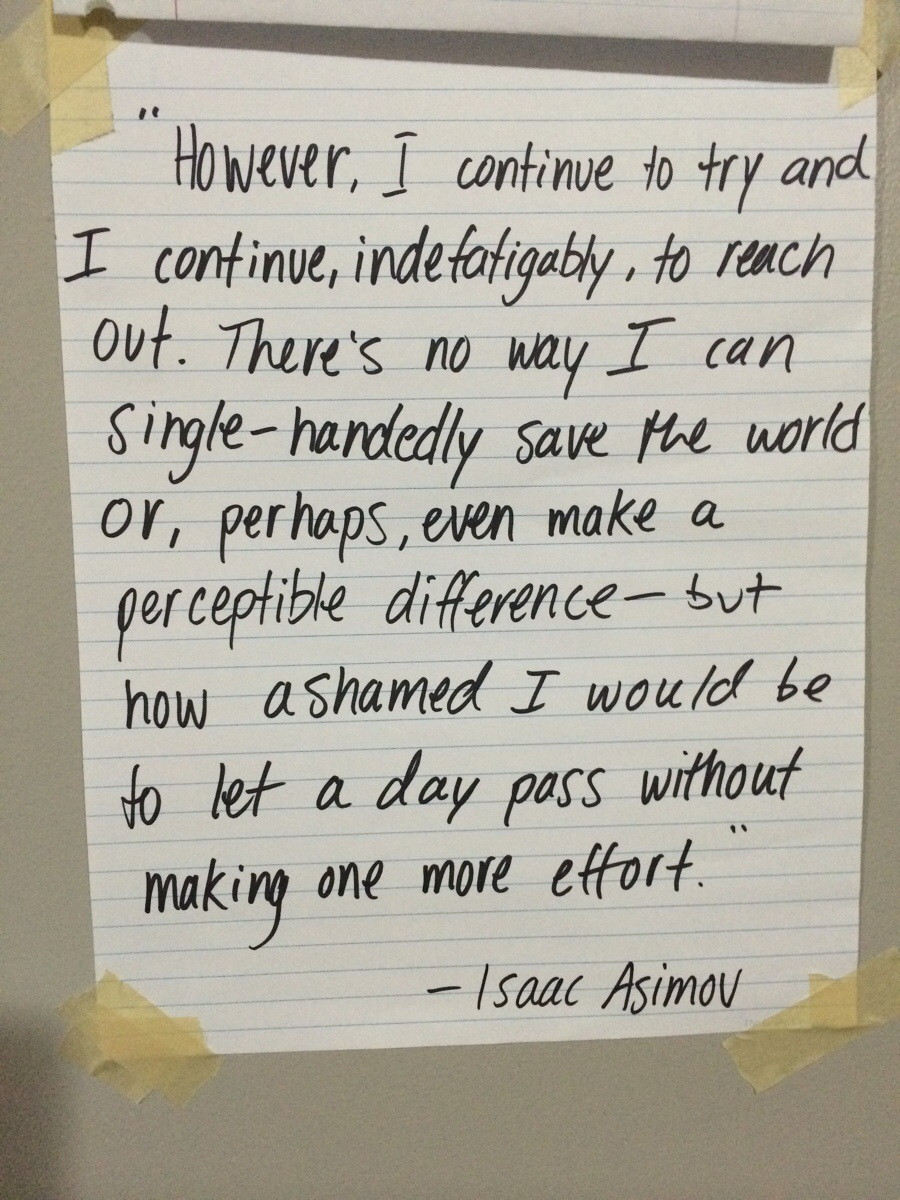
The teacher reaches out, continuing to try to reach his students...day after day, year after year. There's no way that one teacher, working alone, can do it all. But we keep trying...

From his book, The Relativity of Wrong: Essays on Science.


In 1989 Asimov spoke about the greenhouse effect and how it can have an impact on the Earth. Listen starting about 1:30...[to about 7:00].
We are facing problems that transcend nations...


Asimov taught himself to read before he went to school...and he graduated from high school at age 15. He went on to earn a B.S., an M.A. and a Ph.D. in chemistry from Columbia University. He left us with more than 500 volumes filled with his ideas, imagination and knowledge.
The saddest aspect of life right now is that science gathers knowledge faster than society gathers wisdom.


For more on Asimov...

My favorite non-fiction works by Asimov were his articles in The Magazine of Fantasy and Science Fiction. Those have been collected into quite a few books. My favorite Asimovian fiction writings are two short stories which later grew into novels: Nightfall, and The Ugly Little Boy.
###

Friday, August 17, 2012

Back to School

Walk through any discount department store today and it's clear that it's "that time of year" again...time to buy school supplies.

I remember as a kid being excited each year when it was time to get new school supplies. I wasn't a great student, but each year was an opportunity to start over...a chance to do better. For me it was like baseball...no matter how much trouble a team had one year, the next year, when the season starts, everyone has an equal chance to become the champion. Every year is a fresh start.

There are some things I miss about teaching...

I miss the beginning of the school year.

What? It's monumentally stressful -- getting the room set up, counting out books, sorting out name tags/desk charts, making a schedule, going to meetings, talking to last year's teachers, the late nights/early mornings of seemingly endless preparation and paperwork -- the 12-14 hour days.

True...I don't miss all that, but I do miss the excitement of meeting new children. I miss the delightful experience of learning about young humans and their fresh minds, sharing new ideas and getting to know new senses of humor and interests. I miss watching them come into the building for the first time in the new year...the confused, and excited grins on their faces as they search for their classroom and their new teacher. I even miss the ones who come in terrified and lost...I miss how that fear changes to pleasure as they see the familiar face of a friend from the previous year, or to relief as they finally find their classroom and seat...their own personal space, safe and clean.

The newness of each school year is one of those thousands of little things which makes teaching so much fun and such a great adventure. Every year is a new beginning...a chance to start over...a chance to do better. Every year is a fresh start...for teachers as well as students.

In 1951 Isaac Asimov wrote a short story titled The Fun They Had*. It's the story of a young boy who finds a book...
The Fun They Had

The story takes place in the year 2157, where teaching is performed by computer-like robots with vast information stores. The protagonists of this story are two children, Tommy and Margie. Tom, the older child, finds a real book in his attic. He is very surprised by the object because the words on the page do not move like the words on the screen of their mechanical teacher.

The book describes the school from centuries earlier, where there was a real man as teacher that gave homework and asked questions to his students, and all the boys and girls went into a special building. Margie is very curious but her mother calls her because it is time for school. School for Tom and Margie takes place at home in a room where they do homework and hand it in via a proper slot in a mechanical teacher.
The teacher in Asimov's story was mechanical -- a precursor of today's online schools. Margie thought that it would be so much more fun to attend a school like in the old days...with real people, a human teacher and other children.

Walt Gardner, while scolding teachers unions for alienating their most logical supporters, wrote,
...public schools are at an historic crossroads. Whether they will even exist decades from now is uncertain. If they somehow manage to survive, however, I don't think they'll be recognizable.
Perhaps not...it's obvious that the public school system of the US is in flux...charters, vouchers, online schools...who knows what things will look like when Margie and Tommy find a real book about todays schools 145 years in the future.

But if they are so different that there's no interaction among children, if real live human teachers are distant or non-existent, then something more than simple buildings will have been lost. A school is more than just the building, the books, the pencils, and the iPads.

A school is a place where children and adults begin fresh each year to explore the world together. It's a place where one generation literally sits at the feet of their elders to be introduced to our cultures, our knowledge and our shared experiences. It's a place where wonder grows in a community of learners.

One cannot get that experience sitting in front of a computer at a virtual school.

Today I miss the beginning of the school year because I'm not there to enjoy it. I dread the possibility of a time when I might miss it because it no longer exists.


* According to Wikipedia, The Fun They Had was written as a personal favor for a friend, and became more popular than Asimov ever expected. It is the most anthologized of all his stories and has appeared in many publications outside of the science fiction genre. I first read it when I found it included in a basal reader from which I taught during my first full year as an elementary teacher.
~~~

Stop the Testing Insanity!


~~~

Saturday, January 29, 2011

A Break From Politics...

While the Indiana Legislature is poised on the brink of the destruction of the state's teaching profession...and the US DOE continues it's all out attack on teachers...I have something else I want to write about.

First, if you're from Indiana, go HERE and tell your legislators not to destroy the teaching profession in our state...

Second, here are some blogs and articles I considered writing about:
Read them...become enraged or motivated...and then use your voice.

Now...to today's topic...teachers and all they do.

I read Mrs. Mimi's blogpost today, Blood, Sweat, Tears and Many, Many, MANY Dots and was impressed by the list of things that teachers do.

I remember all those things...and more...that took up my time every day. The little things...sorting books, putting up bulletin boards, picking up pencils off the floor, cleaning off the chalk board tray, a million other little tasks every day on top of planning, teaching, grading, phoning parents, collaborating with colleagues and recess duty (If I tried to include everything there wouldn't be room for anything else).

Mrs. Mimi made a comment in her entry today...
People [meaning non-teachers] can sympathize with the behavioral issues. They can sympathize with the hours of grading papers. They can try and understand how unappreciated teachers are. They can feel for our early wake up times.
First of all, I understand that many jobs have their little tasks that threaten to overshadow the important things that people do...and the old adage "walk a mile in my shoes" is completely true. No one knows what another person's day is like unless they've experienced it. I rant about politicians and political appointees not having any idea what it's like in a classroom (yes, you, Secretary Duncan), but I understand that I am in the same position with regards to others' work.

That's why it's so important for teachers to support each other. Who knows better than another teacher what you go through every day? Who knows better than another teacher the stress of trying to actually teach while being interrupted, pressured, twisted and thrown about. Again, from Mrs. Mimi...
But I don't think any non-teacher will truly understand how much time and energy teachers spend organizing, cleaning, lifting, moving, hanging, stapling, taping, cutting, running, bending, wiping and basically doing anything and everything that needs to be done. Whether it feels professional, in our job description or even clean. We just roll up our sleeves and get it done.
Here's to the teachers who try to teach their children while being pummeled by the outside world.

Here's to the teachers who KNOW that what they're being asked to do is NOT in the best interest of their students so they work twice as hard to actually teach, as well as getting all the crap done that the administration (or state DOE, or US DOE, or whoever is bashing teachers today) requires.

Here's to the teachers who, despite all the pain, stress, disrespect, and insults from those who haven't a clue, still get up every day and greet the children in their care with smiles, patience and professionalism because they love what they do.

Make it a point to tell a teacher something supportive every day...That in itself might be all it takes to turn American education around...

Saturday, September 23, 2006

Scripted Teaching

After 30 years of teaching I have watched a lot of teachers teach. I've seen good teachers and bad...exciting teachers and dull...quiet teachers and loud...dedicated teachers and indifferent.

But one thing that is true about every single person into whose classroom I've stepped...each teacher I've observed has brought something unique to his or her students...something of themselves which no one else could possibly bring.

And it's not just the uniqueness of his or her personality, though that's important...it's also the uniqueness of each teacher's teaching style. For example:

I've never seen anyone with the creativity of Mr. X. He created magic with his children as they explored the world through fascinated eyes. He used words designed to excite his students and they responded with excited vocabulary of their own.

There are very few teachers who have the quiet manner and kind demeanor of Mrs. Y. She has tamed the wildest child, eased hurts, calmed angers, and reached through frustrations to help each child achieve her highest potential. Her words were soothing, gentle, and encouraging. In her class children responded to nurturing by helping each other. They learned to use her calming words with their friends.

Mrs. Z. had more enthusiasm than anyone I've ever seen. She carried her primary students through singing, dancing, clapping, laughing, and running to the enjoyment of literacy and the thrill of learning. Her words captivated her students...and the children absorbed her excitement as she taught them to express themselves with feeling.

Every teacher brings their own gifts to their students. Each of us has something to offer our students as we talk and work with them day after day. Scripted teaching, saying what is written on a page that someone else has written because they claim it's the only way to get children to learn, takes away that uniqueness, even if only for a short time. It deadens the energy in the classroom and reduces the teacher to an emotionless robot.

Plato and Socrates were dynamic teachers not solely because of what they taught, but because of how they taught. How teachers teach exposes children to the myriad of personalities which people our world. How teachers teach has the potential to reach the most unteachable student and the most unwilling learner. Scripted instruction does none of that. It smothers a teacher's personality in someone else's words.

If we all approached teaching the same way, used the same techniques and the same words, we would lose the essence of why we use people to teach instead of computers. Isaac Asimov's short story "The Fun They Had" describes a society in which children learn from a computer called a teacher. Everyone learns the same thing in the same way. The point of the story is that there is something important in the natural interaction between adult and child. Scripted teaching removes that and demeans the humanity of teachers and learners.