"The whole people must take upon themselves the education of the whole people and be willing to bear the expenses of it. There should not be a district of one mile square, without a school in it, not founded by a charitable individual, but maintained at the public expense of the people themselves." -- John Adams

"No money shall be drawn from the treasury, for the benefit of any religious or theological institution." -- Indiana Constitution Article 1, Section 6.

"...no man shall be compelled to frequent or support any religious worship, place, or ministry whatsoever, nor shall be enforced, restrained, molested, or burthened in his body or goods, nor shall otherwise suffer on account of his religious opinions or belief; but that all men shall be free to profess, and by argument to maintain, their opinion in matters of religion, and that the same shall in no wise diminish enlarge, or affect their civil capacities." – Thomas Jefferson

Showing posts with label FairTest. Show all posts

Monday, April 27, 2015

Random Quotes - April 2015

NPE 2015 NATIONAL CONFERENCE


Three quotes from the Network for Public Education 2015 National Conference. See the videos at www.networkforpubliceducation.org.

From Jitu Brown, one of the directors of the Network for Public Education and the national director for the Journey for Justice Alliance.
"They look at our students as instruments of profit" -- Jitu Brown
From Yong Zhao, Presidential Chair and Director of the Institute for Global and Online Education in the College of Education, University of Oregon, where he is also a Professor in the Department of Educational Measurement, Policy, and Leadership.
We are in the U.S. one of the very, very few systems that allow everyone to "play in the system" for twelve years. That's something amazing. We do not select. We do not judge, and that preserves the diversity of talents. Once we privatize...once we allow people to select...you exclude people, normally too early. You don't know who they might become...any privatized entity has the right to reject. We are not running a country club. We're running a public education system...that is for the prosperity of the nation and the community and the individuals. -- Yong Zhao
From Lily Eskelsen Garcia, President of the National Education Association.
"What is wrong with the world where testing has become so absurd and so harmful to children that parents are protecting their children from a test [by opting out]...The solution has to be changing the world so we do not have toxic testing..." -- Lily Eskelsen Garcia

The Resistance Meets on Weekends

Peter Greene covered the Network for Public Education 2015 National Conference (as did many other bloggers...see here, here, here, here and here, for example) in an article about how many who support public education are busy with the actual work of education, while "reformers" are full time, anti-public education, privatizers.

At the close of the NPE conference, Diane Ravitch called on pubic education supporters to engage parents and grandparents, students (especially high school students) and retired educators...in other words, folks who can't be fired for standing up for public education.

From Peter Greene, Curmudgucation.
...the irony here is that while [educators] are amateurs in the field of shaping, twisting, and spinning policy, ["reformers"] are the amateurs in the actual field of education. They may have the tools, the money, the hired manpower, and the paths of power on their side, but we are the one who know the territory.

ATLANTA CHEATING SCANDAL

Demonizing Teachers, Privatizing Schools: The Big Lies and Big Plans Behind the Atlanta School Cheating Scandal

More about the Atlanta trial which sent public educators to jail.

From Bruce Dixon, Black Agenda Report
The one-percenters need us to believe public education in our communities is some new kind of sewer infested with incompetent teachers who are cheating children and the public every week they draw paychecks. The long, long crisis of public education has been designed, engineered and provoked by powerful bipartisan forces to justify their long game, which is the privatization of public education. That's the Big Plan.

Jon Stewart: Cheating teachers go to jail. Cheating Wall Streeters don’t. What’s up with that?

Jon Stewart, who is leaving The Daily Show late this summer, will be missed. Valerie Strauss analyzed his review of the Atlanta cheating scandal. The entire segment of The Daily Show follows.

From Valerie Strauss, Answer Sheet
Jon Stewart on Wednesday night made the inevitable comparison between the former teachers and administrators in Atlanta who were sentenced for cheating on standardized tests — a few for as much as seven years — with Wall Street denizens who in 2008 connived in a way that nearly brought down the country’s financial system. Only one was sentenced to 12 months in jail.


POVERTY

Indiana superintendents rail against proposed school funding changes

Under the guise of "equalizing school funding" the Indiana legislature is threatening to reduce funding for large, high poverty urban areas and increase funding for low poverty suburban areas.

From Wendy Robinson, Superintendent of Fort Wayne Community Schools, quoted in Chalkbeat.
“The state is trying to act as if I don’t need different resources for that high school in the high-poverty area,” Robinson said. “The standards I set for the students I receive is the same. We treat our kids in poverty like it’s their fault. … That’s the fallacy of the (state funding) formula.”

TESTING

The One about Bullying, Threats and Arne Duncan...

The justification for annual testing is "parents need to know how their students are doing." Most teachers could provide the same information during any week of the school year, more quickly, and with more accuracy.

The real justification for annual testing, and test prep, and every other expense accompanying annual testing, is money...plain and simple.

From Mitchell Robinson, Ph.D., Associate Professor and Chair of Music Education at Michigan State University, quoted in Badass Teachers Association.
...no teacher needs yearly standardized tests to know if their students are "making progress or growth." Just as parents don't need these tests to know if their children are growing. The people that teach and love these children are well aware of what they are learning, what challenges and successes they are encountering, and what strategies will work best to help them continue to grow and learn. Let's not pretend that a once-per-year multiple choice test will somehow magically provide some special sauce that will reveal what kids know and are able to do.

Report: Big education firms spend millions lobbying for pro-testing policies

How much of our national treasure, some of which used to go to helping students, is now going to testing companies? Imagine how much they're making in profits if they can afford to spend in excess of $20 million in lobbying...

From Valerie Strauss, Answer Sheet
..four companies — Pearson Education, ETS (Educational Testing Service), Houghton Mifflin Harcourt, and McGraw-Hill— collectively spent more than $20 million lobbying in states and on Capitol Hill from 2009 to 2014.

Computerized Testing Problems: 2013 -2015

When you give a test before students are ready they often do poorly on it. The same is true when you give a test before the test is ready. The technical failures of the "new" computer based tests has added to the failure of the tests themselves. The testing companies still get their billions, though. FairTest has a list...

From FairTest.org.
The ongoing litany of computer exam administration failures reinforces the conclusion that the technologies rushed into the marketplace by political mandates and the companies paid to implement them are not ready for prime time. It makes no sense to attach high-stakes consequences to such deeply flawed tools


PRIVATIZATION

At the Network for Public Education 2015 National Conference, one of the speakers commented that privatization is more than just an "education problem." It's occurring in various places in America's economy. The most recent post of Privatization Watch covers much more than just education. It includes articles about a Senate cafeteria worker, a growing movement to transfer federal land to state control in Western states, the military pension system, the privatization of the state-run charity hospital system in Louisiana, and various toll road privatizations (because toll road privatization worked so well in Indiana).

Today's Privatization Watch post includes a link to an Atlanta blog article about privatization of public education...

GA: Opinion: Why competitive model fails schools. No one should lose in education

From Maureen Downey, Atlanta-Journal Consititution (AJC.com)
The Texas Miracle used to design No Child Left Behind was a case of cooking the books; the Atlanta Miracle included systemic cheating to save jobs and schools from being closed and educators are now sentenced to serve time behind bars; the New Orleans Miracle continues to be an embarrassment with the retraction of research reports indicating success and criticisms about bad data; and in 2013 there was confirmed test cheating in 37 states and Washington D.C., but surely it is more widespread than that given the high-stakes of the very tests that have been criticized for their bias, invalidity, very high cost, and damaging effects on what schooling has become. Not everything is a competition, not everything should be designed as a competition, and education – especially – should not be treated as a competition where there are guaranteed winners and losers. No one should lose in education. [emphasis added]

~~~

The narrow pursuit of test results has sidelined education issues of enduring importance such as poverty, equity in school funding, school segregation, health and physical education, science, the arts, access to early childhood education, class size, and curriculum development. We have witnessed the erosion of teachers’ professional autonomy, a narrowing of curriculum, and classrooms saturated with “test score-raising” instructional practices that betray our understandings of child development and our commitment to educating for artistry and critical thinking. And so now we are faced with “a crisis of pedagogy”–teaching in a system that no longer resembles the democratic ideals or tolerates the critical thinking and critical decision-making that we hope to impart on the students we teach.
~~~

Stop the Testing Insanity!


~~~


~~~

~~~


~~~

Friday, March 21, 2014

Testing: From Bad to Worse

This month third grade students in Indiana have had their instruction interrupted so that they could take the ISTEP Applied Skills tests, and the Indiana IREAD-3 test.

Next month the second part of the ISTEP will be administered (testing window: April 28 through May 13).

A YEAR'S WORTH OF TESTING

Last school year (2012-13) I asked a friend who teaches third grade in one of our public schools how much time was spent on testing. He thought about ISTEP, IREAD-3, Acuity, DIBELS, and some other locally chosen tests (See here for a list of state assessments) and came up with this response...
Actual time spent on doing the tests = 54 hours, add an extra 20 hours for DIBELS...

Add another 25 hours for test prep. This would be test strategies, getting familiar with the format but primarily a huge chunk of review for the tests or trying to quickly cover a topic in case it's on the test but we have not had the chance to teach it yet.
That's about 100 hours devoted to testing or test prep...and doesn't include what I would consider to be appropriate classroom assessments such as reading comprehension tests, math quizzes, spelling tests, and content area chapter tests.


The school day for elementary students in our district is about 6 3/4 hours. That's been extended now in order to make up for over a dozen snow days this year, but I'll use 6 3/4 hours as the length of an elementary student's school day in our school system. Subtract about 45 minutes for lunch and recess...another half hour for art, music or PE each day...plus time for announcements, the pledge and a moment of silence, walking in the hallways to and from lunch and other transitions, ending instruction in time to get ready to go places like a special area class or at the end of the day dismissal and we're at about 5 hours as the length of an instructional day. A simple division problem converts those approximately 100 hours devoted to testing into about 20 instructional days.

So, about 20 school days -- nearly 3 weeks of instructional time -- is devoted to testing and test preparation in third grade. The length of the school day varies of course depending on the school -- secondary students have a longer school day, but they also have more and longer standardized tests to take. That's more than a full academic year of testing and test related activities by the time a student graduates from high school.

MISUSE OF TESTS

What is the purpose of all that testing?

Achievement tests are primarily used to determine how much of a particular curriculum students have learned (criterion-referenced tests) or how students compare to other students who have taken the same test (norm-referenced tests). Both types of tests have limitations. Neither type of test can test the entire curriculum. There are aspects of student learning that cannot be tested, like perseverance, excitement, leadership, reliability and a sense of wonder. Neither type of test is value free, which means that some students will miss test items because they are members of a particular cultural, ethnic or socio-economic group. The scoring of multiple test items is objective, however, the quality of the questions determines whether or not a test is free from bias. Even when test scorers use rubrics, there is some subjectivity involved in scoring short answer or essay questions. For a good summary of the problems with standardized tests see What's Wrong With Standardized Tests? by The National Center for Fair and Open Testing.


In addition, standardized tests measure only a small part of what goes into a student's learning. Out-of-school factors weigh heavily on student achievement. Things like low birth weight, adequate medical and dental care, food insecurity, environmental pollution, and family stresses can affect student achievement. Teachers matter, of course, but there is a much larger impact on achievement from outside the classroom.
...roughly 60 percent of achievement outcomes is explained by student and family background characteristics (most are unobserved, but likely pertain to income/poverty). Observable and unobservable schooling factors explain roughly 20 percent, most of this (10-15 percent) being teacher effects. The rest of the variation (about 20 percent) is unexplained (error). In other words, though precise estimates vary, the preponderance of evidence shows that achievement differences between students are overwhelmingly attributable to factors outside of schools and classrooms
Standardized tests, then, don't measure everything that goes on in a classroom...nor do they measure only what goes on in a classroom.

In Indiana test scores are used for more than simply measuring achievement.
  • A student who fails IREAD-3 can be retained in third grade
  • Failed ECAs in High School can be used to refuse diplomas to students
  • Student test scores are used in teacher evaluations
  • Student test scores are used to determine teacher pay
  • School letter grades are based in large part on student test scores
  • Persistently low student test scores can mean state takeover of schools
All these uses of student test scores are inappropriate. The tests were developed to measure student achievement and, while they don't even do that well, that is all they should be used for. They should not be used to measure teacher and school effectiveness, or to deny promotion or graduation of students.

Finally, tests don't improve schools. Schools are improved by
  • finding ways to help students deal with out-of-school factors interfering with achievement (such as the effects of poverty)
  • lowering class sizes
  • supporting a complete curriculum with the fine arts and physical education
  • supporting school libraries
  • providing early childhood programs
  • providing well maintained school facilities
  • providing funding appropriate to the needs of the students. 


MORE TESTS

High stakes testing is harmful to schools and students. Tests are being misused to the point of child (and public education) abuse. And last night I read that Indiana is going to add another layer of testing for the 2014-2015 school year.

Why Indiana Students Should Prepare For Two Rounds Of Standardized Testing
Students will take both the state’s current test, the ISTEP+, and a new test called the College- and Career-Readiness Transition Assessment, or CCRTA, in spring 2015.

“It is two tests,” says Indiana Department of Education Director of Assessment Michele Walker. “It’s two separate sets of standards that are being assessed there.”

Two tests are necessary because of the ongoing dispute over the Common Core. Eager to exit the national initiative to share academic standards, Indiana lawmakers have directed education officials to administer the ISTEP+ next year. But Indiana also promised the U.S. Department of Education it would give a test assessing college- and career-readiness at the end of the 2014-15 school year.
Most Indiana public school students already take more than one standardized test in a year so the title of this article is misleading -- it implies that everyone just takes the ISTEP. First of all, the ISTEP itself is two tests -- an applied skills portion and a multiple choice portion taken at two different times during the year. Second, there's also IREAD-3, ECAs, LAS Links, mCLASS, and Acuity...

How much more instructional time is going to be wasted when CCRTA is added to the already excessive list of tests? How much more learning time is going to be lost to the excessive, obsessive, and abusive use of standardized tests?

United Opt Out: The Movement to End Corporate Education Reform.


~~~

All who envision a more just, progressive and fair society cannot ignore the battle for our nation’s educational future. Principals fighting for better schools, teachers fighting for better classrooms, students fighting for greater opportunities, parents fighting for a future worthy of their child’s promise: their fight is our fight. We must all join in.
~~~

Stop the Testing Insanity!


~~~

Saturday, February 2, 2013

A Picture is Worth a Thousand Words - Feb.2013

Here are some pictures, graphic images and cartoons from around the net -- plus my own 2 cents worth of comments. Click on any image to see the full sized version.

High Stakes are for Tomatoes

There is a lot of great information on the The National Center for Fair and Open Testing (FairTest) web site.


Garfield High School

The teachers at Garfield High School in Seattle have put their jobs on the line and decided to "do no harm" by refusing to participate in the high stakes testing of their students. I hope it's "catching!"
“Our teachers have come together and agree that the MAP test is not good for our students, nor is it an appropriate or useful tool in measuring progress,” says Kris McBride, who serves as Academic Dean and Testing Coordinator at Garfield. “Additionally, students don’t take it seriously. It produces specious results, and wreaks havoc on limited school resources during the weeks and weeks the test is administered.”


There's more to education than reading and math. There's more to education that passing a test. We need to train our children for citizenship. Testing should take second place to learning.


We Still Need Public Schools

If we privatize public schools now, then the public oversight will be lost and our descendents will have a hard time recovering it. Public schools don't belong to the parents of children attending them today. They belong to us all...everyone who has ever attended...everyone who has ever paid taxes...everyone who has ever been a part of the community.


A Child is More Than a Test Score

School is more than just reading and math. Education is more than knowledge. A standardized test can't measure everything. It won't tell you about a child's big picture thinking, civic mindedness, compassion, courage, creativity, curiosity, effort, empathy, enthusiasm, faith, generosity, gratitude, humility, humor, imagination, integrity, kindness, leadership, motivation, patience, persistence, politeness, relationships, reliability, resilience, resourcefulness, respect, responsibility, self-awareness, self-discipline, sense of beauty, sense of wonder, spontaneity and understanding. Add your own below...


Prayer was Never Banned in Public Schools...

...just State-Sponsored prayer. Students can pray whenever they want in school...as long as they don't disrupt the education of themselves or others. As the old saying goes, "as long as there are algebra tests, there will be prayer in public school."


Those who can, Teach.

The legislatures around the country are filled with politicians who think that, because they attended school, they understand what it's like to teach.


Arne Duncan never worked in...never even attended...a public school. Being basketball buddies with the president doesn't give him the knowledge necessary to lead America's public schools.


Public Schools should be led by the public, not corporate boards of directors.


~~~

Stop the Testing Insanity!


~~~

Friday, December 21, 2012

Stop the Testing Insanity!


Why are we still overusing and misusing tests? One answer seems to trump all the others: Money. The more tests taken, the more the test-makers profit. The four largest test producers are raking in record profits, and here in Indiana we're spending almost $50 million a year to tell teachers what they already know.

We've been pushing back against the overuse of test since Clinton's Goals 2000 -- with little success. As money comes in to the test-maker's pockets it's transferred to lobbyists, to politicians, and legislatures find new uses for tests. No longer content with ranking children and schools based on one less-than-reliable test, it's now national policy to evaluate teachers using a measure designed for something else entirely.

We can't give up. We need to keep fighting against the overuse and misuse of testing which harms schools, teachers, children and public education in general.

It's time to end No Child Left Behind and Race to the Top. It's time to end the testing insanity and concentrate on teaching and learning. Lisa Guisbond wrote in What's wrong with standardized tests?
The federal NCLB and other state-imposed high-stakes testing policies have failed to improve our schools and, according to the National Research Council, have caused harm by increasing high school dropout rates. Our misguided national testing craze has squeezed out art, music, sports, social studies and science, even recess, and turned too many classrooms into test preparation centers. It's time for a new direction.
Do Something!

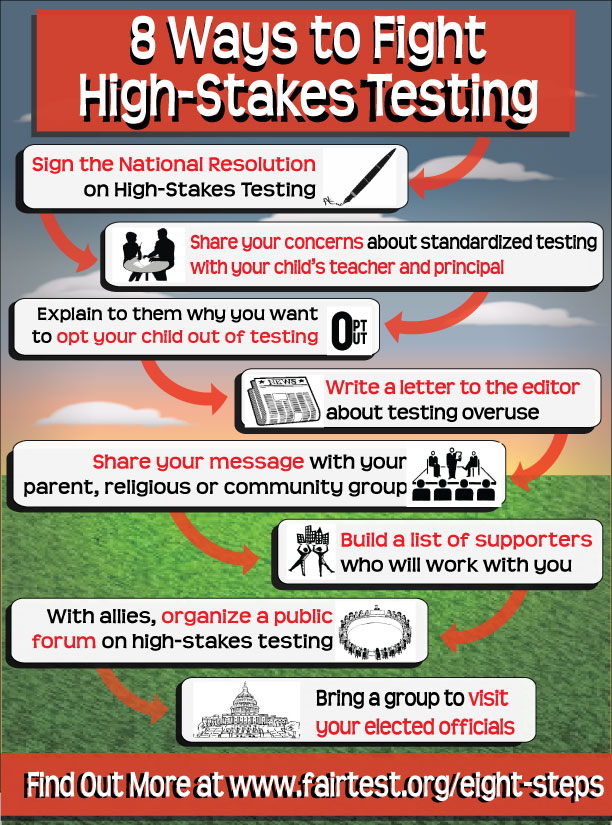
1. Add your voice to the nearly 14,000 individuals and 475 group (including our own Northeast Indiana Friends of Public Education) who have signed the National Resolution on High Stakes Testing.

2. Share FairTest's infographic, “What’s wrong with standardized tests?” Send it to friends...put it on social media sites...tuck it into Christmas presents...or just hand out paper copies (get a pdf of the infographic here)!

Want to know more? Visit the FairTest web site for fact sheets and other information.

~~~

Stop the Testing Insanity!


~~~

Monday, January 16, 2012

10 Years of NCLB -- Part 3

(Click here for 10 years of NCLB -- Part 1)
(Click here for 10 years of NCLB -- Part 2)

Ten years ago No Child Left Behind was signed into law.

Fairtest has a report. Here's the news release:
NCLB’s Lost Decade Report

NO CHILD LEFT BEHIND 10TH ANNIVERSARY REPORT -- MISGUIDED POLICY CREATED “LOST DECADE” FOR SCHOOL PROGRESS; TEST-AND-PUNISH STRATEGY UNDERMINES REAL REFORMS

The federal No Child Left Behind (NCLB) law “failed badly both in terms of its own goals and more broadly,” leading to a decade of educational stagnation. That is the central conclusion of a major new report marking NCLB’s tenth anniversary. President George W. Bush signed the program into law on January 8, 2002.

The report, “NCLB’s Lost Decade for Educational Progress,” summarizes data from the National Assessment of Educational Progress (NAEP) and dozens of independent studies. It was written by staff of the National Center for Fair & Open Testing (FairTest).

Among the report’s major findings:
  • NCLB failed to significantly increase average academic performance or to significantly narrow achievement gaps, as measured by NAEP. U.S. students made greater gains before NCLB became law than after it was implemented.
  • NCLB severely damaged educational quality and equity by narrowing the curriculum in many schools and focusing attention on the limited skills standardized tests measure. These negative effects fell most heavily on classrooms serving low-income and minority children.
  • So-called "reforms" to NCLB fail to address many of the law’s fundamental problems and, in some cases, may intensify them. Flawed proposals include Obama Administration waivers and the Senate Education Committee’s Elementary and Secondary Education Act (ESEA) reauthorization bill
“NCLB undermined many promising reform efforts because of its reliance on one-size-fits-all testing, labeling and sanctioning schools,” explained FairTest’s Lisa Guisbond, the new report’s lead author. “A decade’s worth of solid evidence documents the failure of NCLB and similar high-stakes testing schemes. Successful programs in the U.S. and other nations demonstrate better ways to improve schools. Yet, policymakers still cling to the discredited NCLB model.”

“It’s not too late to learn the lessons of the past ten years. Now is the time to craft a federal law that supports equity and progress in all public schools,” added FairTest Executive Director, Dr. Monty Neill. The Forum on Educational Accountability (FEA), which FairTest leads, is promoting a comprehensive plan to overhaul NCLB. The proposal calls for using multiple measures to assess student and school performance. It also targets resources to improve teaching and learning. More than 150 national education, civil rights, disability, religious, labor and civic groups signed the Joint Organizational Statement on NCLB, which FEA seeks to implement.

- the NCLB 10th Anniversary report is posted at http://fairtest.org/NCLB-lost-decade-report-home
- Forum on Educational Accountability recommendations and the Joint Organizational Statement on NCLB are available at http://www.edaccountability.org
Others are adding their voice, too.
Ravitch: No Child Left Behind and the damage done

After 10 years of NCLB, we should have seen dramatic progress on the National Assessment of Educational Progress, but we have not. By now, we should be able to point to sharp reductions of the achievement gaps between children of different racial and ethnic groups and children from different income groups, but we cannot. As I said in a recent speech, many children continue to be left behind, and we know who those children are: They are the same children who were left behind 10 years ago...It is time to abandon the status quo of test-based accountability and seek fresh and innovative thinking to support and strengthen our nation's schools.
10 years of NCLB means it’s time to Occupy the DOE

...I need to ask the community some questions. Parents. Why do you put up with this? Have you thought about opting out? Teachers. I know you know better. Why do you spend hours prepping for invalid tests? This is not really teaching (or why you became a teacher). Principals. Where is your leadership? Your teachers need you to call the kettle black. Superintendents. Why do you continue to do black flips in a system that, in the end, will dissolve any need for your type of educational expertise? School Boards. Why the silence as your community schools are being dismantled and property values decrease each year in direct correlation to NCLB scores?
A search for "10 Years of No Child Left Behind" will yield others. But the important point is that this law has more than failed. It has provided for the dismantling of public education around the nation. Communities around the country are losing their schools. Control is being transferred to charters and private schools. School boards, who answer to the public ballot box, are yielding control because of the requirements of No Child Left Behind.

~~~

You might also be interested in...

Why the United States Is Destroying Its Education System
Teachers, under assault from every direction, are fleeing the profession. Even before the “reform” blitzkrieg we were losing half of all teachers within five years after they started work—and these were people who spent years in school and many thousands of dollars to become teachers. How does the country expect to retain dignified, trained professionals under the hostility of current conditions? I suspect that the hedge fund managers behind our charter schools system—whose primary concern is certainly not with education—are delighted to replace real teachers with nonunionized, poorly trained instructors...

“I cannot say for certain—not with the certainty of a Bill Gates or a Mike Bloomberg who pontificate with utter certainty over a field in which they know absolutely nothing—but more and more I suspect that a major goal of the reform campaign is to make the work of a teacher so degrading and insulting that the dignified and the truly educated teachers will simply leave while they still retain a modicum of self-respect,” he added. “In less than a decade we been stripped of autonomy and are increasingly micromanaged. Students have been given the power to fire us by failing their tests. Teachers have been likened to pigs at a trough and blamed for the economic collapse of the United States. In New York, principals have been given every incentive, both financial and in terms of control, to replace experienced teachers with 22-year-old untenured rookies. They cost less. They know nothing. They are malleable and they are vulnerable to termination.”

Thursday, September 29, 2011

Stop the Coercion: The Waivers are Simply Necessary

I just posted a communication from the Indiana State Teachers Association on my local association's web site.

The communication applauds the move by President Obama to allow waivers for No Child Left Behind restrictions and asks the State of Indiana Department of Education to accept the waivers for the good of Indiana's schools.

One sentence in the article is very important, though. It reads:
It's important to know that this package, while an important interim step for relief, cannot address all of the problems that remain with NCLB.
It turns out that Obama's "interim" relief effort may cause more problems than it solves proving once again that Education Secretary Duncan and President Obama are no friends of public education.

The waivers for No Child Left Behind require states to agree to some of the more onerous aspects of Race to the Top.

Kevin Welner, professor of Education at the University of Colorado at Boulder, says that the Obama administration is right to provide the waivers because...
The ratcheting up of AYP proficiency thresholds and accompanying sanctions had gotten to the ridiculous stage, as anyone paying attention in 2001 could have predicted. The administration is right in offering waivers from those sanctions.
On the other hand, Welner says that the administration is wrong to use the coercion of Race to the Top conditions for the waivers.
The coercion should be removed and the waivers should be granted simply because they’re necessary.
He reminds us that the provisions of the policy being offered in exchange for waivers are not research based.
The administration has repeated stated the importance of research-based policies. But there is little or no high-quality research to support the policies that states must now adopt because the administration has apparently decided that those policies are the most indispensible changes that can be made for America’s schools.
Monty Neill, the deputy director of FairTest goes even further. he calls on states to flat out reject the administration's "bad deal."
The waivers require states to adopt “student growth” measures and make them a “significant factor” in teacher and principal evaluation. This will push states to adopt statistical techniques that evidence shows are grossly inaccurate for distinguishing strong teachers from weaker ones. It will put even more focus on boosting test scores instead of ensuring the all-around education of the whole child.
He also says
  • States will be required to implement tougher tests which will probably be more multiple choice and short answer. This he says, will further narrow the curriculum.
  • Districts will be required to produce assessments for subjects not currently tested by their states adding even more tests.
  • Growth measures will have to be implemented possibly requiring testing twice a year.
Lest anyone claim that this is just complaining without positive suggestions, Neill says that, instead, what needs to be done is the following:
What Congress should do is pass a new law, in line with the recommendations of the Forum on Educational Accountability, that:
  • significantly reduces the amount of mandated testing;
  • helps states design fundamentally different assessment systems;
  • focuses on evidence-based school improvement efforts; and
  • provides the resources needed so that every child has a strong and equitable opportunity to acquire knowledge, skills and dispositions to be an effective, engaged citizen.
The waivers being offered by the administration are just another way to implement Race to the Top. It requires increased testing, which has not been shown to improve instruction, and in fact have hurt schools and students by narrowing the curriculum and pushing out other subjects like the arts and physical education. It will increase the pressure to evaluate schools, administrators and teachers using test scores, another unproven plan which will demonize teachers, blame schools for the social conditions of their students and do nothing to increase higher level thinking and learning.

NEA, and by extension ISTA shouldn't buy into this...not even as an interim step to getting rid of NCLB. It's bad for teachers. It's bad for students. It's bad for public education.

For more, read http://fairtest.org/administration-offers-bad-“waiver”-plan-congress-f

Thursday, July 14, 2011

Cheaters Never Win -- Part 3

The standardized test cheating scandal in Atlanta continues to get attention. Bob Schaeffer, the public education director of FairTest, the National Center for Fair and Open Testing, addresses it from a different point of view. Most comments about the cheating scandal focus on tightening up test security, but Schaeffer focuses on the root cause of the cheating -- the misuse of standardized tests.

In two articles, in the Atlanta Journal Constitution and USA Today, Schaeffer calls attention to the insanity that is the testing craze in the US. In USA Today he denounces cheating, as he should...
Cheating on standardized exams is unethical, whether done by teachers, students or administrators. Enhancing test security might temporarily reduce the number of reported cases. But it will not address the root cause of the misbehavior.
...then goes on to blame the cheating, not only on the people directly involved, the teachers and administrators, but also the "pervasive misues of standardized tests in public schools."
The cheating spike is the predictable fallout from the pervasive misuse of standardized tests in public schools. When test results are all that matter in evaluating students, teachers and schools, educators feel pressured to boost scores by hook or by crook. Just as in other professions, some will cross the ethical line.

Cheating is not the only negative consequence from test misuse. Many schools have turned classrooms into drill-and-kill test-prep centers, reduced the difficulty of exams and narrowed curriculum. Some even encouraged students to drop out in order to boost scores. Basing teacher evaluations on students' test scores, as some propose, is guaranteed to ratchet up the pressure and further distort schooling.
This supports the conclusions of the report of the Georgia Office of Special Investigators who wrote:
"What has become clear through our investigation is that ultimately, the data and meeting 'targets' by whatever means necessary, became more important than true academic progress" (p. 356).
It's clear that the obsessive focus on test scores, not just in Atlanta, but around the country, as the end-all of the education process has damaged the quality of education.
That’s the biggest problem of all. The high-stakes testing explosion has led to dumbed-down teaching and learning, which, like cheating, is epidemic in Atlanta and across the nation.

Georgia and other states, as well as the federal administration and Congress, should treat the Atlanta scandal as a national warning call. Assessment and accountability policies much be overhauled to promote genuine educational quality, not just easily manipulated test scores.
Teaching to the test is not education. We need a rational approach to assessment...one that combines real classroom experience with good teaching practices. Schools have become test-prep factories focusing on higher scores to the exclusion of everything else. That needs to change. We need to get back to evaluating students on things like problem solving and critical thinking, and we need to teach those skills.

This has been going on for too long...decades. The so-called "reformers" keep calling for more and more standardized tests. Race to the Top, the Obama administrations education plan, calls for increasing the amount of testing to include ALL subjects. Now states are adopting teacher evaluations which are based on standardized tests. This is the current status quo in education -- it's time to end this experiment in test driven education.
There's a better alternative. Instead of putting even more weight on multiple-choice exams — a practice the testing profession's own standards label as improper — schools need an assessment system that encourages learning, not cheating. The core measures should be the academic work students do in the classroom, not how well they fill in bubbles on a one-shot test. Evidence of learning should include essays they write, projects they complete, problems they solve and, yes, regular classroom tests, midterms and finals.


~~~