"The whole people must take upon themselves the education of the whole people and be willing to bear the expenses of it. There should not be a district of one mile square, without a school in it, not founded by a charitable individual, but maintained at the public expense of the people themselves." -- John Adams

"No money shall be drawn from the treasury, for the benefit of any religious or theological institution." -- Indiana Constitution Article 1, Section 6.

"...no man shall be compelled to frequent or support any religious worship, place, or ministry whatsoever, nor shall be enforced, restrained, molested, or burthened in his body or goods, nor shall otherwise suffer on account of his religious opinions or belief; but that all men shall be free to profess, and by argument to maintain, their opinion in matters of religion, and that the same shall in no wise diminish enlarge, or affect their civil capacities." – Thomas Jefferson

Showing posts with label class size. Show all posts

Tuesday, November 21, 2017

By the Numbers

Some random numbers to ponder during the Thanksgiving Recess...

TWO DOWN...AND MORE TO COME

Here's why two Indiana school systems went broke. And others are in danger.

The Indiana Constitution states in Section 1, of Article 8, Education, that
...it should be the duty of the General Assembly to...provide, by law, for a general and uniform system of Common Schools, wherein tuition shall without charge, and equally open to all.
And in Section 3, that
The principal of the Common School fund shall remain a perpetual fund, which may be increased, but shall never be diminished; and the income thereof shall be inviolably appropriated to the support of Common Schools, and to no other purpose whatever.
Let's keep those two sections of the Constitution in mind when we look at how the state has allowed...indeed, encouraged...the financial collapse of two of our public education systems.
In the rush to overhaul education, state lawmakers abandoned decades of commitment to the traditional public school system, pushing forward even as districts started closing schools, cutting programs and losing teachers.

They developed a system that encourages free-market competition with other public schools, charter schools and private ones — creating a sink-or-swim mentality that already has helped push Gary and Muncie schools into such a deep financial crisis that the state was forced to take them over.

They may not be the last.
And lest you think that it's not a state sponsored problem, there's this...

Breaking: Indiana didn’t set aside enough money for schools. Senate leader says a fix is ‘top priority.’

Don't worry, though. There was plenty of money for charter schools and vouchers...
State education officials are expecting a shortfall in school funding this year that could be as high as $9 million because state and local officials underestimated Indiana’s student enrollment.


STARK DIFFERENCES

Charters and Consequences: An Investigative Series by the Network for Public Education

Diverting money to charter schools has an impact on public education. The Network for Public Education has a report focusing on charters and how they hurt real, public schools.
The data show clear, dramatic differences between the charters and the local, neighborhood schools. The neighborhood public schools have greater proportions of students who are poor, and who need special education services. Digging deeper you will  find stark differences in the handicapping conditions of students who attend charter and public schools, with public school special education students having far greater needs.


FIVE ADMISSIONS

5 times Republicans admitted they work for rich donors

Here's why the latest Republican tax scheme favors the wealthy. Reason number three, from Lindsey Graham of South Carolina – deliver the tax breaks for the wealthy or lose political donor cash.
3. Lindsey Graham says the party’s coffers are dependent on tax plan passing.
In addition to cautioning last month that Republicans will lose seats in the House and Senate if the GOP tax reform bill doesn’t pass, Senator Graham issued a more dire warning on Thursday.

"The party fractures, most incumbents in 2018 will get a severe primary challenge, a lot of them will probably lose, the base will fracture, the financial contributions will stop,” Graham said, “other than that it'll be fine."

Graham has also suggested that Trump is a goner if this tax thing doesn’t happen, because the Dems will—politically speaking—take him out by attempting “to impeach him pretty quick.”

"[I]t would be just one constant investigation after another,” Graham groused, without a trace of irony. “So it's important that we pass tax reform in a meaningful way. If we don't, that's probably the end of the Republican Party as we know it."


16% CANCELLED PROGRAMS

Illinois’ teacher shortage and pension theft.

The war against public education is nationwide. Here, we read about the state-sponsored teacher shortage in Illinois and how 16% of the state's schools had to cancel programs. Guess who benefits from the programs lost?
According to a 2015-16 school year survey by the Illinois Association of Regional Superintendents of Schools, 75 percent of districts surveyed had fewer qualified candidates than in previous years, especially in rural districts and those in central and northwest Illinois.

Furthermore, 16 percent of schools canceled programs or classes because of the lack of teachers — mostly special education, language arts, math and science classes.


$170 MILLION

Tech billionaires sank $170 million into a new kind of school — now classrooms are shrinking and some parents say their kids are 'guinea pigs'

Education is not a business, and shouldn't be run like a business. Public schools are a public good, which should be supported by everyone, for the benefit of everyone. When the profit motive gets injected in public education, then things start to fall apart.

Here's an idea...maybe educators, people who understand public education, ought to make the decisions impacting schools.
...some parents are bailing out of the school because they say AltSchool put its ambitions as a tech company above its responsibility to teach their children...

"We kind of came to the conclusion that, really, AltSchool as a school was kind of a front for what Max really wants to do, which is develop software that he's selling," a parent of a former AltSchool student told Business Insider.


FUDGING ATTENDANCE

Weekly Privatization Report 11-20-2017

Privatization of public education means profit. Profit means that the bottom line is money...not children.
Republican Gov. John Kasich’s Department of Education used Electronic Classroom of Tomorrow’s own attendance records to settle a dispute over student attendance at the charter operator. “When the Ohio Department of Education audited ECOT’s attendance for a second school year last summer, the embattled online charter’s verified attendance went up more than 80 percent, and the amount it was forced to repay was $19.2 million, down from $60 million the previous year.” The Columbus Dispatch reports “less than 24 percent of ECOT students spent enough time logged onto classes or participated in enough offline work that they received a full 920 hours of instruction, equal to a year of school.”


$100,000 FOR HOMELESS...OR FOR DEER?

Saving human lives is more important than killing deer

Here's a story about a city which didn't have enough money – $100,000 – to keep funding a homeless shelter, yet found more than that in order to kill deer damaging lawns.

America's priorities are backwards...to say the least.
After losing $100,000 in funding last year, Ann Arbor’s Delonis Center homeless shelter was forced to close a floor full of beds that were badly needed. Meanwhile, the city is spending more than that to shoot local deer.


800,000 MORE STUDENTS AND FEWER PUBLIC SCHOOL EMPLOYEES

Subtract Teachers, Add Pupils: Math of Today’s Jammed Schools

More on the war against public education. 250,000 fewer teachers and support personnel are now responsible for 800,000 additional children. Simple math...for a simple nation.
Across the country, public schools employ about 250,000 fewer people than before the recession, according to figures from the Labor Department. Enrollment in public schools, meanwhile, has increased by more than 800,000 students. To maintain prerecession staffing ratios, public school employment should have actually grown by about 132,000 jobs in the past four years, in addition to replacing those that were lost...


8 WAYS TO SPOT FAKE NEWS

From Climate Denial Crock of the Week
Survival tips for the attack on democracy. Worth circulating.


📊➗💰

Monday, October 23, 2017

Who is Accountable?

RESEARCH-BASED EDUCATION

In the 1990s my school system demanded that our teaching be research-based. This was pre-NCLB, so the purpose had nothing to do with "the test." Rather the goal was to make sure all teachers were using "best practices" for their teaching. I was reminded of this recently when I read this post by Russ Walsh...

Knowledge, Belief, and the Professional Educator
...as I have talked to teachers over the years about instructional practice, I have heard a lot of faith-based language.
  • "I don't believe in homework."
  • "I believe in phonics."
  • "I don't believe in teaching to the test."
  • "I believe in independent reading."
  • "I believe in using round robin and popcorn reading."
For about 2,000 years doctors "believed" that blood-letting was an effective treatment for a wide variety of ailments. Today, I would bet if you encountered a doctor who recommended blood-letting for your flu symptoms, you would run, not walk, out the office door screaming. Science, and mounting numbers of dead patients, caught up with blood-letting. So, as professionals, we need to hold ourselves to the same standards. We need to follow the science and stop talking about our beliefs and start talking about the scientific research behind our instructional decision making.


Scientists understand that science isn't static. It changes as knowledge increases. We know now that the Earth revolves around the Sun...that germs, rather than demons, cause disease... and that we had better find alternatives to our current energy sources before we choke the breath out of life on Earth. Our understanding grows. Our knowledge grows.

The same is true with learning. As teachers, our understanding of child development, pedagogy, and the impact of the outside world on our students must grow and change as our understanding of those concepts changes based on new research. We need to alter our presentation and adapt our instruction to incorporate new information and techniques as they become available.

A teacher who thinks she knows everything there is to know about teaching and learning will not be effective for long, because what she needs to know will likely change throughout her career. Teachers must be the life-long learners we wish our students to become...we must continue to be students...if we want to grow in our knowledge and ability.

There are, however, times when a teacher's attempts to use "best practices" and a well-researched basis for teaching is thwarted by outside forces. For example, the out-of-school factors associated with child poverty interfere with learning and achievement. Even the most well-trained, up-to-date, and knowledgable teacher will have difficulty reaching students who come to school traumatized, hungry, or sick.

In addition to social factors interfering with teaching and learning, the government can be a hindrance to good, research-based education. Two ways government interference prevents schools from doing what is best for students are 1) inadequate funding, resulting in large class sizes, and 2) the requirement that students either pass a test or repeat a grade.


LEGISLATIVE INTERFERENCE: CLASS SIZE

We know that class size has an impact on student achievement and learning, especially with young, poor, and minority students. Smaller class sizes work because students are more engaged, they spend more time on task, and instruction can be customized to better meet their needs.

So why don't we reduce class sizes?

It costs too much.

Legislators don't want to spend the money to reduce class sizes. State legislatures around the country are generally filled with adults who have never taught and don't know anything about education or education research. Instead of learning about the research into class size, (or listening to teachers) they simply look at the cost. Smaller class sizes means higher costs...and with the obsessive, anti-tax atmosphere in most states, legislators don't want to increase funding for public schools just to make classes smaller.

Small Class Size – A Reform We’re Just Too Cheap To Try

Steven Singer makes the case for small class sizes...
The benefits go far beyond the classroom. Numerous studies concluded that reducing class size has long lasting effects on students throughout their lives. It increases earning potential, and citizenship while decreasing the likelihood students will need welfare assistance as adults or enter the criminal justice system. In short, cutting class size puts a stop to the school-to-prison pipeline.

It shouldn’t be surprising, then, that those students who benefit the most from this reform are the young, the poor and minorities.
See also Class Size Matters.Org


LEGISLATIVE INTERFERENCE: RETENTION IN GRADE

Studies going back over 100 years are consistent in their conclusion that retention in grade does not result in higher achievement.

This is a subject where legislators, parents, and even many educators, don't know, or refuse to accept the research. If a child doesn't learn the material required for a certain grade, then the impulse is to "give him another chance" by retaining him. I've heard parents and teachers claim that retention in grade gives a child "the chance to grow another year," or "catch up." None of those statements are based on research. Retention does not help students, and often causes harm.

Legislatures in many states, including Indiana, have chosen third grade as the year in which students must either "be average" in reading or repeat the grade. The legislature, in other words, has decided that, if students cannot reach an arbitrary cut-score on an arbitrary reading test in third grade, they will not be allowed to move on to fourth grade. The cause of the failure is often not taken into consideration. Students have trouble learning to read for a variety of reasons, yet legislatures apply the single intervention of retention in grade to reading difficulties no matter what the cause. Unfortunately, this has no basis in educational research.

Students are punished by legislative decree for not learning to read soon enough or well enough.

Recently Michigan joined the "punish third graders" club.

County public schools brace for implementation of third-grade retention law
In an effort to boost reading achievement in the early stages of elementary school education, public schools across the state of Michigan are conducting universal screening and diagnostic testing of kindergarten through third grade students.

The testing is in response to Public Act 306, passed in October 2016 by Michigan lawmakers, called the Third Grade Retention Law. The law was passed to ensure that students exiting third grade are reading at or above grade level requirements. All students in grades K-3 will be assessed three times per year, fall winter and spring. The assessments will identify students who need intensive reading instruction and provide useful information to help teachers tailor instruction to meet individual student needs. The law also states that a child may be retained in third grade if he or she is one of more grade levels behind in reading at the end of the third grade.


FORCE and FLUNK: Destroying a Child’s Love of Reading—and Their Life

Florida is another one of the states which punishes children for not reading well enough. In this article Nancy Bailey takes the state to task.
If they aren’t reading well enough, they will have to remain in third grade–so they will do more reading remediation! They will watch as their classmates leave them behind.

At this point, how much do you think children like to read?

The Florida plague, the undeniably ugly and stupid practice of flunking children if they are not reading well by third grade, is now a reform across the country.


ACCOUNTABILITY

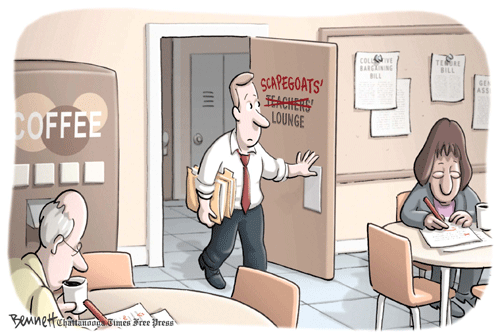
Legislatures force teachers and schools to accept practices which we know through research are detrimental to student learning. We're forced to accept responsibility for working conditions which interfere with achievement, and then we are held accountable when the practices fail.

Teachers (and schools) should be accountable for understanding the
scientific research behind our instructional decision making.
But policy makers should also be held accountable for the instructional restrictions they place on public schools.

📋🚌📝

Tuesday, May 2, 2017

2017 Medley #14

Class Size, Testing,
The Federal Role in Education, Privatization, Indiana General Assembly, Walmart

CLASS SIZE

Trump's Education Budget Will Undermine Teaching and Schools

Thirty-five percent of America's school districts – especially high-poverty districts – use federal money to reduce class sizes. The Trump budget will result in larger class sizes in exactly the locations where smaller class sizes are needed the most.

Once again, it is America's high poverty students who are shouldering the burden so the wealthy can have a lower tax obligation.
Why is this important? Class size reduction is not only extremely popular among parents and teachers – it is one of the very few reforms proven to work through rigorous evidence, and to provide especially large benefits for children from low-income families and students of color, who see twice the academic gains from small classes. Indeed, it is only one of a handful of educational policies that has been shown to significantly narrow the achievement gap between economic and racial groups.


TESTING: PISA

Is PISA Data Useless?

Peter Greene asks some questions about the PISA test. Privatizers and "reformers" love to quote America's "low scores" on the PISA and other international tests (see The Myth of America's Failing Public Schools), but new information about the PISA indicates that analyses of the results might not be accurate. What then?
The Testocrats have been quietly assuming that taking a Big Standardized Test on a computer is exactly like taking it on paper. But what if that's not true? What if taking a math test involves not only math skills, but test-taking skills. And what if computer test-taking skills are not the same set of skills as pencil-and-paper test-taking skills?

What if the Big Standardized Tests aren't really measuring what they purport to measure at all, and the whole test-centered education model is built on a sham?


FEDERAL ROLE IN EDUCATION

Don’t Trash the Department of Education. Fix It.

In education, just like other areas of our society, the federal government has an important role to play. In the current education atmosphere, the federal government needs to make sure that equitable funding exists for all schools.

The nation is slowly but surely moving back to segregated schools and as Earl Warren put it in 1954's Brown vs. Board of Education decision, "We conclude that in the field of public education the doctrine of ‘separate but equal’ has no place. Separate educational facilities are inherently unequal." It's the job of the federal government to make sure that states don't revert to the illusion of "separate but equal."
...it’s not the Department of Education that’s the problem. It’s what we’ve done to it.

The department has a vital and important role to play in making sure our system of public education serves everyone. Speaking in broad terms, the department should be dedicated to these three things: ensuring public schools are being properly funded, student and parent civil rights are not being violated and to be a repository for national data and research.

Separate but equal?

FEDERAL ROLE IN EDUCATION: VOUCHERS

Save Our Schools! Americans Oppose Trump-DeVos Plans To ‘Voucherize’ Education

It's clear that Betsy DeVos is ignorant about public education. Like other Trump cabinet and administrative appointees, she has spent her life trying to do damage to the very aspect of society her department is charged with supporting. During her confirmation hearing she proved to America that she is woefully ignorant of how public schools work.

The last thing that America needs is for the nation's schools to contribute to increased segregation by race, ethnic group, or economic status.
Halley Potter, a fellow at The Century Foundation who researches public policy to address educational inequality, examined DeVos’ comment during her Senate confirmation process that “empirical evidence finds school choice programs lead to more integrated schools than their public school counterparts.”

To the contrary, Potter found that “voucher programs on balance are more likely to increase school segregation than to decrease it or leave it at the status quo.” Potter considered not only racial diversity, but religious diversity as well: “(D)ata suggest that there is a strong risk that voucher programs will be used by white families to leave more diverse public schools for predominantly white private schools and by religious families to move to parochial private schools, increasing the separation of students by race/ethnicity and religious background.”


PRIVATIZATION: VOUCHERS

Latest D.C. Voucher Study: Program Harms Students’ Academic Achievement

When the Indiana General Assembly, along with then-Governor Mitch Daniels, demanded a voucher program for Indiana's private schools, the argument was that children who live in poverty should have the same access to "high-quality" schools as wealthier students. The error in that logic is clear. A "high-quality" school is defined by higher test scores and greater support from economically affluent communities. When you segregate students economically, you'll see schools with lower test scores in economically depressed areas.

Over the last few years we've learned that voucher accepting private schools and privately run charter schools are not guaranteed to give children a better education. So the reason for providing tax money to private and privately run schools has changed. No longer are we diverting tax dollars away from public education in order to help poor children "escape" from so-called "failing" schools. Now it's for "choice." Every parent should have the right to choose the best school for their children. This is reasonable, but private choices shouldn't be tax supported.

People don't get subsidies from the government for other "choices." We don't get a voucher to move into any neighborhood we want to move to. We don't get a voucher to "choose" a private country club over public parks. We don't get a voucher to "choose" books at a book store instead of the public library. Like other public benefits, public schools are, and should be, the tax supported option. The cost of other options are the responsibility of the tax payer.

Instead of underfunding and closing public schools filled with struggling students, we should improve the quality of the school and its teachers. We need to invest in our public schools, and we need to invest more where more support is needed.
The Department of Education just released a new study of the Washington, D.C., school voucher program. And the findings confirm what we’ve known for years: The program doesn’t improve students’ academic achievement. In fact, it has resulted in statistically significant negative impacts on student test scores.

The study found that students using a D.C. voucher performed 7.3 percentage points worse in math than their peers. The program especially hurts students in elementary schools, which comprise 68 percent of the voucher students in the study and are the largest demographic in the program. These students performed worse in math and reading: 14.7 percentage points lower in math and 9.3 percentage points lower in reading.

This conclusion isn’t a surprise considering similar results were reached in recent studies of voucher programs across the country. The studies have found negative impacts on student achievement for voucher students in Ohio, Louisiana and Indiana.

PRIVATISATION: CHARTERS

PolitiFact Florida: How not-for-profit are charter schools, really?

Are non-profit charter schools a better use of tax dollars? Not necessarily.
The management company does not manage the governing board; rather, it handles certain aspects of the operations of the school under a contract with the governing board.

The Miami Herald's examination of South Florida's charter school industry found several instances of for-profit management companies controlling charter schools' day-to-day operations.

The Herald found examples of charter schools relinquishing total control of their staff and finances to for-profit management companies. In Miami-Dade County, the Life Skills Center paid 97 percent of its income to cover fees incurred by a management company.


INDIANA GENERAL ASSEMBLY

Quick takes on the 2017 legislative session

What did the Indiana General Assembly give us this year?
  • Large budget increases for charters and vouchers, not so much for public schools
  • No voter input for state education policy making
  • Continued emphasis on expensive and wasteful testing policies
  • Another voucher expansion, this time it's attached to a minimal pre-K increase
  • Lower professional requirements needed to teach in charter schools
This is a state that (still) really hates its public schools.
A session of the Indiana General Assembly is kind of like a tornado. When it’s over, you crawl out of your shelter, look around and assess the damage.

Lawmakers finished their business and left the Statehouse on Saturday morning. Here’s a quick look at some of the wreckage they left on the education front.

Voucher program gets outsized share of K-12 funding increase
Students who receive tuition vouchers to attend private religious schools will get nearly 10 percent of the K-12 education funding increase that Indiana lawmakers included in the 2017-19 state budget.

That’s an outsized share given that voucher students make up only about 3.5 percent of the students who receive funding from the state.


WALMART

The Walmart Tax

I'm tired of subsidizing Walmart employees so the Waltons can retain their position as America's richest family. With a family net worth of $130 billion, they can afford to pay their employees a decent wage so the public doesn't have to fork over $6.2 billion in welfare...
In essence, when a Walmart employee must rely on food stamps or other safety-net benefits, taxpayers are paying a portion of that employee’s wages.

Walmart (including its Sam’s Club operation) is currently the largest private employer in the country–and one of the largest recipients of corporate welfare. Walmart employees receive an estimated $6.2 billion dollars in taxpayer-funded subsidies each year. Money not paid out in salary goes directly to the shareholders’ bottom line.

Not only is this greedy and despicable, it is bad business. For one thing, as awareness of this subsidy grows, the numbers of people shopping at Walmart declines. But there are other costs incurred.

🚌🏫🚌

Saturday, May 21, 2016

2016 Medley #14

Why Teachers Quit,
Candidates' Positions on K-12 Education, Privatization, Unions, Priorities, Poverty, Class Size, Support for Public Education

WHY TEACHERS QUIT

‘In some ways I don’t feel like a teacher at all any more’

It's happening all over the country and around the world as well.
  • developmentally inappropriate content
  • teaching to the test
  • obsession with data
  • changing "cut" scores
  • more tests
  • frozen salaries
  • media smears
  • new tests
  • cutting budgets and underfunding
A teacher from the UK writes an open resignation letter to Nicky Morgan, a British Conservative Party politician who has been Britain’s secretary of state for education since July 2014.
It’s been happening across the pond, too. Just as standardized test-based corporate school reform has taken hold in the United States, elements of it have also been implemented in England too — and a lot of teachers don’t like it a bit. For some time now, authorities have been increasing school “choice opportunities” for families under the theory that a market approach will force poor-performing schools to improve or close. Standardized testing has increased as well as the consequences for schools if students don’t score well. The reforms, not surprisingly, have not worked the miracles they were intended to.

Polk Teacher's Resignation Letter Hits a Nerve

...and an American teacher gives up rather than allow herself to be forced into harmful educational practices.
Like many other teachers across the nation, I have become more and more disturbed by the misguided reforms taking place which are robbing my students of a developmentally appropriate education. Developmentally appropriate practice is the bedrock upon which early childhood education best practices are based, and has decades of empirical support behind it. However, the new reforms not only disregard this research, they are actively forcing teachers to engage in practices which are not only ineffective but actively harmful to child development and the learning process.


THE CANDIDATES

The Candidates on Public Education

Blogger Nancy Bailey posted three articles discussing the education policies of the three remaining presidential candidates. Determining their official K-12 education policy is a challenge. Hillary Clinton, the only one of the three with a K-12 Education link on her Issues page, has vague policies which don't really say anything about her plans for when she is elected. It speaks of "support" in general terms. Bailey got most of the information from candidate speeches and voting records where available.

Here are some excerpts from her posts for each of the three candidates (in the order she posted them).

Education Mirages and Presidential Politics—Hillary Clinton
...she supported lowering class size...

...backed No Child Left Behind...

...said that teachers need better pay...

Clinton seems to support Teach for America, although I have not heard her discuss it. She does, however, speak in terms of a “new” teaching workforce. I believe this is a euphemism for TFA.

Hillary Clinton sees charter schools as public schools. Charter schools were started under the Clinton administration. So when she says she is for public schools it is important that she distinguish between real public schools and charters that are only public because they get tax dollars.

...she is also against vouchers and tax credit scholarships to private schools.

Donald Trump’s Education Mirage
...no one really knows what a President Trump would do when it comes to public schools and education. He complains but offers few real solutions.

Trump constantly says he will get rid of Common Core...

...Trump praises choice and vouchers yet claims school boards and “local” communities should be in charge of schooling.

In his favor, Mr. Trump is liberal leaning when it comes to the student debt crisis. He blames the federal government for profiting off of students.

...Donald Trump is a businessman when he compares schools with a failed telephone company. He believes they should be shut down if they aren’t working!

...doesn’t seem to understand the kinds of failed reforms that have taken place due to business pals who know little about children.

Public Schools With a President Bernie Sanders
  • He voted against No Child Left Behind and was especially against high-stakes standardized testing.
  • He stood by Chicago’s principal and public school activist Troy LaRaviere and students, teachers and parents. He spoke out against LaRaviere’s firing.
  • He, like Clinton, opposes private charter schools and school vouchers.
  • He gets that poverty directly affects students and is concerned about health care, mental health, nutrition, and other supports. He wants wrap-around services for poor children.
  • Sanders did not vote for or against the Every Student Succeeds Act but seemed to support it.
  • In one debate Sanders stated his admiration of Bill Gates. This did not specifically refer to schools. Also, when Jane Sanders was interviewed by Nikhil Goyal and asked about corporate involvement in public schools for The Nation, she said, I think some of them, like Bill and Melinda Gates, have very pure motives.
  • Bernie Sanders did not vote for or against Common Core State Standards. But in early 2015, he voted against an anti-Common Core amendment.
  • In 2001 he voted to authorize $22.8 billion to track student progress through testing.


PRIVATIZATION: REFORM

The assault on public education in North Carolina just keeps on coming

Another state falls to the "reform" monster – vouchers, charters, attacks on teachers. Students end up the losers.
Meanwhile, lawmakers have also embraced charter schools and school vouchers without appropriate accountability, and the teaching profession has been “battered,” as educators are being asked to do much more with much less.


UNION POWER

Teachers’ Unions Are Associated with Higher Student Test Scores

American politics, and the politics of education specifically, doesn't change based on facts, but here are some to think about: Union teachers increase student test scores more than non-union teachers. Union teachers are better qualified than non-union teachers. Union teachers work more hours than non-union teachers.

Are teachers unions standing in the way of students' education?
In general, members of unions tend to be more productive due to high-skill training. Over half of union members who are educators, trainers, and librarians have a master’s degree or higher (Figure 2). Compared to their nonunion counterparts, members of teachers’ unions are 16 percentage points more likely to have advanced degrees – which increase the quality and skills of the employee. In addition, union employees earn 22 percent more than non-members in educational occupations. Union teachers also work 14 percent more hours per week than nonunion teachers.

AMERICA'S PRIORITIES

A War for Education

It's no secret that America's children are a low national priority. The collective well-being of the nation's future citizens is only given lip-service. A child is their parents' responsibility, and if parents can't (or won't) provide for them, then screw the kids. This is one more example of American shortsightedness and selfishness...and the tendency we have to work against our own interest, which, in this case, is the education of our future leaders and citizens.

One out of every five American children live in poverty. It's a national disgrace. It should be a national emergency...

Peter Greene suggests a way to raise the priority of our children. "What if we treated education like a war..."
...we tolerate that sort of thing with real war, considering it part of the cost of Getting the Job Done. You can't say it's because resources aren't infinite and we can only afford to spend so much, because that doesn't restrain us one whit when i comes time to throw another hundred billion dollars into Iraq or Afghanistan. No, I suspect the truth is less appealing. We just don't value education and children all that much. Or at least-- and I'm afraid this may really be it-- not ALL children. I mean, for my own kids, I really will spend whatever it takes (check that college debt total) and do whatever I can for my own kids, but Those Peoples' Children? I don't really want to spend a bunch of my money on Those Peoples' Children.


POVERTY

Science says parents of successful kids have these 13 things in common

Quick quiz...What's one thing that parents of successful students have in common?

They have enough money to live on. They have enough money not to be homeless. They don't live in poverty.

Children don't choose to be poor, but poverty has an effect on their achievement. We know that poverty correlates to lower achievement due to
  • lower birth weight
  • higher exposure to environmental pollutants (such as lead)
  • insufficient medical care
  • food insecurity
  • increased rates of family violence and drug or alcohol abuse 
  • higher mobility and absenteeism
  • lack of preschool
  • lack of summer programs
Every one of those factors are out of the child's control...and out of the school's control yet all are associated with lower achievement levels. And "reformers," even those who are charged with solving the problem of societal poverty, continue to blame schools, teachers, and students for low achievement.

Policy makers should take responsibility for the high level of child poverty in the nation before they blame students' low achievement on public education, teachers, or the students themselves.
11. They have a higher socioeconomic status.

Tragically, one-fifth of American children grow up in poverty, a situation that severely limits their potential.

It's getting more extreme. According to Stanford University researcher Sean Reardon, the achievement gap between high- and low-income families "is roughly 30% to 40% larger among children born in 2001 than among those born 25 years earlier."

As "Drive" author Dan Pink has noted, the higher the income for the parents, the higher the SAT scores for the kids.

"Absent comprehensive and expensive interventions, socioeconomic status is what drives much of educational attainment and performance," he wrote.


CLASS SIZE MATTERS

What is a "Just-Right" Class Size in Public Schools?

When I started teaching, before the "reformers" in Indiana started their attack on children and public schools, the state had a class size limit built into law for grades K through 3. Kindergarten and first grade had a limit of 18 students per class, 20 in second grade, and 22 in third grade. Researchers, in an Educational Leadership report, said, "...our study data show that students are learning more in smaller classes." But Project PrimeTime cost too much money. Our students, apparently, weren't worth it.

In this post, adapted from his new book, A Parent's Guide to Public Education in the 21st Century, Russ Walsh reminds us that class size does matter. He recommends class size limits for every grade. Check out the entire article for his suggestions.
...class size does matter and it matters especially for low-income and minority children and it is likely to be worth the taxpayers’ money to attempt to keep class sizes down.

SUPPORT YOUR PUBLIC SCHOOLS

Sharing from NEIFPE and NEA: What can YOU do to help support public education in your community and state?
Are you frustrated about what is happening in public schools? Here are some actions that you CAN do to ensure your child has opportunity for success:

"Here are seven things you can do to raise your hand for equity, get involved, and ensure your child has access to a great public school.

1. Serve on the school board and/or attend school board meetings where you can be vocal and persuasive. Attend school district meetings when academic issues are discussed.

2. Contact school leaders and state education officials to express support for policies that provide all children—no matter their ZIP code—with access to great public schools.

3. Talk to community and faith-based leaders about why they must be involved in the schools in their communities and fight for what’s right for children.

4. Write a letter to your local newspaper editor describing the issues your children face in school and what can be done to help support their teachers.

5. Visit your members of Congress when they are at home so that they appreciate your level of commitment to ensuring great public schools. Or, send them an email from NEA’s Legislative Action Center. (www.nea.org/lac)

6. Talk to local business leaders and military families who understand how educated citizens benefit the economy, communities, and the nation.

7. Discuss education issues with friends who may not have children in public schools. Talk about education when you’re in the grocery store, and at community sporting events. Wherever you are talk about why it is important to support public education!

Want to know what makes a great public school? Check out NEA’s Great Public Schools (GPS) Indicators (www.nea.org/gpsindicators) – a tool that can help you advocate for the policies and practices that are integral to the success of schools and students. Don’t miss the special section on parent and community engagement."
See also Raise Your Hand for Public Education

###

Sunday, December 29, 2013

2013 Medley #27

Poverty, Testing, Charters, Class Size, 
Readaloud, Retention in Grade

POVERTY AND TESTING

Education Isn't Broken, Our Country Is

Politicians, policy makers and pundits claim that it's the schools and teachers who are to blame for low achievement. They do this in order to redirect the blame away from themselves and the inadequate safety nets provided for people living in poverty, the loss of jobs, and the inability of our leaders to deal with the effects of poverty.

The facts that nearly 25% of the nation's children live in poverty and that approximately 50% of all school children are poor, are ignored when talking about academic achievement even though the correlation is clear.

President Bush II referred to the "soft bigotry of low expectations" when he was pushing for passage of No Child Left Behind. What we have now is the "hard bigotry of neglect and denial" towards our children who live in poverty.
Story after story, blog post after blog post, one op-ed after another cite the importance of an educated workforce in order to maintain or regain our rightful place atop the global economy. Politicians suggest that poverty would be eradicated if only our schools were more like those in Finland. If we don't fix education -- politicians and pundits proclaim -- we are in for big trouble. News flash: We're already in big trouble.

We don't have an education problem in America. We have a social disease. It is as though we are starving our children to death and trying to fix it by investing in more scales so we can weigh them constantly.

Charter schools, Common Core, voucher programs, online education, Teach for America... None of these initiatives, whether financially-motivated opportunism or sincere effort at reform, will make a dent in our educational malaise, because the assumptions are wrong.

As is often the case in our "blame the victim" culture, it is generally believed that improving education will cure poverty. This invites the inference that poor education created poverty. But it is simply not true. Poverty created poor education...


What are Tests Really Measuring?: When Achievement isn't Achievement

The testing industry has taken over the curriculum of America's schools. In order to generate scores states have focused on standardized tests to the detriment of student learning. Testing has replaced learning as the goal of education.

See also Roll Back Test Misuse and Overuse at FairTest.
Our educational world has been turned over wholesale to testing, despite ample evidence that test scores are many things (markers of privilege, markers of genetic predispositions, markers of teaching-to-the-test), among the least of which are student achievement and teacher quality.

If we don’t have the political will to de-test our schools, the evidence is clear that the stakes associated with testing must be greatly lessened and that the amount of time spent teaching to the tests and administering the tests must also [be] reduced dramatically.


Even when test scores go up, some cognitive abilities don’t
In a study of nearly 1,400 eighth-graders in the Boston public school system, the researchers found that some schools have successfully raised their students’ scores on the Massachusetts Comprehensive Assessment System (MCAS). However, those schools had almost no effect on students’ performance on tests of fluid intelligence skills, such as working memory capacity, speed of information processing, and ability to solve abstract problems.

CHARTERS

Charters vs. Public Schools on NAEP 2013

Charters are no better than regular public schools at educating children.
Nicole Blalock, who holds a Ph.D. and is a postdoctoral scholar at Arizona State University, compared the performance of charter schools and public schools on NAEP 2013.

She acknowledged the problems inherent in comparing the two sectors. Both are diverse, and demographic controls are not available.

Nonetheless, she identified some states where charter performance is better, and some where public school performance is better.

The result, as you might expect: Mixed.

Bottom line: charters are no panacea.

Indiana public schools ‘out-grow’ charter, private schools
School-choice advocates argue that children will get a better education if they can leave public schools for charter or private schools, especially in urban areas. The Indiana Growth Model tells a different story.

It suggests public schools, overall, are performing better than charter schools or the private schools — most of them religious schools – that are getting state vouchers.


RETENTION

Does Retention Help Struggling Learners?

Indiana's fourth grade scores on the National Assessment of Education Progress (NAEP) went up. Could this be due to the fact that more students were retained in 3rd grade as punishment for not passing "the test?" Did retention actually help any students or just provide for higher scores on the fourth grade NAEP scores?
CONCLUSION: No. Evidence showing a benefit of retention is virtually non-existent whereas evidence showing no effect or harm is plentiful.
Politicians shouldn't be the ones who decide whether or not a child is promoted to the next grade. State laws mandating retention when students fail a test are inappropriate. The people who know the child best -- the child's parents and teachers -- should work together to make decisions on promotion.
Although some test score gains in Florida are held up as a model, any such gains were achieved by much more than just accountability reforms. Florida also has universal preschool, class-size limits and guaranteed high-quality literacy coaches, among other well-financed innovations...

There is no published research testing the effectiveness of retention in Florida. There is one study finding that retention plus being assigned to a highly effective teacher and receiving 90 minutes of additional literacy instruction per day is more effective than being promoted with no such guaranteed, high-dosage interventions...

Although proponents of retention might take the Florida case in isolation as suggesting that "retention done well" benefits the ost struggling students, the existing evidence suggests instead that "promotion done well" may provide equal or greater benefits in the short-term, and is very likely to be a less harmful strategy in the long run.

The Third-Grade Crackdown Club

During my 35 years as a professional educator (as opposed to now as a volunteer) I taught primary students in the classroom. Following that I diagnosed learning problems and worked as a reading specialist. I attended or ran dozens of meetings about students and the question of retention often came up. In every case the argument for retention was based on one of three "reasons."
  1. The child needed more time to grow. Unfortunately, research has shown that retention doesn't usually provide for that since most retentions place a child back in the same or similar class with few other interventions to address the actual problem.
  2. The child needed to be punished for not achieving. No one actually spoke those words aloud, of course, but the reason was there. He (and it was usually a "he") "didn't do his work" in his current grade and therefore received grades of F.
  3. We have to do something. When we don't know what to do we often do things that are inappropriate.
The research on retention is clear. Allowing legislators -- most of whom have never set foot in a classroom and don't know the first thing about teaching children -- to dictate terms of retention in grade for 8 and 9 year olds is at best, foolish. At worst it constitutes child abuse.
...retaining students is costly-- an average of $10,000 per retention--and the money would be better spent on tutoring. Oddly, in a time when economic efficiency is righteously pursued in public education, this doesn't seem to be a factor. Lawmakers and commenters seem bent on penalties, but it's hard to put a finger on who deserves blame when kids aren't reading fluently by the third grade...

As a middle school teacher who's attended dozens of retention meetings, this is my observation: most retentions of older children aren't based on inherent academic weakness. They happen because kids have checked out, stopped trying. Failing a grade is used as both threat and punishment. Although it's rare, there are cases where retention is the right decision. But that call should be made by teachers and parents, not at the statehouse.


CLASS SIZE

On Teacher Workload and Pretending

Class size matters most for students who need the most attention. We continue to provide fewer resources to those students who need more.
Students from safe environments who know how to learn, are motivated to learn, and already have background knowledge in the subject at hand are significantly more manageable in class. But even when you have all of those factors working in your favor, an increase in class size still portends a massive increase in work when it comes to parent communication, assessment, and tutoring - all tasks that fall outside of the school day, and therefore often slip the minds of those in this "debate" who don't work in schools.

For teachers who work in schools that serve unsafe communities with students from less educated families who don't see education as a vital component for their future, increase in class size carries an even heavier burden. It means that you have to be extraordinarily skilled at classroom management, be willing to devote a tremendous amount of time planning your classes, and have the competencies and social-emotional characteristics that allow underprivileged students to trust you and learn from you.

READ ALOUD

The Importance of Reading Aloud to Your Students

Read aloud to your students of all ages. Read aloud to your children. For more information see http://readaloud.org and http://www.trelease-on-reading.com
Studies show that reading aloud, especially to younger children, is crucial in the formation of language acquisition, preparation of pre-emergent reading skills and brain development. Studies also show that reading aloud to older children and teens allows them the application needed to cross between their own world and the world of the book that is being read. It allows them to assimilate and synthesize information. It allows them to strengthen their verbal communication skills when discussing the book with other students and teachers. It allows them the opportunity to think outside the box and share those thoughts with others who may not have seen it that same way. It allows for an increase in newly acquired vocabulary usage, which is crucial to college prep exams and basic college courses.

~~~

All who envision a more just, progressive and fair society cannot ignore the battle for our nation’s educational future. Principals fighting for better schools, teachers fighting for better classrooms, students fighting for greater opportunities, parents fighting for a future worthy of their child’s promise: their fight is our fight. We must all join in.
~~~

Stop the Testing Insanity!


~~~

Wednesday, July 11, 2012

2012 Medley #14

Public Education, Class Size, Tenure, Teacher Evaluations, Corporate Charters, Privatization, Politics, Testing.

PUBLIC EDUCATION

Platform of NEIFPE, the Northeast Indiana Friends of Public Education
To build a school, family, and community partnership that fosters learning, creativ- ity, critical thinking skills, and success among our children:

1. We believe tax money should support public education in the state of Indiana. All school districts in Indiana deserve equitable funding....
See the rest at http://neifpe.blogspot.com/

Indiana Teachers Would Like to See State Surplus Fund Education

This is a case of "put your money where your mouth is." Politicians talk about supporting schools, but when it comes to actually doing something, like replacing the millions which were cut because "times were tough" they often come up short.
INDIANAPOLIS — Though Indiana's fiscal year closing with a $2 billion reserve means $100 refunds for taxpayers, some educators say the surplus should be used to fund programs and budgets that were cut.

The Indiana State Teachers Association would prefer to see the money go toward K-12 education, where Gov. Mitch Daniels implemented $300 million in funding cuts in 2010 and 2011 as the recession forced the state to slash its budget, said spokesman Mark Shoup.

Shoup said the state has cut funding for K-12 education and has imposed cuts on higher education and unemployment benefits. He said he would like to have seen the surplus used to increase funding for those programs.

CLASS SIZE

Politicians Ignore Research, Say Smaller Class Size Makes No Difference
...research including long-term experiments such as Tennessee’s 1980’s Student/Teacher Achievement Ratio (Project STAR), which has long been heralded as definitive proof of the difference class size makes in student achievement, and Wisconsin’s Student Achievement Guarantee in Education (SAGE) program.

In examining both Project STAR and SAGE, experts found that students in the smaller classes performed better than those in larger classes. Minority and socioeconomically disadvantaged students made the most gains, according to the Center for Public Education (CPE).

TENURE

Teacher Tenure Is Still Needed

The people who are in the schools, every day, working with children and following the mandates of districts, states and the federal government, are the ones we need to rely on to keep America's schools honest. This teacher was fired for telling the truth...for doing what was best for children...and for standing up to corruption. Tenure protects teachers.
Bruno Mpoy...was fired from Ludlow Elementary School in the District of Columbia after he told former Chancellor Michelle Rhee that his principal had instructed teachers to "change and falsify student records, to alter test scores on standardized assessments, and to fabricate levels of student achievement"...The judge allowed the suit to continue under the D.C. Whistleblower Act and the D.C. Human Rights Act, along with breach of contract, retaliation and wrongful termination.

TEACHER EVALUATIONS

Georgia professors blast teacher evaluation system

When are the no-nothings going to start listening to education professionals?
...No evidence exists that evaluation systems that incorporate student test scores produce gains in student achievement. In order to determine if there is such a relationship, researchers recommend long-term, small-scale pilot testing of such systems. Furthermore, student test scores have not been found to be a strong predictor of the quality of teaching as measured by other instruments or approaches[5].

CORPORATE CHARTERS*

Seize the Charters

Tony Bennett, the "Superintendent of Department of Education" is busy traveling around the country selling the public school students of Indiana.
An article in the Yuma, Ariz., Sun confirms that not only is the Indiana superintendent of public instruction eagerly supporting charter schools, he's also actively recruiting them.
Now It Can Be Told! The Secrets to Success and Riches

How would your local public school do with funding like the Geoffrey Canada's Harlem Children's Zone, for example?
His schools spend nearly three times as much per-pupil as the nearby neighborhood school, yet he unabashedly claims it is the great teaching alone which makes all the difference, again as a way to market the schools. (emphasis added)
Diane Ravitch explores what public schools could do with some of the same "rights" as corporate charters.
The same things that “work” in charter schools should also work in public schools.
  • First, the best charters spend considerably more money...
  • Second, the charters are free of burdensome regulation by the states and districts.
  • Third, the charters do not accept the same proportion of students with special needs or students who are English language learners.
  • Fourth, the charters have even more money to spend because of the small proportion of children with disabilities and English language learners...
  • Fifth, the charters make their own disciplinary rules and can toss out kids who misbehave by their rules...
  • Sixth, the charters have longer school days, longer school weeks, and a longer school year. More time to teach...
  • Seventh, charters keep their costs low by encouraging or tolerating or not minding constant turnover among the teachers...
Linda Sutton to Washington State Voters
...cutting the budgets, demonizing teachers, and trashing unions help make "bad" schools a self-fulfilling prophesy. And the public and parents, disgusted with what is left in these money-starved and dumbed-down curriculums (caused by teach-to-the-test), grasp for any straw of hope. Thus, the corporate-driven propaganda constantly tells them that charters are the answer.

PRIVATIZATION

Let Big Business Save Our Schools and Our Children

Shall we give our schools to the same hedge fund managers who brought us "Economy 2008?"

Students from middle to high income schools in America have among the highest scores on international tests. Poverty is the factor that lowers our scores compared to other nations. With our child poverty rate growing beyond 22% our "average" scores are diminished internationally.
P. S. No one seemed to notice that the "school crisis" in America was still limited almost entirely to the poorest inner cities and poorest rural areas.

No one seemed to notice that in the very best public school districts, teachers were still unionized.

No one noticed that Japan always ranked near the top in education; but that the Japanese economy stalled out in the 1990s and hasn't grown a bit since. And none of the right-wing thinkers bothered to explain how--if schools were failing--we were losing jobs to Mexico and Bangladesh and not Finland and South Korea.
Ten Years of “Reform” and Still So Much Failure
The New York Daily News has an editorial this morning complaining about an arbitrator’s decision to stop Mayor Michael Bloomberg from closing 24 schools.

As usual, the editorial lambastes the teachers’ union, which is supposedly the font of all evil in education. The editorial writer forgets that the city Department of Education agreed to enter into binding arbitration. Having lost the decision, the city and the newspaper forget the plain meaning of the word “binding.”

The crucial issue: No question is raised about why so many schools continue to “fail” after a full decade of “reform” in New York City.

How many years must it take before the failure stops? Twenty? Thirty? Forty?

The Daily News editorial writers will never hold the mayor accountable for improving the schools, over which he has had total control for ten years. He has a puppet board, which routinely approves whatever the mayor wants. Never in ten years has the board said no to any decision of his. He negotiates with no one.
When is a school not a school? When it’s a profit center.
...if the education reformers have their way it soon will be. No matter what direction the so-called reform comes from, and no matter what level it’s aimed at, all the solutions to what ails education in America today have one thing in common: taking money from public institutions and putting it into private pockets.

POLITICS

Mitt Romney unveils education reform plan heavy on 'parental choice'

This is the man who wants American students to have the best education that they can afford. His policies will mean mediocre or worse for whoever is unable to "afford" the best.
“As president, I will pursue bold policy changes,” said Romney. “Dramatically expanding parental choice, making schools responsible for results by giving parents access to clear and instructive information, and attracting and rewarding our best teachers – these changes can help ensure that every parent has a choice and every child has a chance.”

TESTING

How Indiana Students Fared On This Year’s ISTEP+ Exams

Testing can be an important educational tool, but it's being misused. The information in this report shows -- once again -- that our students who live in poverty are struggling. That's where we need to focus our attention.

This information should not be used to punish schools or school systems, to evaluate teachers, or to enrich the pockets of corporate edupreneurs. Test results give us an indication of where our public resources need to be directed. We need to fix and support our public schools...not privatize them.
Overall ISTEP+ scores are higher than they’ve ever been, but stubborn socio-economic achievement gaps remain. While low-income and minority students’ scores have increased slightly faster than the population as a whole, they still lag behind.
~~~

*References to charters generally imply corporate, for-profit charter schools. Quotes from other writers reflect their opinions only. See It's Important to Look in a Mirror Now and Then

~~~

Stop the Testing Insanity!


~~~