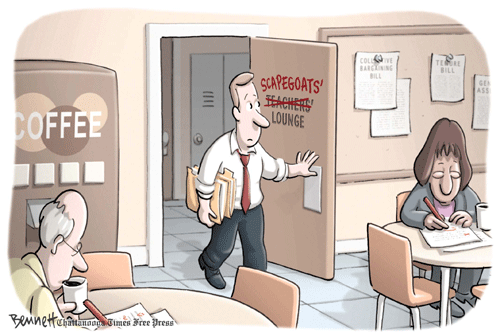
"The whole people must take upon themselves the education of the whole people and be willing to bear the expenses of it. There should not be a district of one mile square, without a school in it, not founded by a charitable individual, but maintained at the public expense of the people themselves." -- John Adams

"No money shall be drawn from the treasury, for the benefit of any religious or theological institution." -- Indiana Constitution Article 1, Section 6.

"...no man shall be compelled to frequent or support any religious worship, place, or ministry whatsoever, nor shall be enforced, restrained, molested, or burthened in his body or goods, nor shall otherwise suffer on account of his religious opinions or belief; but that all men shall be free to profess, and by argument to maintain, their opinion in matters of religion, and that the same shall in no wise diminish enlarge, or affect their civil capacities." – Thomas Jefferson

Showing posts with label WhyTeachersQuit. Show all posts

Saturday, January 30, 2021

Vaccine for Teachers, Shortages, and The Shock Doctrine


VACCINATE TEACHERS

Anthony Fauci: ‘Get Teachers Vaccinated as Quickly as We Possibly Can’

Teachers were acclaimed as heroes when the pandemic lockdowns occurred in March. They adapted quickly to new technologies and new circumstances. That changed quickly, however, when people (and the media) realized that not everyone could stay home with their children and help them learn. Getting the "kids back in school" was a high priority. Teachers, apparently, are essential workers after all.

The CDC has guidelines for reopening schools which include making sure that everyone has sufficient PPE, that the school is well ventilated, and that no one, staff or students, should come to school if they test positive or have been in contact with someone who has tested positive for COVID. That means, if a school can't follow those guidelines (and others) it's not safe to reopen.

Meanwhile, teachers unions are fighting for the health and safety of their members and their members' students. Our public school infrastructure is not the best and many schools don't have adequate ventilation, especially older buildings. Most schools don't have the resources to make sure that all their students are COVID free before they enter the classroom...nor do they all have extra money to spend on PPE for their teachers and staff members.

So teachers unions are getting blamed for "insisting that those lazy teachers stay home and get paid for not working." Meanwhile, teachers and students continue to test positive for COVID.

And in Indiana, teachers, noted by the CDC as essential workers needing vaccines ASAP, were skipped when health professionals and first responders were vaccinated.

If we really want schools to open shouldn't we be willing to pay to make them safe for students and teachers?

From Anthony Fauci, quoted in Education Week

“We’re not going to get back to normal until we get children back into school, both for the good of the children, for the good of the parents, and for the good of the community,” he said. “We want to make sure we do that by giving the teachers and the teams associated with teachers the resources that they need to do that. The idea of, ‘Go do it on your own'—that doesn’t work.”

Making sure schools can reopen safely is a personal issue for him, Fauci added: His daughter is a 3rd grade science teacher in New Orleans.


THE TEACHER SHORTAGE

27% of teachers are considering quitting because of Covid, survey finds

This is from December 2020. The teacher shortage isn't going away.

We were already losing teachers at an alarming rate before the pandemic hit. Now, with uncertainty about school funding and uncertainty about classroom safety, many teachers are calling it quits.

From CNBC Make It
The coronavirus pandemic has put significant pressure on America’s teachers. Some have been asked to weigh risks to their personal health and teach in person. Some have been asked to teach from behind computer screens and perfect distance learning. Many have been asked to do both.

These pressures are taking a toll on teachers across the country.

According to a new report, 77% of educators are working more today than a year ago, 60% enjoy their job less and 59% do not feel secure in their school district’s health and safety precautions. Roughly 27% say they are considering leaving their job, retiring early or taking a leave of absence because of the pandemic.

“Before the pandemic, large numbers of U.S. educators were already leaving the profession due to the financial pressure the job puts on their lives,” reads the report. “Then COVID-19 came along.”


THE SHOCK DOCTRINE COMES TO YOUR PUBLIC SCHOOL

Americans United Gears Up To Oppose Private School Voucher Bills

The pandemic has the country in an economic as well as a medical uproar. Social unrest related to political upheaval has added to the chaos. In this atmosphere, it should come as no surprise that "edupreneurs" want to get their hands on the billions of dollars spent each year on public education.

Across the country, state legislatures are starting their legislative year with bills focusing on transferring public funds to private and privately owned (aka charter) schools.

To add to the trouble, public schools are hemorrhaging teachers as the normal stresses of being a teacher in the 21st century are compounded by the stresses of the pandemic, virtual teaching, combination teaching, and teaching without proper equipment.

The loss of professional teachers is a plus for the privatizers. As states come to the conclusion that there aren't enough professional teachers for their students, they'll weaken certification requirements allowing untrained or poorly trained people to take charge of classrooms -- because of course, anyone can teach. This weakening of teacher professionalism will lead to lower pay for those in the classroom and weakened teachers unions - a definite plus for those who want to profit from the economic challenges faced by the country.

Enter "Disaster Capitalists" as described by Naomi Klein in her 2007 book, The Shock Doctrine. The crisis in education can only be solved by the private sector. Hence the pressure on legislatures to give public dollars to private schools and CMOs.

From Americans United for the Separation of Church and State
We know that private school voucher programs are bad public policy for so many reasons, including that they funnel desperately needed funds away from public schools to private, mostly religious, schools. And public schools face unprecedented financial difficulties right now because of COVID-19. There are increased costs to offer virtual learning and make sure in-person classes are safe for teachers and students. At the same time, states are cutting public school budgets because of decreased revenue. The Learning Policy Institute estimated that COVID-19 has cost public schools between $199 billion and $246 billion. Lawmakers should not drain additional money away from public schools – which 90 percent of our students attend – in the middle of a pandemic.
💉🦠🌡

Wednesday, January 22, 2020

2020 Medley #2

Vouchers, Environmental Toxins interfere with learning, NPE, Why kindergarten teachers quit, NAEP, Reading aloud


SHOULD YOUR TAX MONEY BE USED TO EXPEL KIDS WHO LIKE RAINBOWS?

Louisville Christian school expelled student over a rainbow cake, family says

Kentucky has no plan providing vouchers for students to attend religious schools. Why is that good? As of now, private schools in Kentucky that expel (or force out) a child because they like rainbows, like the one in this article, cannot receive any state funding.

Depending on what happens with the case currently before the Supreme Court, however, this could change.

Public money for public schools!
A Christian school in Louisville expelled a student last week after her family said school officials discovered the girl had celebrated her birthday with a rainbow-themed cake.

Kimberly Alford told The Courier Journal that until Jan. 6, her 15-year-old daughter had been a freshman at Whitefield Academy, a private school at 7711 Fegenbush Lane that serves students in preschool through 12th grade.

That's when Alford said she received an email from Whitefield Academy's head of school, Bruce Jacobson, explaining how her daughter was being expelled "immediately due to a post on social media."

Alford had recently posted a photo on her Facebook page showing her daughter celebrating her birthday in late December at a Texas Roadhouse restaurant. In the photo, the girl is wearing a sweater featuring a rainbow design and sitting by a colorful, rainbow-themed cake.
See also: Gerth: This just in ... God expelled from Louisville Christian school for creating rainbow

VOUCHER PROGRAMS DON'T HELP LEARNING

The Danger Private School Voucher Programs Pose to Civil Rights

From last May...

More reasons not to divert public money to private/religious school vouchers.
More recently, evidence has shown that these programs are not effective at improving educational achievement. Recent evaluations of certain voucher programs have shown no improvement in achievement or a decline in achievement for students who use them. For example, a Center for American Progress analysis found that the overall effect of the D.C. voucher program on students’ math achievement is equivalent to missing 68 days of school. Voucher programs are also not a viable solution in many rural areas of the country because these programs can strain funding resources in communities that already have lower densities of students and schools. Public funding should be used to ensure that all students have access to a quality public education, but voucher programs divert funding away from public schools. There have been a number of reports detailing how voucher programs provide public funding to schools that can legally remove or refuse to serve certain students altogether.


POISONING OUR CHILDREN...CONTINUED

The learning effect of air quality in classrooms

Yet another environmental issue that interferes with student learning. We know that environmental toxins like mercury and lead can cause damage to students which impacts their learning. Recent research shows that air pollution can also cause problems.
We’ve known for quite some time that pollution is bad for your health but researchers are documenting how it affects our brains. A 2016 Israel study found that high rates of pollution on the day of an exam tamped down high school test scores. The same students scored higher on different test dates with cleaner air. Boys and low-income students were the most affected. A 2019 draft, working paper of a study on university students in London also found that exposure to indoor air pollutants was associated with lower exam test scores. Again, males were more affected than females and the mental acuity problems were triggered by particulate levels that were below current guidelines at the U.S. Environmental Protection Agency.

FUNDING FOR NPE

The Dark Money Behind Union-Owned NPE: Time to Fess Up.

Just kidding...NPE doesn't take "dark money." In fact, NPE hardly has any money at all when compared to groups funded by billionaire privatizers.
The short answer is that NPE is not funded by the “dark money” effort of millionaires and billionaires doling out money to puppet-string a school privatization agenda.

However, let us see exactly who funds NPE and who (like Stewart) is rolling in the dough as a result.


TEACHERS ARE LEAVING

Kindergarten Teachers Are Quitting, and Here Is Why

Appropriate instruction is better for the children. Good teachers understand that...and many are leaving the classroom to avoid doing damage to 5- and 6-year-olds.
• “I had to retire in 2017 because I could not take the pressure of having to force my 5- and 6-year-old students to sit with books… no talking allowed. …. I taught for 18 years and in the last 3 years teaching this stuff to my sweet little kinders I heard students cry, talk about how they didn’t understand, say they hated reading time, and act out. We were basically regurgitating the curriculum script. It was awful. I hated going to work that last 2 years with all the stress of academic achievement expectations… All administrators want to hear is the exact same stuff from one room to another from school to school.

• “Teachers have been complaining about more testing every year. And every year we hear, ‘We’ll look into that,’ and every year someone higher up decides, ‘We need more data.’ That, in turn, means more testing, more seatwork, and less play. I personally couldn’t take it anymore and took early retirement.”

See also: Let the Children Play, by Pasi Sahlberg and William Doyle.

NAEP -- MISUNDERSTANDINGS AND LACK OF PROGRESS

We’re Pressuring Students to Read Too Fast, Too Much, Too Soon

First, the disclaimer: On the NAEP test, a score demonstrating proficiency does not mean "grade level." It means that the test taker can competently handle challenging material. There is some debate that the scoring levels are set too high. See Curmudgucation's post titled, The One And Only Lesson To Be Learned From NAEP Scores for a discussion of this.

Second, our scores on the latest NAEP moved very little from the previous test. Maybe it's because there's too much pressure on students. The main takeaway is that the "reformist" status quo isn't helping to improve children's learning or lessen any racial or economic "achievement gaps."
Recent reading tests report that students’ reading comprehension scores show that just over one-third of students in grades four, eight, and 10 are proficient at reading. Researchers and education policy makers ponder the significance of little to no improvement in reading scores for students as a whole and the widening gap between our high-performing and low-performing students. What many of these thinkers fail to consider is the way education has changed. The system ignores that developmental psychology says when we push students too much and too fast we do more harm than good. The reading pressures we put on students may be one major cause of the stagnant scores.


WANT TO IMPROVE READING SCORES? READ ALOUD

The Most Powerful Family Ritual? The Bedtime Story

As if we needed any more reason to read aloud to our children (and students), here's an article about the benefits of reading aloud at bedtime. One thing the author neglects to mention in his article is that reading aloud to a child is the "single most important activity for building the knowledge required for eventual success in reading..."

Teachers and parents, if you're not reading to your children every day for at least 15 minutes, you're not doing enough. It's never too early...or too late to start.

There is simply nothing more powerful than the bedtime story—especially in this age of continuous screen time. As we go deeper into the discussion, we start to see how the bedtime story is the perfect ending to the day. So let’s rethink and reclaim this special decompression time for both parent and child.

It is not just something we are doing for our kids—the benefits accrue to us as well. We don’t just read to our kids, we read with our kids. Here are five reasons why the bedtime story is the most powerful family ritual...

Setting Children Up to Hate Reading

This article is from February, 2014. I've added it here to help with the understanding of the article above.

The best way to teach children to read is to increase their interest and enthusiasm in reading.

The best way to get children interested and enthusiastic about reading is to read to them. Every day.
Pick up any book about normal reading development and you will find that young children progress when they are ready—at their own pace.

The American Academy of Pediatrics notes the critical factor as to how a student will learn to read “is not how aggressively,” the child is given instruction, but rather their “own enthusiasm for learning.” They also state that many early learning programs “interfere with the child’s natural enthusiasm” by imposing on children to “concentrate on tasks” when they aren’t ready.

Why are young children being made to learn at a faster rate? Why is there this mistaken notion that children’s brains have somehow evolved to a higher level where they are supposed to read earlier and earlier?


📚📊🙋🏽‍♂️

Monday, August 6, 2018

2018 Medley #20

Segregation, Testing Toddlers, VAM, Duncan Still Unqualified, Why Teachers Quit, Giving Kids Books, Charters

SCHOOL SEGREGATION

Why Is This Happening? Investigating school segregation in 2018 with Nikole Hannah-Jones: podcast and transcript

The U.S. gave up on integrattion. Public school systems are more segregated than when Brown vs. Board of Education was handed down sixty-four years ago. This is all complicated by our underfunding of public education, especially for black and brown students.

So where is the concept of the public good -- where is the concept of "promote the general welfare"?

Nikole Hannah-Jones is one of the few voices calling for Americans to teach their children...all their children...together.
...who the hell pays your social security one day?

Right, when we're a country that is very quickly going to be a minority white country and you're gonna continue to under-educate half of the population of your country, then what jobs are they gonna get that are gonna help pay for the infrastructure of this country, that are gonna help pay your social security.


TESTING

Toddlers and Preschool Testing? Don’t Steal the Joy of Reading!

From the makers of DIBELS comes a new test...this one for toddlers. The next step in educational malpractice.
A child three years old is still a toddler. What demands, if any, should be placed on a child this young when it comes to learning to read? Will it harm their chances of enjoying reading in the future? This is what we should ask when it comes to the new PELI testing.

The same creators of DIBELS (Dynamic Indicators of Basic Literacy Skills), the controversial assessment started with the controversial program Reading First, following the recommendations of the controversial National Reading Panel, now have reading assessment for children as young as three years old.

DIBELS uses nonsense syllables which might not mean anything to a child. There are other problems with the assessment according to reading expert Ken Goodman who edited Examining DIBELS: What it is What it Does.


Top 10 Reasons You Can’t Fairly Evaluate Teachers on Student Test Scores

Using student test scores to evaluate teachers isn't appropriate, yet we still do it. There's no rational reason for continuing a practice that even the American Statistical Association says is statistically unreliable and invalid. This ignorant use of numbers is just another example of America's anti-science and anti-intellectualism.

Steven Singer lists 10 reasons why VAM is junk science...
2) You can’t assess teachers on tests that were made to assess students.

This violates fundamental principles of both statistics and assessment. If you make a test to assess A, you can’t use it to assess B. That’s why many researchers have labeled the process “junk science” – most notably the American Statistical Association in 2014. Put simply, the standardized tests on which VAM estimates are based have always been, and continue to be, developed to assess student achievement and not growth in student achievement nor growth in teacher effectiveness. The tests on which VAM estimates are based were never designed to estimate teachers’ effects. Doing otherwise is like assuming all healthy people go to the best doctors and all sick people go to the bad ones. If I fail a dental screening because I have cavities, that doesn’t mean my dentist is bad at his job. It means I need to brush more and lay off the sugary snacks.


Former Education Secretary Arne Duncan says U.S. education system "not top 10 in anything"

I agreed with some of what Duncan had to say in his interview on Face the Nation. Unfortunately, when he had the chance to change things he made them worse.

In 2015 I wrote,
Look what we got...Arne Duncan -- who never set foot in a public school as either a student or a teacher -- and Race to the Top which doubled down on No Child Left Behind's labeling of low test takers as losers. Arne Duncan, who cheered when an entire school full of teachers in Rhode Island were fired because the school was "low achieving" (aka filled with high poverty students). Arne Duncan, who manipulated federal dollars meant for low income students so that it became a contest to see which states could raise the caps on Charters fast enough and evaluate teachers based on test scores.
It's the ultimate of ironies that this man wrote a book called "How Schools Work."
"We say we value education, but we never vote on education. We never hold politicians accountable — local, state or national level — for getting better results," Duncan, the education secretary under President Obama, said on "Face the Nation" on Sunday. He added that the "toughest lie" for him personally is that "we say we value kids, and we've raised a generation of young people, teens, who have been raised on mass shootings and gun violence, and that simply doesn't happen in other nations."

"I don't look at what people say. I look at their actions, their policies. I look at their budgets. Our values don't reflect that we care about education or we care about teachers or that we truly care about keeping our children safe and free of fear," Duncan said.


WHY TEACHERS QUIT

Brittani Pollock: "I Left Teaching. I Had To."

Here is yet another story about a teacher who left teaching. In this case it's because of lack of funding in poorly funded Oklahoma. Americans are so intent on paying no taxes that we're sabatoging our future.
I'm donating my blog today to a former student, now friend, Brittani. She was my student and an officer in my club, Teen Volunteers, at Norman North. I always knew she wanted to be a teacher, you could see her deep love of children when she volunteered. I watched her get her teaching degree and watched as she began what we both thought would be a long career in the classroom. I planned to watch her become a National Board Certified Teacher. Things did not work out the way we hoped. And my heart is broken for every student who will never know Miss Pollock's love.


GIVE KIDS BOOKS

Dolly Parton's literacy program donates its 100 millionth book to Library of Congress

Before LeBron James, there was Dolly Parton. She started the Imagination Library in 1995. From the Imagination Library web site...
...a book gifting program that mails free, high-quality books to children from birth until they begin school, no matter their family’s income.

After launching in 1995, the program grew quickly. First books were only distributed to children living in Sevier County, Tennessee where Dolly grew up. It became such a success that in 2000 a national replication effort was underway. By 2003, Dolly Parton’s Imagination Library had mailed one million books. It would prove to be the first of many millions of books sent to children around the world.
Earlier this year the Imagination Library sent out its 100 millionth book.
Alongside Carla Hayden, who heads the Library of Congress, the iconic country singer dedicated the 100 millionth book from her Imagination Library to the research library. Through the nonprofit, she has been donating millions of books to children for more than 20 years.

...as of August 1, 2018

The 4th Annual National Give-A-Kid-A-Book Day

Speaking of giving kids books, last July 6 was the fourth annual Give-A-Kid-A-Book day. Did you remember? Russ Walsh reminds us every year.

It's not too late...give-a-kid-a-book today.
Literacy research has shown that the single best way to combat summer reading loss is to get books in kids hands. One way to do this is to give children books.

Participation is easy. All you need to do to is find a child and give that child a book. The child could be your own, a neighbor's child, a student, a grandchild, one of your own kid's friends, children in a homeless shelter. Just give the child a book and say, "I thought you might enjoy this." Some participants like to include a lollipop or other small sweet treat to send the message, "Reading is Sweet!", but the most important thing is to give a kid book.


CHARTERS

In the Public Interest’s weekly privatization report

In the Public Interest posts a weekly privatization report. The reports cover more than just the privatization of public schools. Here is just one of eleven different reports about charter schools from this week's report.

You might also be interested in taking a look at Breaking Point: The Cost of Charter Schools for Public School Districts.
29) Pennsylvania Just a few weeks before the start of the new school year, Wonderland Charter School in Ferguson Township is closing its doors, sending students and parents scrambling after they received email notification. “During the charter review, several people associated with Wonderland, including board members, teachers and parents, informed the board of directors of their concerns with the charter: ‘long-standing, calculated, inappropriate, and unlawful practices with respect to students with special needs,’ according to a letter to the board from Superintendent Bob O’Donnell.”


🚌🚌🚌

Thursday, April 5, 2018

2018 Medley #8: Teachers Finally Stand Up

Teachers Stand Up, Speak Out

Why are public schools, and public school educators, such an easy target for abuse in terms of wage stagnation, underfunding, and worker disrespect? Why is it so easy for legislators and policy makers to treat teachers like enemies of the state?

Oklahoma teachers on strike.

WHO ARE THE TEACHERS?

One possible answer to the questions, above, is the relative value given to work done by women in our society.

Three-fourths of American teachers are female, and despite the fact that teaching is a difficult job, needing training and experience, it's still considered "women's work" by the patriarchal society at large. In nearly every job, at every level, in every area where both men and women are employed, women earn less – even when men and women are doing the same exact work.

The assumption has been, even among educators, that women who work will (or ought to) have a higher-earning spouse at home, so they don't need to earn as much. There is rarely an assumption that women are the "bread-winners" of a family or that a woman might need to earn more than their partner of either sex. The tradition of women as teachers leads to teachers being disrespected because women are disrespected.

To the extent that work done by women is denigrated in our society, teachers are denigrated.

To the extent that work done by women is disrespected in our society, teachers are disrespected.

To the extent that work done by women is shortchanged in our society, teachers are shortchanged.

Blogger Jan Resseger has a similar response...

Kentucky: Teachers Stand Up for a Decent State Budget, Their Pensions, and Public Responsibility
Maybe part of our forgetting about teachers comes from gender bias. As we have all noticed in West Virginia last month, and now in Oklahoma and Kentucky, most of these teachers are energetic young women. All the old messages come into play: Teachers do their work because they love our children; the money isn’t so important to them. They’re probably married and have another income to depend on in addition to whatever they can bring in from teaching. These women should be good sports as they do more with less. And the worst: Teaching is really just glorified babysitting.


TEACHER'S MAKE THEIR VOICES HEARD

Finally...thankfully...teachers are speaking out in large numbers. They have been taking the brunt of the political, legislative, and social war on public education that has been waged for the last four decades. The war has been fought on several fronts...the most notable being funding. Public school funding has taken a hit from the poor economy as have other areas, but with the recovery, those who control the money have not seen fit to increase funding for schools.

In Indiana, teachers have seen a loss of earning power adjusted for inflation of over 15% in the last 15 years. Add to that, larger classes, media bashing, professional demoralization and fewer benefits which have resulted from the recent recession, tax cuts, and political pandering. Most teachers are doing more with less...and less...and less. Policy makers assume that teachers will pick up the slack, which, of course, they do...at a rate of about $500 per teacher, per year. There are more than 3 and a half million teachers in the United States. In other words, teachers subsidize our public schools by more than $1 billion a year.

Salaries are not keeping up with inflation...funding is not keeping up with inflation...teachers are donating money, as well as time, for their students...it all adds up to...

"ENOUGH IS ENOUGH"

Teachers have had it. Why they’re revolting against low pay and inadequate school funding.
...Underpaid and under-resourced teachers have had enough. Tired of struggling to pay their bills and educating students without sufficient resources — or, in some places, heat to keep kids from freezing in the winter — teachers are suddenly rebelling in places not known for union activism.

The protests are coming in states that have seen the country’s deepest funding cuts for public education by Republican legislators, including West Virginia, Oklahoma and Arizona...

Arizona teachers rally at the statehouse.

No Wonder Teachers Are Saying Enough Is Enough
Teachers have long been underpaid. Their average salary is a little over $58,000 a year. While that’s just below the national median income, teachers have the kinds of qualifications that should mean they bring home more than the average employee. About half of public-school teachers have a master’s degree, and nearly two-thirds have more than 10 years of job experience. And yet they make 17 percent less than other similarly educated workers, according to the Economic Policy Institute. Compensation for all college graduates rose over the last two decades, adjusted for inflation, but for teachers it actually declined.

Oklahoma teachers are protesting 10 years of low pay. Here’s what their walkout looked like.
Thousands of teachers returned Tuesday to the Oklahoma Capitol in Oklahoma City to protest low teacher pay and years of cuts to school funding, continuing a strike launched Monday.

Nearly 200 of the state’s 550 school districts remained closed, according to a tally on the Oklahoma Teacher Walkout Facebook group. An estimated 30,000 teachers and educators had gathered at the capitol on Monday, joined by hundreds of state employees.

Teachers are demanding that state legislators come up with $3.3 billion over the next three years for school funding, benefits, and pay raises for all public employees. On Monday, lawmakers didn’t give an inch.

That made teachers even angrier.

Kentucky teachers.

And We Will Rise: Day 3 of the Oklahoma Walkout
Don’t try us, Oklahoma legislatures. We work in classrooms of 30-35 children, seven-plus hours a day, with very few supplies, no restroom breaks, kids who are out of hand, kids who are hungry, kids who are angry, kids who have horrible home lives, kids who have broken hearts. And we still get up every school day, ready to work, ready to do everything necessary to help our kids, in conditions that are not suitable for what we need to do with pay that barely pays our bills and feeds our families.

Go ahead, try to reduce us to ashes.

The Phoenix will continue to rise.

TEACHERS ARE QUITTING

While many teachers are taking to the streets, others are leaving. Teachers are moving to other states to seek better conditions for themselves and their own children. They're looking for places where public schools are publicly supported.

Others are walking away from the profession completely.

The biggest loss, however, is with pre-service teachers. There are fewer and fewer young people choosing teaching as a profession...and with good reason. The pay gap between teachers and other similarly educated professionals is still large.

It's hard to recruit young people to a career which doesn't pay well and is regularly insulted and figuratively spat upon by the national media and politicians.


Teacher Exodus, Plummeting Enrollments and Teacher License Deregulation: I don’t feel fine.
As a dean of a school of education I have watched our undergraduate enrollments take a nose dive (55%) in the last 3 years. I meet with prospective students and parents who actively encourage their sons and daughters to avoid becoming a teacher. I know teachers that actively advise their students to avoid teaching. And I have talked to high school students who tell me they’ll never go into teaching. When I ask why, I get this response, “I’ve seen what my teachers go through. They’re not allowed to teach. So many of them are miserable. No thank you.”


PAYING FOR THE COMMON GOOD

The anti-taxers – or more accurately, anti-taxers-of-the-wealthy – have convinced Americans that all taxes are always bad. But that's not true.

We're not the highest taxed nation on Earth, contrary to what some political leaders would have you believe. And our businesses and wealthy fellow citizens could pay more than they do, especially after the latest tax cuts for wealthy Americans.

Our taxes pay for the physical infrastructure of our cities and counties which benefit everyone. It pays for roads and their upkeep, water and sewage systems, transportation, libraries, parks, and support for the elderly and needy. Taxes also pay for public schools.

When we refuse to pay taxes, we refuse to pay our membership fee for living in a free society.

When we shortchange public education we shortchange our future. That is something Americans throughout history have understood...


Proposals Relating to the Education of Youth in Pensilvania

by Benjamin Franklin, Philadelphia, 1749
The good Education of Youth has been esteemed by wise Men in all Ages, as the surest Foundation of the Happiness both of private Families and of Common-wealths. Almost all Governments have therefore made it a principal Object of their Attention, to establish and endow with proper Revenues, such Seminaries of Learning, as might supply the succeeding Age with Men qualified to serve the Publick with Honour to themselves, and to their Country. [emphasis added]

Letter to John Jebb from "The works of John Adams, second President of the United States : with a life of the author, notes and illustrations"

by John Adams, Second President of the United States, 10 September, 1785.
The whole people must take upon themselves the education of the whole people and be willing to bear the expenses of it. There should not be a district of one mile square, without a school in it, not founded by a charitable individual, but maintained at the public expense of the people themselves. [emphasis added]

Address to the National Convention of Colored Men, Louisville, Ky.

by Frederick Douglass, African American writer and abolitionist, speech at the National Convention of Colored Men, 1883
[T]he fact remains that the whole country is directly interested in the education of every child that lives within its borders. The ignorance of any part of the American people so deeply concerns all the rest that there can be no doubt of the right to pass laws compelling the attendance of every child at school...


🚌✏️📚

Wednesday, January 10, 2018

2018 Medley #1

Shortchanging Our Children and our Future,
Retention-in-Grade, Struggling Readers,
Why Teachers Quit, Chalkbeat

SHORTCHANGING OUR CHILDREN...AND OUR FUTURE

Missing an S for Science in the STEM Frenzy

Like other aspects of America's infrastructure, our public education system is being systematically dismantled. We're shortchanging the future of the nation by not providing a full curriculum for all our students.
Two in 5 schools don’t offer physics! In both Alaska and Oklahoma, about 70 percent of high schools don’t offer the course. Florida and Utah are close behind, with nearly 60 percent of high schools lacking physics. Iowa, New Hampshire, and Maine do much better, with only about 15 percent of schools not offering the subject.

Small schools are hurt worse, raising questions about the quality of science instruction in charter schools.

Ninety percent of America’s kids attend public schools, so dwindling science instruction is troubling. But it’s not surprising. Defunding public education is intentional, meant to transform schools into technology hubs—charters for the poor.

What message are we sending to the future?

RETENTION-IN-GRADE

Held back, but not helped

Yet another state discovers that retention-in-grade doesn't help students.

Louisiana is one of the states where you have to pass a test to move on to the next grade (in fourth and ninth grades). After a retention rate of around 25%, they've found that the process doesn't really help.

Retention is a problem that even educators contribute to...not just legislatures, school boards, or politicians. It's true that the legislatures and politicians are the ones who pass the "third grade punishment" laws (fourth grade in Louisiana), but rarely do teachers or administrators object beyond the "we need to make those decisions" stage. Those voices shouting "retention-in-grade doesn't work" are drowned out by the crowd shouting "we have to do something" followed by "what else can we do?" And therein lies the problem.

Teachers can't solve the problem of retention-in-grade on their own. Retention is ineffective as a method of remediation, as is passing a child to the next grade without any intervention. Intervention takes time and costs money.

States should stop wasting millions on testing, and, instead, spend that money on remediation. Struggling students need extra help, not another year doing the same thing over again. Research has repeatedly shown that intensive intervention works...but it costs money.

Only when we decide that our children are worth the cost will we be able to provide the education that each child needs.
Students who fell short were assigned mandatory summer-school classes, after which they took the test again. If that second attempt wasn’t successful, students couldn’t move on to fifth or ninth grade. The practice of retention in Louisiana also extended beyond the high-stakes grades. In 2015-16, more than one-third of all retained students were from grades K-3. In that same year, 10 percent of all ninth graders were held back. In a presentation a few years ago, a top education-department administrator, Chief of Literacy Kerry Laster, wrote, “We retain students despite overwhelming research and practical evidence that retention fails to lead to improved student outcomes.” Laster’s presentation, based on 2010 data, reported that 28 percent of Louisiana students did not make it to fourth grade on time.


WHY TEACHERS QUIT

Why Good Teachers Quit Teaching

Teachers are leaving the profession faster than they're entering. The non-educators in statehouses and legislatures are forcing teachers to do things that are not educationally sound. This has been going on for too long.

In what other profession do outsiders dictate practice? Who tells your attorney how to practice law? Who tells your plumber how to fix a leak? Who tells your doctor how to diagnose an illness?

Let teachers teach.
Bonnie D. left after 30 years of teaching because she felt the system was no longer acting in the best interest of all students. “Everything became all about passing the ‘almighty test,'” she says. “Decisions were made by the administrators to concentrate only on those students who could perform well. Call me old fashioned, but I always did my best to reach and teach every student in my room, not simply the ones who had the best chance of passing a test.”

In addition, many teachers worry about the effect high-stakes testing has on kids. “Sometimes tests coincide with a bad day,” Michelle S. tells us, “or a day when a student is just not feeling it. That is an incredible amount of stress on kids—especially those classified as ‘bubble kids.'”


Why It’s So Hard to Be a Teacher Right Now

Many legislatures are still relying on test scores to tell them which schools are "good" and which are "failing." That continued stress, added to the attitude out of the U.S. Education Department that public schools are a "dead end" means that being a teacher is not getting easier.
...test-prep stressors haven’t gone away, Weingarten says they started to abate late in 2015 when President Obama signed into law an act that gave states more power to determine public school curricula without the threat of federal penalties tied to standardized test scores. “There was hope things would get better,” she says.

But then a new source of stress emerged: the 2016 election, and President Trump’s appointment of Betsy DeVos to the post of Education Secretary. DeVos is a prominent charter-school advocate, and at times has been highly critical of America’s public schools. (She once said America’s public schools are “a dead end.”)

CHALKBEAT'S GREAT AMERICAN TEACH-OFF

Watch Out Padma, Here Comes Chalkbeat!

Chalkbeat accepts money from the forces of DPE (Destroy Public Education) such as the Gates Foundation, the Joyce Foundation, the Anschutz Foundation, EdChoice, and the Walton Family Foundation. They claim that their supporters (complete list here) don't impact their editorial decisions.
Here's what I do know--teaching is not a competition. It's not a reality show. If it were a reality show, it would be judged by experts like Diane Ravitch and Carol Burris. The thing is neither of them would deign to participate in an exercise like this one by reformy Chalkbeat. More likely it will be an exercise in determining who can best read the Moskowitz Academy Scripted Lesson Plan, or who can make the Most Kids Pass the Test, or some other reformy nonsense.

I'm personally offended that Chalkbeat deems itself worthy of judging teachers. I've been reading Chalkbeat since it started. I rate it biased, reformy, ineffective, and totally unqualified to understand our jobs, let alone judge our work. We do not cook meals. We do not just do test prep. We deal with real people, and they have many more layers than the artichokes they prepared three ways on Top Chef last week.


A QUICK PEEK

There are always many more articles I'd like to post than I have room for (I try to keep the Medleys to between 4 and 8 articles). Here, then, are some that I recommend...without comments.

When Readers Struggle: Background Knowledge

This is the first in a series on struggling readers by Russ Walsh. As of Jan 7, there is a second post, When Readers Struggle: Oral Language
Whenever I ask a group of teachers to identify areas that seem to cause difficulty for struggling readers, lack of background knowledge is sure to be near the top of the list.

Liking Those We Don’t Like: The Dissonance Involved with Supporting Public Schools
It’s one of the most exasperating issues for parents and educators, but education goes relatively unmentioned in each campaign.

We can draw school zones to make classrooms less segregated. This is how well your district does.
Is your district drawing borders to reduce or perpetuate racial segregation?

American kids are 70 percent more likely to die before adulthood than kids in other rich countries
A new study ranks 20 wealthy countries on childhood deaths. The US comes in last.

Lawmakers want more research before they spend big on preschool. When it comes to vouchers, there’s no such hesitation.
Lawmakers have demanded lots of proof to determine whether preschool helps kids...

Yet they’ve requested no long-term study of another similarly designed, tuition support program — vouchers for private schools...

The Lasting Payoff of Early Ed
The benefits of early education are found to persist for years, bolstering graduation, reducing retention, and reducing special education placements.

🚌🙋🏻📓

Sunday, May 7, 2017

Listen to This (Random Quotes) #6

REMINDER

John Kuhn is a strong voice in the fight for public schools. He understands that public education is not just for parents and children who participate in the public school system...public education exists to enrich and preserve our nation, just like public parks, museums, roads, street lights, and water systems.

This is one of my favorite quotes...


POVERTY

Can Schools Cure Poverty?

In order to heal the plague of poverty in America, schools would have to be equipped with medical facilities, counseling services, social workers, and psychologists, as well as all the necessities of a fully funded school like libraries staffed with trained librarians, specialists for students with special needs, specialists in the arts and physical education, nutritionists providing healthy food offerings, administrators with experience in the classroom and in management, and highly trained professional educators in every classroom.

Schools can't be expected to solve a problem which politicians and policy makers have either failed or ignored for centuries. Even with all the amenities listed in the above paragraph (and any others I might have forgotten), schools would find it difficult to heal the national illness of poverty. Poverty has roots in racism, class structure, economics, a financially ruinous health care system, and a ubiquitous drug culture. Schools can't repair this societal affliction alone.

Until we, as a people, develop the skill and desire to provide a decent standard of living to all our citizens, poverty will continue to be a major cause of school failure.

From Diane Ravitch
Poverty should be addressed by reducing poverty. No matter how high the standards, no matter how many tests, no matter how swell the curriculum is, those are not cures for homelessness, joblessness, and lack of access to decent medical care. This realization explains why I changed my mind about the best way to reform schools. It is not by turning schools over to the free market but by seeing them as part of a web of social supports for families and children. [emphasis added]


WHY TEACHERS QUIT

Teacher: I love my job, but the chaos of urban school reform is wearing me out

I recently took part in a discussion with my Indiana State Senator. This man is not a friend to public education and regularly promotes bills which
  • divert funds from public to private and privately run schools
  • support sectarian practices in public schools such as school sponsored prayer or anti-science legislation
  • support abusive or excessive testing practices
  • encourage the de-professionalization of teaching
During the discussion (which was with other educators), the Senator stated that, "The Senate is suffering from education reform fatigue."

His point, which I agreed with, was that education reform in Indiana needs to pause and reflect on the changes made. I would, of course, take it a step further and eliminate the damage that "reform" has caused in this state.

In any case, he indicated that members of his branch of the government were tired of focusing on ways to hurt public schools. He blamed the excesses on the Republicans in the State House of Representatives.

My response to him was something along the lines of, "Imagine what it must be like for teachers."

I wish I had said, "If it's tiring for you in the Senate to dump all these damaging changes on public education, imagine what it must be like to be a teacher at the end of the dumping."

From Ryan Heisinger in The Answer Sheet
Lasting relationships with teachers and peers aren’t forged over just a few months. An amazing arts program takes years to build. It takes a long time to develop a wide variety of student-led extracurricular opportunities. School pride comes when students feel they are a part of a community in which they’re able to express themselves and show off their talents. But in a marketplace in which schools compete for test scores, narrowed priorities and school closures erode the stable soil teachers and administrators need to put roots down and grow an enduring culture of success and school community and pride.


TEACHING CAREER

Teacher photographed completing lesson plans while in labor

Every teacher knows the drill...it's sometimes harder to miss a day at school than to go to school when you're sick. I remember getting up at 4 AM to get to school and make up lesson plans in order to go back home and collapse into the bed waiting for the pain of some illness to pass.

Naturally, I've never been pregnant, but I'm not surprised that a teacher would do this...

From Jennifer Pope of Burleson, Texas
"Really, I'm no different than any teacher that I know," Pope told ABC News. "They would've done the same thing. We think about our students like our own children. I'm grateful [people] are celebrating all teachers and working moms. Being a working mom is hard, but it's also fulfilling. I can't imagine not being a teacher."


CHOICE

Testing Opt Out: Parent Wants Conference; School Calls Police *Just in Case*

The "choice" crowd of "reformers" are adamant that parents know best and should have the tax-funded choice to send their children to any school they want – religious, corporate, or otherwise. They claim that it's only fair that parents have "choice" in everything having to do with their children...

EXCEPT...testing.

No one should get to "choose" to opt out of state mandated testing.

How many ways can you spell hypocrisy?

From Mercedes Schneider
One of the great contradictions within corporate ed reform is the promoting of a “parental choice” that stops short of the parent’s choice to opt his or her children out of federal- and state-mandated standardized testing.


TESTING: INAPPROPRIATE USES

Anger doesn’t describe it

From rlratto at Opine I Will
Anger doesn’t describe my feelings. Our society is being driven over a cliff by an extreme ideology that will destroy our nation. When we look the other way when children are being forced to fulfill an agenda, when we allow school children to go hungry, when we refuse to provide health care, when we demonize a segment of our population, we are heading for a fall.


AHCA

Despicable and Inexcusable

Sheila Kennedy

Every Republican who voted for this abomination must be held accountable

Paul Waldman

The quote below is from Paul Waldman. He's quoted in the excellent post by Sheila Kennedy. I've included both links.
Perhaps this bill will never become law, and its harm may be averted. But that would not mitigate the moral responsibility of those who supported it. Members of Congress vote on a lot of inconsequential bills and bills that have a small impact on limited areas of American life. But this is one of the most critical moments in recent American political history. The Republican health-care bill is an act of monstrous cruelty. It should stain those who supported it to the end of their days.


🎤🎧🎤

Saturday, April 15, 2017

2017 Medley #12: Teachers

Why Teachers Quit, Teacher Evaluations, Teacher Pay, Experience Matters 

WHY TEACHERS QUIT

Previous posts about why teachers quit (more).

Many legislators, privatizers, and "reformers" continue to blame teachers for low achievement. Unionism is anathema to some because teachers unions, in many places, are the only thing preventing the compete corporate takeover of public education. The right wing in America continues to push myths about failing public schools and the dual "solution" of charters and vouchers.

The teacher shortage currently afflicting public education in the U.S. is not surprising. Fewer college students are choosing education as a career due to declining wages, fewer benefits, lower social status, and the constant drumbeat of failure (see here, here, and here).

Public schools are not failing. Public schools reflect the failure of the nation to build an equitable society.

Teacher Resignation Letters Paint Bleak Picture of U.S. Education

Studies are showing what public educators already know...that "reform" is driving teachers from the classroom.
In a trio of studies, Michigan State University education expert Alyssa Hadley Dunn and colleagues examined the relatively new phenomenon of teachers posting their resignation letters online. Their findings, which come as many teachers are signing next year’s contracts, suggest educators at all grade and experience levels are frustrated and disheartened by a nationwide focus on standardized tests, scripted curriculum and punitive teacher-evaluation systems.

Teacher turnover costs more than $2.2 billion in the U.S. each year and has been shown to decrease student achievement in the form of reading and math test scores.

“The reasons teachers are leaving the profession has little to do with the reasons most frequently touted by education reformers, such as pay or student behavior,” said Dunn, assistant professor of teacher education. “Rather, teachers are leaving largely because oppressive policies and practices are affecting their working conditions and beliefs about themselves and education.”


Teacher resignation letter goes viral: ‘I will not subject my child to this disordered system’

A teacher from Florida tells why she's leaving.
Like many other teachers across the nation, I have become more and more disturbed by the misguided reforms taking place which are robbing my students of a developmentally appropriate education. Developmentally appropriate practice is the bedrock upon which early childhood education best practices are based, and has decades of empirical support behind it. However, the new reforms not only disregard this research, they are actively forcing teachers to engage in practices which are not only ineffective but actively harmful to child development and the learning process.

Letter Written Down By A Teacher Goes Viral!

This is not a resignation letter, but this letter from a teacher in Oklahoma is indicative of the problems public school teachers face on a daily basis.
We can no longer afford rolls of colored paper or paint or tape to make signs to support and advertise our Student Council activities. This fall our football team won't charge through a decorated banner as they take the field because we can't afford to make the banner. There won't be any new textbooks in the foreseeable future. Broken desks won't be replaced. We're about to ration copy paper and we've already had the desktop printers taken out of our rooms.

We live in fear that our colleagues will leave us, not just because they are our friends, but because the district wouldn't replace them even if we could lure new teachers to our inner-city schools during the teacher shortage you[, the legislature] have caused. We fear our classes doubling in size.

We fear becoming as ineffective as you are. Not because we can't or won't do our job, like you, but because you keep passing mandates to make us better while taking away all the resources we need just to maintain the status quo. We fear that our second jobs will prevent us from grading the papers we already have to do from home. We fear our families will leave us because we don't have time for them.

TEACHER EVALUATIONS

Teacher Evaluation: It's About Relationships Not Numbers

If we don't use test scores to evaluate teachers what should we use? This question implies that test scores are not only appropriate to use as a teacher evaluation, but there isn't anything else which is as accurate. That's not true. Using student achievement tests to evaluate teachers (or schools) is an invalid since achievement tests are developed to evaluate students, not their teachers.

A good teacher develops relationships with her students. Good relationships improve the classroom atmosphere and create the feelings of safety and trust necessary for learning. The same is necessary for teacher evaluation; there must be a feeling of trust between the evaluator, usually an administrator, and the teacher. Russ Walsh explains...
Reformers can't see this very simple and most basic fact of teacher evaluation because they are focused on a fool's errand of seeking objectivity through numbers and a plan designed to weed out low performers, rather than a plan designed to improve performance of all teachers. These folks could have easily found out the flaws in the plan. All they needed to do was spend some time in schools talking to teachers and supervisors. To the extent that current teacher evaluation schemes interfere with teachers and supervisors developing trusting relationships, they are pre-ordained to fail.


TEACHER PAY

Just Paying Teachers More Won’t Stop Them From Quitting

Ask most teachers. They will tell you that they didn't choose education because of the high pay. Most people who become teachers do so because they want to make a difference in the lives of children.

"Reformers" don't understand that people don't become teachers for the huge salaries. Autonomy, respect, and a living wage, is enough. Teachers are quitting because in many areas, they aren't getting any of those.
“Teachers have also been subjected to demonization” from people and politicians from both the right and left, said Lawrence Mishel, the president of the Economic Policy Institute and one of the authors of the report, noting that Education Secretary John King in January felt the need to offer what many saw as an apology to teachers after taking over the Education Department. “Despite the best of intentions, teachers and principals have felt attacked and unfairly blamed for the challenges our nation faces as we strive to improve outcomes for all students," King said at the time.

Merit Pay for Teachers Can Lead to Higher Test Scores for Students, a Study Finds

Merit pay is, as Diane Ravitch says, the idea that never works and never dies.

If you define "student learning" simply by a standardized test score, then you might be able to design a merit pay plan which will get higher test scores, but that's not education.

This report in Education Week summarizing research into merit pay, indicates that merit pay helps teachers find ways to increase test scores for some students, oftentimes by learning to "game the system."
Teacher participation in a merit-pay program led to the equivalent of four extra weeks of student learning, according to a new analysis of 44 studies of incentive-pay initiatives in the United States and abroad.

New Merit Pay Study Hits The Wrong Target

Peter Greene follows up on the Education Week report. He emphasizes that testing is not teaching and that "gaming the system" is essentially paying people more who learn how to cheat.

The basis of the research is wrong. Education is not a test score. Learning is not a test score.
Springer's research suffers from the same giant, gaping ridiculous hole as the research that he meta-analyzed-- he assumes that his central measure measures what it claims to measure. This is like meta-analysis of a bunch of research from eight-year-olds who all used home made rulers to measure their own feet and "found" that their feet are twice as big as the feet of eight-year-olds in other country. If you don't ever check their home-made rulers for accuracy, you are wasting everyone's time.

At a minimum, this study shows that the toxic testing that is already narrowing and damaging education in this country can be given a extra jolt of destructive power when backed with money. The best this study can hope to say is that incentives encourage teachers to aim more carefully for the wrong target. As one of the EdWeek commenters put it, "Why on earth would you want to reward teachers with cash for getting higher test scores?" What Springer may have proven is not that merit pay works, but that Campbell's Law does.


EXPERIENCE MATTERS

New Studies Find That, for Teachers, Experience Really Does Matter

Education is more than a test score. Teachers with experience provide more than test prep for their students.
Researchers Helen F. Ladd and Lucy C. Sorenson, both of Duke University, in Durham, N.C., analyzed records from about 1.2 million middle school students in North Carolina from 2007 to 2011, including absences, reported disciplinary offenses, and test scores. The data also contain responses from 6th through 8th graders about time spent on homework and their reading habits...

Regarding nontest outcomes, the data show that as teachers gained experience, they were linked to lower rates of student absenteeism. The researchers postulate that more experienced teachers got better at motivating students and in classroom management, resulting in better attendance and fewer infractions.

✏️📝✏️