"The whole people must take upon themselves the education of the whole people and be willing to bear the expenses of it. There should not be a district of one mile square, without a school in it, not founded by a charitable individual, but maintained at the public expense of the people themselves." -- John Adams

"No money shall be drawn from the treasury, for the benefit of any religious or theological institution." -- Indiana Constitution Article 1, Section 6.

"...no man shall be compelled to frequent or support any religious worship, place, or ministry whatsoever, nor shall be enforced, restrained, molested, or burthened in his body or goods, nor shall otherwise suffer on account of his religious opinions or belief; but that all men shall be free to profess, and by argument to maintain, their opinion in matters of religion, and that the same shall in no wise diminish enlarge, or affect their civil capacities." – Thomas Jefferson

Sunday, December 22, 2013

A Picture is Worth a Thousand Words - December, 2013

Someone commented to me that the "pictures" I include on these monthly "A Picture is Worth a Thousand Words" posts usually have plenty of words with them. I agree...so this should more correctly be titled "A Picture Enhances a Thousand Words." Be that as it may, the title is not important...it's the content.

Here are some graphic images from around the net -- plus my own 2 cents worth of comments. Click on any image to see the full sized version.

Our Society's Soul

Most enlightened nations in the world direct more of their education resources towards the children who need them the most. In the US we provide more for those who already have more. It's not "rewarding success" like "reformers" would have us believe. It's rewarding wealth with more wealth and punishing the poor for being poor.

President Bush II referred to the "soft bigotry of low expectations" when he lit the fire to destroy the nation's public education system through No Child Left Behind. The fact is that
  • No Child Left Behind
  • Race to the Top
  • state and federal support of charters
  • state voucher schemes
  • evaluation of teachers using test scores which reflect family income more than actual achievement
  • state rules reducing requirements for educators
  • municipal and state actions to lay off veteran teachers and hire TFA temps
  • grading schools based on test scores

...all reflect the hard bigotry of neglect and denial towards the nearly 25% of our nation's children who live in poverty. What does this say about our society's soul?


Posterity

The priority of our nation is not education. Politicians, pundits and policy makers may bluster about "failing schools," and "bad teachers," but our nation's real obsession is with getting money now, not the future of our nation based on the success of our children.

We've lost sight of our goal of securing "...the Blessings of Liberty to ourselves and our Posterity..." Instead we've developed into a people focused only on ourselves and the immediate gratification of our desire for material things. In the long term, this focus will leave our Posterity searching for wisdom in a world of greed. We have become a nation of short-sighted, selfish people.


Thought Without Learning is Perilous

"Don't label a school as failing one day and then throw your hands up and walk away from it the next. Don't tell us that the only way to teach a child is to spend too much of a year preparing him to fill out a few bubbles in a standardized test...You didn't devote your lives to testing. You devoted it to teaching, and teaching is what you should be allowed to do." -- Candidate Barack Obama, Summer 2007.


A Handsaw vs. Sequoia

Bill Gates, the Koch Brothers, Eli Broad, the Walton Family...It sometimes feels like those of us trying to cut down the tree of "reform" are using a handsaw against a sequoia. Perseverance is key, however. We have to keep the goal in mind -- fully funded, equitable, free and appropriate public education for all of America's children.


Standing up to Money

Fighting money from Gates, Broad, Walton, et al, is difficult, but not futile. We can't give up!


Encouragement Matters

Not everyone learns at the same rate. Standardized tests, by definition, rank students based on the assumption that every child will learn exactly the same thing at the same time.


Sick Days are Hard Work

Teaching is such a personal job...that's why even the best teachers have trouble making substitute plans. Just writing down page numbers, listing lesson plans, or setting a schedule isn't sufficient to replace the relationships a good teacher builds with her students.


Play is Children's Work

Play is the young child's most important medium for learning (and it works for older children and adults, too!). Kindergarteners shouldn't be practicing filling in bubbles on test prep worksheets. For more on the importance of play see Play and Children's Learning from the National Association for the Education of Young Children (NAEYC).


~~~

All who envision a more just, progressive and fair society cannot ignore the battle for our nation’s educational future. Principals fighting for better schools, teachers fighting for better classrooms, students fighting for greater opportunities, parents fighting for a future worthy of their child’s promise: their fight is our fight. We must all join in.
~~~

Stop the Testing Insanity!


~~~

Tuesday, December 17, 2013

2013 Medley #26

Poverty, Testing and Privatization


POVERTY AND TESTING

To the editor

Stephen Krashen repeats...and repeats...and repeats...facts about the relationship between poverty and test scores. his first sentence is telling..."The media has learned nothing..."
Published in San Francisco Chronicle 12/03/2013

The media has learned nothing from the extensive research done on international test scores in the last decade ( U.S. Students Get Stuck in Middle of the Pack on OECD Test, December 3). Study after study shows that the strongest predictor of high scores on these tests is poverty, a conclusion that is backed by a number of other studies showing that students who live in poverty have poor diets, insufficent health care, and lack access to books, all of which contribute to low academic performance. When researchers control for the effect of poverty, the US ranks near the top of the world.

In contrast, no studies show that increased testing, increased rigor, and a more controlled curriculum help school achievement. The solution, in other words, is not the common core, which Susan Ohanian has described as "a radical untried curriculum overhaul and . . . nonstop national testing." The solution is to protect our youngsters from the impact of poverty.

— Stephen Krashen

Daniel Wydo Disaggregates PISA Scores by Income

Diane Ravitch posted this analysis of the PISA scores. American students who attend schools with low poverty score near the top of the world, as Krashen has repeatedly said. The problem is poverty, not America's public schools.
Science literacy
U.S. schools with less than 10% free/reduced – score=556 [1st in the world]

Finland – ranked 4th in the world
Reading literacy
U.S. schools with less than 10% free/reduced – score=559 [1st in the world]

Finland – ranked 5th in the world
Mathematics literacy
U.S. schools with less than 10% free/reduced – score=540 [5th in the world]

FInland – ranked 11th in the world

A poverty, not education, crisis in U.S.: Column

USA Today, not the usual source for pro-public education information, tells us what we've known for decades. Poverty matters and it's the national "crisis" not education.
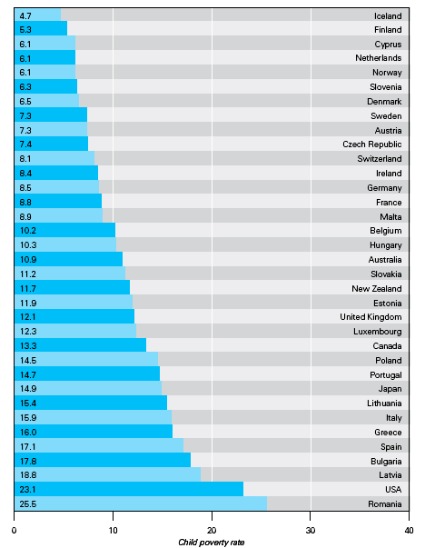
Poverty is the most relevant factor in determining the outcome of a person's educational journey, and in Finland, the child poverty rate is about 5%. In the U.S., the rate is almost five times as high. Unlike us, the Finns calculate the rate of poverty after accounting for government aid, but the differences remain substantial...

Here's one data point worth remembering. When you measure the test scores of American schools with a child poverty rate of less than 20%, our kids not only outperform the Finns, they outperform every nation in the world...

Two new studies on education and poverty were reported in Education Week in October. The first from the Southern Education Foundation reveals that nearly half of all U.S. public school students live in poverty. Poverty has risen in every state since President Clinton left office.

The second study, conducted by the National Student Clearinghouse Research Center, reveals that poverty — not race, ethnicity, national origin or where you attend school — is the best predictor of college attendance and completion.

America’s Shameful Poverty Stats

It's understandable that Americans would want to deny such an embarrassing situation. The United States has one of the highest levels of child-poverty in the developed world. That we would allow almost one fourth of our children to live with food insecurity, poor or no health care, poorly funded education facilities, and homelessness, is shameful and it's a reflection of our national morality that it continues.

If a foreign power were to subject one fourth of our children to this treatment we would go to war...yet the mostly wealthy, mostly white men who make up our congress (google: millionaires in congress), both Democrats and Republicans, generally agree that public schools are to blame for low achievement and do nothing to change the status-quo which favors their own mostly wealthy, mostly white children.
That our poverty numbers have risen to such a high level exposes the fact that as a society, we are choosing to ignore the needs of tens of millions of Americans—as we have done for much of the period since the War on Poverty went out of fashion and the harsher politics of Reaganism set in. These ignored Americans include kids like the ones I interviewed in Los Angeles, forced to choose between applying to college or dropping out of school and getting dead-end jobs to support parents who had lost not only their jobs but their homes, too. They include the elderly lady I met outside Dallas, who was too poor to retire but too sick to take the bus to her work at Walmart. Her solution? She paid her neighbors gas money to drive her to a job that paid so little she routinely ate either 88-cent TV dinners or went to bed hungry. They include, too, the residents of New Orleans’s Lower Ninth Ward I met in 2011, who, six years after Hurricane Katrina, were still living in appalling conditions in a largely obliterated community...

Does money affect children’s outcomes?

Think money doesn't matter in public education? The article below discusses exactly why money matters...and why poverty matters. This was written in the UK. While the child poverty rate in the UK is only 12.1 compared to America's 23.1 it's still high. The research can help us as well...if we listen.

Key points
  • This review identified 34 studies with strong evidence about whether money affects children’s outcomes. Children in lower-income families have worse cognitive, social-behavioural and health outcomes in part because they are poorer, not just because low income is correlated with other household and parental characteristics.
  • The evidence was strongest for cognitive development and school achievement, followed by social-behavioural development. Income also affects outcomes indirectly impacting on children, including maternal mental health, parenting and home environment.
  • The impact of increases in income on cognitive development appears roughly comparable with that of spending similar amounts on school or early education programmes. Increasing household income could substantially reduce differences in schooling outcomes, while also improving wider aspects of children’s well-being.
  • A given sum of money makes significantly more difference to children in low-income than better-off households (but still helps better-off children).
  • Money in early childhood makes most difference to cognitive outcomes, while in later childhood and adolescence it makes more difference to social and behavioural outcomes.
  • Longer-term poverty affects children’s outcomes more severely than short-term poverty.
  • Although many studies were from the US, the mechanisms through which money appears to affect children’s outcomes, including parental stress, anxiety and material deprivation, are equally relevant in the UK.

U.S. Rare in Spending More Money on the Education of Rich Children

Adding Insult to Injury

We spend less money on our students who need more. It seems that, where our children are concerned the US is a "leader" in exactly the wrong areas. We lead the developed world in child poverty as well as low education funding for our poor students.
“The United States is one of few advanced nations where schools serving better-off children usually have more educational resources than those serving poor students,” writes Eduardo Porter for the New York Times. This is because a large percentage of funding for public education comes not from the federal government, but from the property taxes collected in each school district. Rich kids, then, get more lavish educations...

This makes us one of the three countries in the OECD — with Israel and Turkey — in which the student/teacher ratio is less favorable in poor neighborhoods compared to rich ones. The other 31 nations in the survey invest equally in each student or disproportionately in poor students. This is not meritocracy and it is certainly not equal opportunity.

PRIVATIZATION

The Great Voucher Fraud

The voucher plans in places like Milwaukee, Louisiana, Indiana, Washington DC and elsewhere are designed to divert public funds to private schools.
Fifty years after the March on Washington, D.C., ardent voucher pro­ponents such as Jindal would have Americans believe that they are something like modern Martin Luther King Jrs., seeking enhanced opportunities for all. They claim that parents should be able to use taxpayer money to educate their children as they see fit rather than being locked into certain schools, and they say taxpayer-funded “scholarships” – a euphemism for vouchers – are the only way for low-income families to escape failing public schools.

But the reality is far different. Despite the best efforts of “school choice” advocates to spin the effectiveness of vouchers, decades of accumulated evidence paints a different story: Vouchers do not improve educational outcomes, they take money away from struggling public schools, they’re cash cows for institutions offering questionable education, they aid students already attending private institutions and they ignore the needs of special-education students.

“It’s Not a School Problem” -- Diane Ravitch

Privatizers want to close public schools and replace them with voucher accepting private schools. When some charter schools "failed" in Fort Wayne, Indiana they were reopened as private schools so that they wouldn't be subject to closure for lack of success. Grading schools using an A-F measure isn't meant to improve education. It's meant to blame poverty on public education.
...that’s the point of, for an example, the A to F grading system. No school ever got better because it was given a D or F grade—that’s a way of setting them up for closure. And we’ve never, I mean, I look back as a historian, and we’ve never in the history of American education had a movement that was designed to close huge numbers of schools.

Schools For Scandal: New Government Report Another Blow Against D.C.’s Voucher Plan

A recent report by the General Accounting Office has shown that the Washington D.C. voucher plan does exactly what voucher plans were designed to do...
...an investigation last year by The Washington Post found that the amount of the vouchers, $8,000-$12,000, is not enough to pay the annual tuition at the exclusive private schools in the region – most of which don’t want voucher students anyway.

As a result, vouchers in D.C. are largely subsidizing Catholic schools or private schools of questionable quality that sprang up to take advantage of the program....

It turns out that the program simply lacks any serious oversight.

The GAO report found that the Children and Youth Investment Trust Corporation, a non-profit group that is supposed to run the program, “does not effectively oversee participating schools, has not implemented effective policies and procedures, and is unable to efficiently manage day-to-day program operations.”

...Let this be a lesson to all of us: Voucher proponents talk about “choice” and “options” and merely wanting to try a new approach to see if it works. The D.C. fiasco has shot down all of those arguments. There are precious few choices, and the option to admit students always remains with the people who operate private schools, not the parents.

Still the plan lurches along. Maybe it’s time to admit that the forces driving this scheme are hatred of public education (and indeed government-sponsored programs generally), a desire to undermine church-state separation by propping up flagging Catholic schools and a data-proof belief among anti-government ideologues that a private system is always better than a public one.

The ugly truth about “school choice”

Click the link above to read the details behind each point...
1. It’s not about racial justice and equal opportunity.
2. It’s not about making public education stronger.
3. It’s not about supporting teachers.
4. It’s not about giving parents what they want.
5. It’s not a bipartisan, secular movement.
~~~

All who envision a more just, progressive and fair society cannot ignore the battle for our nation’s educational future. Principals fighting for better schools, teachers fighting for better classrooms, students fighting for greater opportunities, parents fighting for a future worthy of their child’s promise: their fight is our fight. We must all join in.
~~~

Stop the Testing Insanity!


~~~

Sunday, December 15, 2013

Musical Interlude


December 16th
Beethoven's 243rd birthday.


I found a YouTube site with color coded analyses of all of Beethoven's nine symphonies. For all you music nerds, I've included the entire Ninth below.

For the rest of you...listen to a few minutes at each of the following locations...

15:50, 27:10, 41:40 (Song of Joy theme begins), 1:00:25


From Wikipedia, about the first performance of Beethoven's Ninth (Choral) Symphony.
Although the performance was officially directed by Michael Umlauf, the theatre's Kapellmeister, Beethoven shared the stage with him. However, two years earlier, Umlauf had watched as the composer's attempt to conduct a dress rehearsal of his opera Fidelio ended in disaster. So this time, he instructed the singers and musicians to ignore the almost totally deaf Beethoven. At the beginning of every part, Beethoven, who sat by the stage, gave the tempos. He was turning the pages of his score and beating time for an orchestra he could not hear.

There are a number of anecdotes about the premiere of the Ninth. Based on the testimony of the participants, there are suggestions that it was under-rehearsed (there were only two full rehearsals) and rather scrappy in execution. On the other hand, the premiere was a great success. In any case, Beethoven was not to blame, as violinist Joseph Böhm recalled: "Beethoven directed the piece himself; that is, he stood before the lectern and gesticulated furiously. At times he rose, at other times he shrank to the ground, he moved as if he wanted to play all the instruments himself and sing for the whole chorus. All the musicians minded his rhythm alone while playing".

When the audience applauded—testimonies differ over whether at the end of the scherzo or the whole symphony—Beethoven was several measures off and still conducting. Because of that, the contralto Caroline Unger walked over and turned Beethoven around to accept the audience's cheers and applause. According to one witness, "the public received the musical hero with the utmost respect and sympathy, listened to his wonderful, gigantic creations with the most absorbed attention and broke out in jubilant applause, often during sections, and repeatedly at the end of them." The whole audience acclaimed him through standing ovations five times; there were handkerchiefs in the air, hats, raised hands, so that Beethoven, who could not hear the applause, could at least see the ovation gestures. [Emphasis added]


###

Tuesday, December 10, 2013

Beware the Foxes

TWO PARTIES? -- NOT WHEN IT COMES TO EDUCATION POLICY

The Indiana Legislature has a supermajority of Republicans so it's not surprising that they are opposed in almost everything they do by the Democratic minority.

Republicans have favored, and Democrats have opposed, almost all the public education legislation of the last few years which favors privatizers, opposes public schools and their teachers, and channels money away from public education through for-profit charters and vouchers:
  • the end of collective bargaining and due process for teachers
  • the increase in funding for charter schools (which, for the umpteenth time do not perform better than regular public schools)
  • the voucher plan and the expansion of the voucher plan which transfers public funds to private and parochial schools
  • the evaluation of teachers using test scores
In addition, the requirements for becoming an educator (teacher or administrator) in Indiana have now been lowered so that an education background is not necessary.

Is this a case of the Republican Philosophy of public education versus the Democratic Philosophy of public education? Only partially -- the exception being vouchers -- because in other places, the Democrats lead the fight for so-called "reform" of public education. To see the bipartisanship in the corporate quest to destroy America's public education system we here in Indiana have only to look next door to our neighbors in Illinois...

Illinois Education Reform: Gov. Pat Quinn Signs Bill Into Law
[The bill] makes teacher tenure and layoffs contingent on student achievement and makes it easier for school districts to dismiss tenured teachers deemed ineffective based on student performance.
The phrases "student achievement" and "student performance" mean test scores, of course.
Quinn was joined by legislators, a school marching band and other stakeholders such as Dan Montgomery, president of the Illinois Federation of Teachers, Jonah Edelman, head of reform group Stand for Children and Jo Anderson, senior aide to U.S. Secretary of Education Arne Duncan, who lauded the bill. Chicago Mayor Rahm Emanuel -- who will benefit directly from the law by gaining the power to extend his city's school day -- also attended.
Aside from the sell-out IFT president, Jonah Edelman is notorious as an anti-public education "reformer" as readers of Diane Ravitch's blog are aware. Arne Duncan (and by association, his representative) is no friend of public education. And you can read here to see what Rahm Emanuel has done to the children of Chicago...

The Democratic supermajority in the Illinois legislature and the Democratic governor have supported much of the same "education reform" plan as the Republican supermajority and Republican governor in Indiana. The Democrats in Illinois have gone further in one area, though...they have attacked the teachers' pension fund.

The Arrogance of Sen. Biss: Cuts teacher pensions and offers workshop for finding retirement security
The sheer arrogance of Illinois Sen.Biss (D) glares from his latest emailed newsletter. After he cut teacher pensions, he offers a workshop for finding “retirement security” – via his buddies.
See blogs by brothers Fred and Mike Klonsky for more about the teacher pension fight in Illinois.


BEWARE THE FOXES

Someone once said that our two major party politicians are like members of the canine family. Republicans, he said, are wolves: it's clear where they stand on the issues. Their disdain for public education is open and vicious. On the other hand, the Democrats are like foxes: they smile at you to make you think they're your friends – and then, when you least expect it, they devour you.

I'm not suggesting to those who are fighting the privatization of public education that they ignore what their local politicians have done when election time rolls around next November. However, we must remember that no matter what the partisan label a politician has next to his or her name the campaign contributions from the Broads, Gates, Waltons and other school "reformers" will go a long way towards corporatizing politicians of both parties.

The corporate takeover of public education is bipartisan. Work for the defeat of the "wolves," but beware of the "foxes."

~~~

MORE FROM AROUND THE BLOGOSPHERE...

Democrats" Against Public Education"
The nation’s third largest school district, the Chicago Public Schools (CPS) has a total of 681 schools. The announcement follows the plans to shut 26 public schools in Philadelphia, Pennsylvania and 15 public schools in the nation’s capital, Washington, DC. Detroit, Michigan has closed 130 schools since 2005, including 40 in 2010, and has plans to close another 28.

These closings are part of Obama’s administration’s program of “school reform,” which is aimed at victimizing teachers, shutting down public schools and privatizing education through the expansion of charter schools.
What’s Wrong with Democrats for Education Reform (DFER)?

DFER Candidate for Governor, Democrat John Gregg

Hedge Fund Operative Gordon Hendry Joins Indiana State Board of Education
Gordon Hendry may, in fact, be on the state board to carry out the Democrats for Education Reform’s hedge fund agenda for education, since word on the street is the DFER is seeking to buy out the Indiana Democratic Party. There have been signs. In April of 2013, in order to help hide campaign funding, Larry Grau—Hoosier waterboy for the New York hedge fund managers--filed the papers for an Indiana PAC where the hedge fund money will start rolling. Since the hedge fund managers know that Hoosiers may kick the Republicans to the curb in the upcoming elections, they see this as the perfect opportunity to move in for the kill. It would be wise for voters to start monitoring the campaign donations of their local Democrats now.
Voices: What Indiana’s ed reform upset means
Interestingly enough, at the same time Ritz’s teacher-backed insurgency prevailed, a Democrats for Education Reform-backed reform slate took strong control of the Indianapolis Public Schools board.
Voters embrace education reform locally, but not in state race
Change within the Indianapolis Public Schools board is coming faster than expected even for The Mind Trust, the locally based education reform group pushing for a sweeping transformation of the district.

Tuesday’s election saw three reform-minded IPS board candidates—Gayle Cosby, Caitlin Hannon and Sam Odle—win their races by sizeable margins. Another candidate, reform-minded incumbent Diane Arnold, ran unopposed.

Combine the four with like-minded board members Samantha Adair-White and Annie Roof, who won in 2010, and The Mind Trust could have allies in six of the seven seats.

MORE FROM THIS BLOG...


~~~

All who envision a more just, progressive and fair society cannot ignore the battle for our nation’s educational future. Principals fighting for better schools, teachers fighting for better classrooms, students fighting for greater opportunities, parents fighting for a future worthy of their child’s promise: their fight is our fight. We must all join in.
~~~

Stop the Testing Insanity!


~~~