"The whole people must take upon themselves the education of the whole people and be willing to bear the expenses of it. There should not be a district of one mile square, without a school in it, not founded by a charitable individual, but maintained at the public expense of the people themselves." -- John Adams

"No money shall be drawn from the treasury, for the benefit of any religious or theological institution." -- Indiana Constitution Article 1, Section 6.

"...no man shall be compelled to frequent or support any religious worship, place, or ministry whatsoever, nor shall be enforced, restrained, molested, or burthened in his body or goods, nor shall otherwise suffer on account of his religious opinions or belief; but that all men shall be free to profess, and by argument to maintain, their opinion in matters of religion, and that the same shall in no wise diminish enlarge, or affect their civil capacities." – Thomas Jefferson

Saturday, February 14, 2015

2015 Medley #4: Politics of Education

The Politics of Education in America: The Privatization Party, The Schools All Children Deserve, Legislative Bias in Favor of Privatization

THE POLITICS OF EDUCATION

Public Education: Political Orphan

There's only one political party in the US when it comes to public education...and that's the Democrapublican Privatization Party. It's controlled by billionaires, hedge fund managers, "free"-market fanatics, and religious exclusionists. They're not interested in the public good of "public education." They're not interested in what is best for the nation's children (only their own). They're not concerned with anything other than their own economic or idealogical interest.
In terms of policy, the biggest difference between the parties may be that Democrats still occasionally feel the need to hide their druthers behind language designed to keep teachers and other public school advocates from deserting them, whereas Republicans don't try to pretend that teachers, their work, and their union matter factor in GOP political calculations.

Somehow US public education in just one short decade has transformed from the baby that every politician was ready to kiss into the ugly kid that nobody wants to go to Prom with. In this environment, I'm honestly not sure who there is to speak up for public education in the political world, but I hope we can figure it out soon, because the hearings last week were one more reminder that there is no cavalry coming any time soon.


Public schools aren’t failing

...at least not yet. The lack of a strong public school system in the U.S. is becoming a self-fulfilling prophesy. Starve schools for money...push out career teachers...create mistrust of schools and teachers among the general public...and deny the influence of poverty.

The problem is our nation's failure to address the real issues facing our children and our future.
If policy makers were to listen to educators – and to students and parents – they would hear that the real crisis in public education is the loss of our collective commitment to the common good. If we continue to make the kinds of choices that steer resources away from our neediest students, the false narrative of failing public schools will become a sad reality.

Education Reformers Engineer a Teacher Brain Drain

Trash teachers, steal public funds, destroy public education.
For the last ten years now, a steady drumbeat of trash talk about teachers has made its way into the public comments about education. Experienced teachers are portrayed as lazy and incompetent, incapable of teaching students in any kind of adequate way.

...those who call themselves “education reformers” usually are not [true reformers]. Instead they are those who want only to raid public funds taken by force as taxes and then converted to the wealth of investors who do not care about your children, only their own.

Tully: Teachers shouldn’t have to beg
We ask a lot of our teachers. Too much. The least we can do is make sure they have what they know they need to teach and inspire the students who fill their classrooms every day.


What Republicans Don’t Want Us To Know About America’s ‘Failing’ Schools (VIDEO)

Democrats need to learn this, too. For too long Democrats have assumed that teachers and their unions will give them unconditional support. It's up to us to make sure they know that's not true -- at least not for education issues.
“Maybe it’s not the parents, the teachers, or the unions. Maybe we’re not doing the right things.”


THE SCHOOLS OUR CHILDREN DESERVE

"One, Two, Three What Are We Fighting For" by Anonymous

Here's an excellent list of characteristics for schools all children deserve.
  • Classrooms where children’s potential and aptitudes guide instruction, not the profits of test makers or the needs of future employers
  • Schools where recess and physical education periods are sacred, times when young people get needed exercise and a release for tension, not another period of test prep.
  • Classes which, at all levels, leave room for play and imagination, where children are allowed to be children, and all young people are allowed to dream
  • Schools where the arts, and science and school trips are never sacrificed to prepare for tests, and where joy has equal weight as academic achievement
  • Schools where testing, when it occurs, is used to help students improve their skills, not sort them out or rate their teachers. No test should ever be given which is not returned to students, teachers and families to assess individual students progress
  • Schools where no child, because of their race, or class economic background, is viewed as a potential criminal, and is subject to “zero tolerance” disciplinary policies designed to whip them into line
  • Schools where teachers are treated with respect, and encouraged to stay in schools for a long time and develop long term relationships with students and families
  • School communities where parent,student and teachers voices are welcomed and shape development of curriculum and school policies, and where the local community is welcome to come in after normal school hours end
  • School Governing bodies at the city, state, and national dominated by professional educators, not business leaders, who respect local control of schools and solicit teacher parent and student input.
  • A National Education Policy which stops using threats of school closings and privatization to improve student performance and uses cooperative, and not coercive measures to help schools improve
  • A Commitment, from all levels of government, to make public schools places where children are nurtured, and loved and inspired in all their diversity and individuality. Where profit isn't in the equation and where critical thinking is prized and enlightened citizenship is the goal;

LEGISLATIVE MOVE TO PUNISH PUBLIC SCHOOLS FOR BEING PUBLIC

Vic’s Statehouse Notes #201 – February 12, 2015

More benefits for parochial and private schools instead of public schools.

If the state test isn't important enough for every child who goes to school using public money needs to take it, then perhaps it's not a good test...or it's not needed...

This is just one more way to punish public schools for not supporting privatization.
If anyone doubts that Governor Pence and the leaders of the General Assembly and State Board are favoring private schools over public schools in Indiana’s intense competitive marketplace of school choice, [Senate Bill 470] should remove all doubts. The voucher program was sold in 2011 by promising that private schools would take ISTEP and would be measured like all public schools using the A-F system. Now just four years later the voucher schools want to change the rules but keep the money.


~~~

The narrow pursuit of test results has sidelined education issues of enduring importance such as poverty, equity in school funding, school segregation, health and physical education, science, the arts, access to early childhood education, class size, and curriculum development. We have witnessed the erosion of teachers’ professional autonomy, a narrowing of curriculum, and classrooms saturated with “test score-raising” instructional practices that betray our understandings of child development and our commitment to educating for artistry and critical thinking. And so now we are faced with “a crisis of pedagogy”–teaching in a system that no longer resembles the democratic ideals or tolerates the critical thinking and critical decision-making that we hope to impart on the students we teach.
~~~

Stop the Testing Insanity!


~~~


~~~


~~~

Thursday, February 12, 2015

Cancel the Chaos

What a mess.

Indiana's elementary and middle school testing program, ISTEP, is at the center of a chaotic mess and no one seems to be looking at the real problem...

ISTEP

The tests this year average more than 19 hours for grades 3 through 8...Does it make sense for kids ages 8 through 14 to take exams taking longer than the SAT and ACT put together, and longer than the Indiana Bar Exam? No, not at all, but that's where we've come in our national testing insanity.

This year's ISTEP debacle can be explained simply...

Indiana and Governor Pence jumped on the Common Core Standards bandwagon (along with most other states), but when a backlash arose against inappropriate standards among educators, and federal intervention among conservatives, the state reversed directions. Here, then, is a quick summary of how we got to where we are today...
  • Indiana backed out of the Common Core Standards.
  • The US Education Department insisted that Indiana still needed "college and career ready standards and a test to measure them."
  • Indiana rushed to create standards (instead of returning to the pre-CCSS standards which were among the best in the nation) and an assessment program to test them.
  • The State Board of Education refused to run a pilot of the test in the Fall.
  • McGraw Hill said that the state needed pilot questions for the test to be valid.
  • The pilot questions, instead of being given in the Fall have been added to the Spring test.
  • Result: hours and hours of testing for Indiana's public school children.


MISSING DISCUSSION

The big problem, however, is one which hardly anyone is talking about.

Yes, the test is too long...yes, the basis for the problem stems from a combination of things, most important being the CCSS, Federal Requirements, and conflict in Indiana between Republicans and the lone elected Democrat. But the most important part of this problem which is being almost universally ignored is this...

Testing in Indiana and the US is out of control.

As Linda Darling-Hammond said in an interview for Rise Above the Mark,
The problem we have with testing in this country today is that...we're using the wrong kinds of tests, and...we're using the tests in the wrong kinds of ways.

MISUSE

Achievement tests ought to be used to measure that which they were designed to measure -- the achievement of students.

We're misusing tests by using them to rank schools, evaluate educators, and make high stakes decisions for students.

Using achievement tests to rank schools helps schools in wealthy areas and harms schools in high poverty areas. It doesn't improve instruction...and only leads to inappropriate state intervention. Indiana's A-F school grading system is unnecessarily complicated and measures neighborhood income rather than the instructional success of a school. See here and here.

Even Superintendent Ritz fell into the trap of calling low graded schools "low-acheiving." No public schools are "low achieving." Rather, there are schools with many low achieving students and they need more resources, more support, and yes, better teachers, which brings us to...

Using achievement tests to evaluate teachers is unreliable and invalid. Doctors don't give blood tests to determine if a bone is broken. We don't use teaspoons to measure temperature. Achievement tests are developed to measure student achievement and good testing practice means that we don't use them for anything else -- like evaluating teachers. See here and here.

Using achievement tests to make high stakes decisions for students is also inappropriate. FairTest makes the case against using tests for graduation, grade promotion, or any other high stakes purpose. See The Case Against High Stakes Testing.

Misusing standardized tests does not improve student achievement.


OVERUSE

We give too many tests in the US. We don't have to test every student every year. Most high achieving nations in the world use standardized testing sparingly if at all. Our use borders on the Obsessive-Compulsive and it's based on the fact that Americans believe that our schools are failing and that there is an epidemic of bad teachers -- two beliefs which are incorrect.

We spend about $1.7 billion a year on state testing in the US, which is actually a fairly small percentage of the nation's education spending. However, that $1.7 billion does not include
  • the cost of time spent at the state and local level to manage test distribution, organization, sorting, packaging, and shipping.
  • the cost of time spent in classrooms preparing and taking tests
  • the cost of other assessments given to students either by states or local school systems
  • the loss of instructional time
  • the cost in emotional stress on students pressured by 1) inappropriate high stakes assessments, 2) less instructional time, and 3) less time for childhood
  • the cost in emotional stress on school staff pressured by 1) inappropriate high stakes assessments affecting their job security, and 2) lack of time to do the tasks they were hired to do
We're wasting time, money, and doing real damage to the mental health of people (children and adults) who work in our public schools. Overusing standardized tests does not improve student achievement.


MISDIRECTED ATTENTION

The overuse, misuse, and obsession with testing in the US has misdirected our attention from the single greatest problem affecting public education today: Child poverty.

The US has the highest child poverty among the "wealthy" nations of the world. Poverty, not "low achieving schools," or "bad teachers," is the most important factor in low student achievement. See here and here.

We could raise our national achievement level -- and secure our nation's future in the process -- if we could find a way to counter the effects on poverty among our children. Politicians and policy makers don't know how to do this...so they redirect our attention to a result of poverty -- low school achievement --  rather than admitting that they don't know what to do.


BACK HOME AGAIN IN INDIANA

While the politicians fight over a long decided election...and blame each other for the mess surrounding the state's standardized testing program...and jockey for positions of power by legislating new rules...

Indiana's public school teachers and students are waiting to be bludgeoned once again by an inappropriate, unreliable, and invalid measuring stick.

If Indiana needs a standardized test at all, we should use one which will
  • reflect what students learn
  • cost less in money and time
  • provide information that teachers can use rather than information with which to label winners and losers
  • have no impact on school funding
  • not be the basis for high stakes decisions for students or teachers
Indiana should use tests in a way which helps us see how we're doing. We should focus on what we can do to become better at educating our youth.

In short, we don't need to change the length of the ISTEP tests. We need to change them into something we can use for the benefit of students, or cancel them, forever.

~~~

The narrow pursuit of test results has sidelined education issues of enduring importance such as poverty, equity in school funding, school segregation, health and physical education, science, the arts, access to early childhood education, class size, and curriculum development. We have witnessed the erosion of teachers’ professional autonomy, a narrowing of curriculum, and classrooms saturated with “test score-raising” instructional practices that betray our understandings of child development and our commitment to educating for artistry and critical thinking. And so now we are faced with “a crisis of pedagogy”–teaching in a system that no longer resembles the democratic ideals or tolerates the critical thinking and critical decision-making that we hope to impart on the students we teach.
~~~

Stop the Testing Insanity!


~~~


~~~


~~~

Tuesday, February 10, 2015

Reform Rolls Through Indiana

[UPDATE: A quick update on HB 1486. It was recommitted back to education committee to continue to work on it. Apparently the original bill has been changed and is still being worked on to address many of these concerns. Keep an eye on that one...I know I am.]

CECI: SHADOW DOE

In early December Governor Pence decided that CECI had to go. CECI is the Center for Education and Career Innovation, a controversial agency he created last year to quietly take become the Indiana Department of "Reformist" Education. The actual Indiana Department of Education (DOE), for those of you who are not from Indiana, is run by Glenda Ritz, a Democrat who won a surprise victory over Reformist favorite, and cheater, Tony Bennett.

With Ritz at the helm of the DOE "reformers" could no longer change the rules for favored charter schools or ignore the rules about politicking.

Ritz also ran on a platform which called for stopping the reform steamroller crushing Indiana's public education system. The Governor and the Republicans in the state's General Assembly are in favor of the expansion of Indiana's already expansive voucher program. They're for the expansion of Indiana's charter industry. In other words, the Governor and the Republicans in the General Assembly are in favor of privatizing education in Indiana. Ritz ran on a pro-public education platform against privatization and she won the election handily over the reformist, Bennett.


Once elected, Superintendent Ritz and Governor Pence were in conflict. Most of the conflict was between Ritz and the Governor's proxy, the State Board of Education (SBOE).

The Governor, to make things easier for himself, created CECI in order to give full time help to the members of the SBOE who were charged with carrying out his agenda. Then, in December, Pence claimed the high road by disbanding CECI (which, as of this writing, hasn't happened), because it was too controversial.

ENTER THE LEGISLATURE

The Indiana House of Representatives has a supermajority of Republicans. The first education bill this year (HB1609), which passed just yesterday, February 9, 2015, removes the Superintendent of Public Instruction, Glenda Ritz, as chair of the SBOE. Ritz is the only elected member of the SBOE; all other members of the board are appointed by the Governor. The bill allows the board to choose its own chair.

Now that the only voice of the voters on the SBOE has been reduced to "a member" (assuming the Senate's version of the bill passes as well) the way is clear for Pence and Co. to continue their assault on public education.

Unfortunately, the DOE still has control of much of the public education process in the state. So, the next bill in the privatization steamroller is HB1486, which would transfer important Department of Education functions to the SBOE. It would also allow them to hire an executive director and staff to run things.

The summary of House Bill 1486 from the General Assembly web site...
Education issues. Requires the state board of education (state board) to adopt voluntary prekindergarten standards that align with the kindergarten through grade 12 standards. Provides that records of the state board shall be kept by the state board. (Current law provides that the records are kept by the state superintendent of public instruction.) Provides that the state board oversees the operation of turnaround academies. Provides that the state board shall appoint an executive director of the state board. Provides that the state board may employ third party experts and consultants to assist the state board in carrying out the state board's functions. Provides that the state board is considered a state educational authority within the meaning of the Family Educational Rights and Privacy Act. Provides that the department of education (department) shall provide any data necessary to conduct an audit or evaluation of any federal or state supported program principally engaged in the provision of education. Provides that the state board may adopt rules relating to performance qualified schools. Provides that a model teacher evaluation plan developed by the department must be approved by the state board. Authorizes the state board to establish academic standards in subject areas determined appropriate by the state board. Provides that the update of academic standards must be revised on a schedule determined by the state board. Makes changes to who may be appointed to the academic standards committee. Provides that the state board may obtain assistance from the legislative services agency with the approval of the legislative council or another entity to ensure the validity and reliability of the performance category or designation placements calculated by the department. Makes various changes to the administration of the ISTEP program. Makes various changes to provisions relating to the assessment of school performance. Requires the state board to require IREAD-3 as a statewide assessment to assess reading skills in grade 3.
In a (rather large) nutshell, HB1486...
  • Moves the records of the SBOE from the DOE to SBOE
  • Gives the SBOE control of the operation of "Turnaround Academies"
  • Allows the SBOE to appoint an executive director (Claire Fiddian-Green, perhaps?)
  • Employ third party "experts and consultants" to assist the SBOE (CECI staff? Tony Bennett?)
  • Makes the SBOE a state educational authority (FERPA)
  • Provides that the Indiana DOE give the SBOE data so the SBOE can conduct an audit or evaluation of any federal (like CECI tried to do with the state's NCLB waiver) or state program
  • Authorizes the SBOE to establish academic standards in subject areas determined appropriate by themselves
  • Provides that the update of academic standards must be revised on a schedule determined by the SBOE
  • Makes changes to who may be appointed to the academic standards committee. The bill includes higher education representatives with subject matter expertise, and "industry representatives" in addition to subject area teachers and parents
  • Allows the SBOE to obtain assistance from "another entity" to determine A-F categories with the DOE providing data.
  • Gives the SBOE authority to develop and implement ISTEP including but not limited to, content, format, and cut scores
  • Gives the SBOE the option to "check" the DOE school performance ratings
  • Gives SBOE Control over IREAD-3
No wonder Governor Pence was so willing to let CECI go...he knew the legislature would create another, more "reform" friendly Department of Education and attach it to the State Board of Education.

HB1609 now goes to the Senate...which also has a supermajority of Republicans. HB 1486 will likely pass as well. I'll follow them both...

It looks like the CECI staff members might be able to keep their jobs after all.


ASIDE: DEMOCRAPUBLICANS

I have to add one more thing. In Indiana it's the Republicans who are working hard to destroy public education. But it isn't necessarily so everywhere...and it might not have been so in Indiana had Mike Pence not become Governor.

Governor Pence's opponent in the last election was DFER June 2012 Reformer of the Month, John Gregg. I have no doubt that he would have been an only slightly better Indiana Governor for the public schools of the state.

There are also some Democrats on the Indiana State Board of Education, though it would be hard to identify them by their votes.

My point is that Democrats, by definition, are not necessarily friendly to public education. Take a look at the Illinois legislature and the Governor of New York, for example. Even worse is the President and his US Education Department tool, Arne Duncan.

Reformists all.

The only way this is going to change is if parents and teachers stand up and make a lot of noise...

~~~

The narrow pursuit of test results has sidelined education issues of enduring importance such as poverty, equity in school funding, school segregation, health and physical education, science, the arts, access to early childhood education, class size, and curriculum development. We have witnessed the erosion of teachers’ professional autonomy, a narrowing of curriculum, and classrooms saturated with “test score-raising” instructional practices that betray our understandings of child development and our commitment to educating for artistry and critical thinking. And so now we are faced with “a crisis of pedagogy”–teaching in a system that no longer resembles the democratic ideals or tolerates the critical thinking and critical decision-making that we hope to impart on the students we teach.
~~~

Stop the Testing Insanity!


~~~


~~~


~~~

Friday, February 6, 2015

An Open Letter to Indiana Educators on the Occasion of ISTEP 2015

Dear Indiana Educators...

TESTING, TESTING, TESTING

The new ISTEP, which, when both parts (applied skills and multiple choice) are combined, averages more than 19 hours for grades 3 through 8, is most likely on your mind right now. The people who developed this test are obviously not the ones who have to spend their day with children. If they were they would know that the test is too long and therefore, by definition, developmentally inappropriate for all grades in which it is given. For comparison, the SAT takes three hours and 45 minutes (not counting breaks), the ACT takes a little over four hours (including breaks), and the Indiana Bar Exam takes thirteen hours...


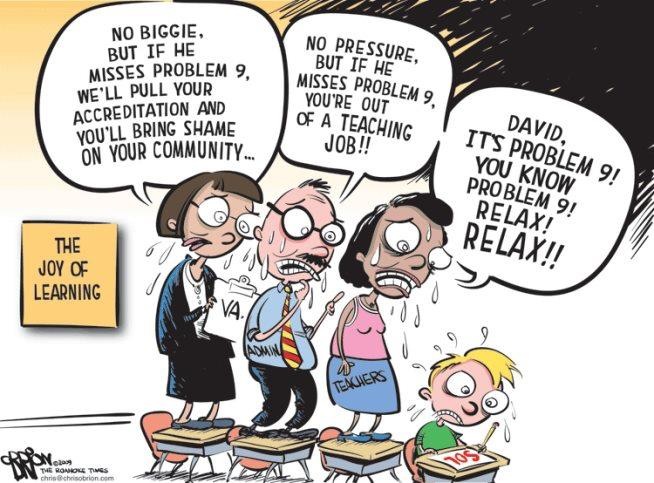
Still, we're all required to administer the tests and the dates are approaching quickly. Third grade teachers have the added burden of IREAD-3 immediately after ISTEP. Then there's Acuity and, for secondary students, ECAs.  It sometimes seems like the entire year is spent trying to squeeze in a tiny bit of teaching among all the days and weeks of testing. [If you're interested you can see a list of all the tests with all their dates at Indiana Assessments on the Indiana DOE web site.]

It's a shame that schools, teachers, and students are blamed when outside forces contribute so much to student achievement. David Berliner, in his study titled Poverty and Potential: Out-of-School Factors and School Success, tells us that there are factors which contribute to a student's achievement which are completely out of the control of schools and teachers.
  • Low birth weight
  • Medical care including dental and mental heath services
  • Food and shelter insecurity
  • Environmental pollutants
  • Family relations and stresses
  • Community stresses such as violence and drug abuse
Schools and teachers have no control over any of those things, and teachers'  impact on achievement is surprisingly small. Yet schools and teachers are held completely accountable for students' successes and failures in the classroom.

When the ISTEP scores are published in the papers, and school letter grades are determined and published we hear about so-called "failing schools" and "low performing schools." No one speaks about "failing communities," "low performing policy makers," or "low performing parents." The schools get blamed...and because of the State of Indiana's teacher evaluation policies, so do teachers.

Many teachers are leaving the profession rather than work under conditions such as these. Teachers who have the option might choose to avoid working with hard to educate students -- those with special needs, or those whose home environment leaves them unprepared for academic success. Some of the teachers who stay are struggling to hold on to their jobs and their self-respect as they are asked to participate in more and more inappropriate educational practices like test-prep and curriculum trimming.

We know that Indiana is overusing and misusing standardized testing. We know that what's being forced on schools by policy makers in Washington D.C. and Indianapolis is not in the best interests of children.

What can you do?

You can fight back, write letters to the editor, give testimony to the State Board of Education, write legislators and the Governor, but for the next few weeks what's most important is helping your students deal with the massive, stressful, and overwhelming amount of testing. For your own health and emotional well-being you need to find ways to relieve your own stress as well.

Elementary grade teachers especially, your students are still new to this, and even if they weren't, it's hard for children to sit still for hours and hours, even when it's spread out over March and April. It's not what they should be doing. You know that...and your administrators know that.


ROUTINES

Most ways to help students survive the stresses of high stakes testing are just common sense. Still, it helps to come up with some ways to let students relieve the stress. I don't have all the answers and there is no way to change, just in the next couple of weeks, the massive injustice being done to your students. You probably have suggestions of your own. Please share with each other, especially with newer teachers who might not have had this experience before.

A few suggestions...

As much as possible, continue your normal school routines. Humans become comfortable in familiar settings, so encourage your building administrators not to cancel any special area classes like PE or Music. Continue to spend time each day talking to your students about upcoming events, school assemblies, field trips, and so on. Don't cancel recess if you teach in an elementary grade. Continue to teach when daily testing is over, but keep in mind the level of stress the students are under and make sure that new concepts are kept to a minimum.

If you don't already read aloud to your students, testing time is a good time to start. No matter what their age, no matter what the subject, reading aloud to students is beneficial. If you need help getting started try looking around Jim Trelease's web site, trelease-on-reading.com. There you'll find lists of books to read aloud listed with appropriate ages and helps on the how-to's of read aloud. Choose something light and entertaining (like Sideways Stories from Wayside School).

Most of all remember that the students are under unusual stress...as are you. Be a good role model of patience and help them learn ways to take the extra stress in stride.


TESTING IS NOT TEACHING (reprinted from last year)
Don't tell us that the only way to teach a child is to spend too much of a year preparing him to fill out a few bubbles in a standardized test...You didn't devote your lives to testing. You devoted it to teaching, and teaching is what you should be allowed to do." -- Candidate Barack Obama, 2007
Testing is not teaching and a child (or a school/state/nation) is more than a test score.

Here are some things to keep in mind when you're administering tests this month -- or at any time during the school year.

1. You have already prepared them as much as you can. No matter what you do you can't (legally) add more to their knowledge once a testing session begins.

2. Standardized tests measure knowledge, but you have provided your students with growth opportunities, experiences and skills which aren't (and can't be) tested such as (but not limited to):
creativity, critical thinking, resilience, motivation, persistence, curiosity, endurance, reliability, enthusiasm, empathy, self-awareness, self-discipline, leadership, civic-mindedness, courage, compassion, resourcefulness, a sense of beauty, a sense of wonder, honesty, integrity
3. Understand that the increased importance of standardized tests -- the fact that they are used to rate schools and teachers, as well as measure student knowledge accumulation -- is based on invalid assumptions. As a professional your job is to teach your students. Standardized tests add nothing to that task. Standardized tests measure knowledge. If knowledge were all that were important in education then an understanding of child development, pedagogy, and psychology wouldn't be necessary to teach (and yes, I know, there are people in the state who actually believe that). We know that's not true. We know that one of the most important aspects of teaching and learning is the relationship between teacher and child. We know that well trained, caring teachers are better educators than computers.

4. People who make rules and laws about teaching, from legislators to billionaires to presidents, don't understand the teaching and learning process. For most of them, their understanding of teaching comes from the point of view of a learner.

They don't understand what it means to be a teacher in a classroom. They learned about teaching by watching their teachers.

They don't know the planning that takes place before the first day of school. They don't understand the thought behind creating an entire year's worth of lesson plans. They don't know the emotional responses a teacher feels when a class leaves her care at the end of a school year. They don't know all the time and effort spent preparing at night, on weekends, and during "vacations."

They have never helped a child decide to remain in school only to lose him to a drive-by shooting. They have never gotten a letter from a former student thanking them for supporting her during a family crisis. They have never tried to explain to a class of Kindergartners why their classmate who had cancer is not coming back. They have never felt the joy of watching a student who they helped all year long walk across the stage to accept a diploma.

State legislators who come from jobs as attorneys, florists, or auctioneers don't know what preparing for a class -- or half a dozen classes -- of students, day after day, for 180 days, is like. They have an image of what a classroom teacher does based on their childhood and youthful memories, but they don't know how it really works.

Understand that. Remember that you are much more valuable to your students than what is reflected on "the test."

5. Do what you have to do to survive in today's classroom. Make sure your students are, to the extent that you are able, ready to take "the test." Then, let it go and return to being the best teacher you can be. Keep in mind that the most important thing you will do for your students is to be a person they can respect, learn from, look up to, emulate, and care about.


One looks back with appreciation to the brilliant teachers, but with gratitude to those who touched our human feelings. The curriculum is so much necessary raw material, but warmth is the vital element for the growing plant and for the soul of the child. -- Carl Jung


~~~

The narrow pursuit of test results has sidelined education issues of enduring importance such as poverty, equity in school funding, school segregation, health and physical education, science, the arts, access to early childhood education, class size, and curriculum development. We have witnessed the erosion of teachers’ professional autonomy, a narrowing of curriculum, and classrooms saturated with “test score-raising” instructional practices that betray our understandings of child development and our commitment to educating for artistry and critical thinking. And so now we are faced with “a crisis of pedagogy”–teaching in a system that no longer resembles the democratic ideals or tolerates the critical thinking and critical decision-making that we hope to impart on the students we teach.
~~~

Stop the Testing Insanity!


~~~


~~~


~~~