"The whole people must take upon themselves the education of the whole people and be willing to bear the expenses of it. There should not be a district of one mile square, without a school in it, not founded by a charitable individual, but maintained at the public expense of the people themselves." -- John Adams

"No money shall be drawn from the treasury, for the benefit of any religious or theological institution." -- Indiana Constitution Article 1, Section 6.

"...no man shall be compelled to frequent or support any religious worship, place, or ministry whatsoever, nor shall be enforced, restrained, molested, or burthened in his body or goods, nor shall otherwise suffer on account of his religious opinions or belief; but that all men shall be free to profess, and by argument to maintain, their opinion in matters of religion, and that the same shall in no wise diminish enlarge, or affect their civil capacities." – Thomas Jefferson

Friday, June 1, 2012

2012 Medley #11 Part 1

Vouchers, Privatization, Charters.

(There's too much for one blog entry...I'll post more when I get it organized. Part 2 will cover Testing, Class Size and Untruths.)

The attacks continue. My guess is that with the upcoming election the candidates will try to outdo each other in bashing public school teachers and public schools. The push for corporate reform (READ: a way to turn a profit no matter what the consequences) will intensify.

Here's more proof that it's not about excellence in education...just about money.

A scary (and telling) school voucher story
Gov. Bobby Jindal recently signed a new law that sets up the largest voucher program of any state in the country. It is part of a series of “reforms” that Jindal says will expand school choice for families and critics say is the broadest state assault on public education in the country.
What we're experiencing is nothing less than the attempt to privatize America's Public Education system. Keep an eye on Privatization Watch. Remember, these are the same people who brought us the economic collapse. If you liked what they did to banking, you'll love what they're going to do to public education.

Are critics justified in accusing Philadelphia schools of privatization?

The Public Schools of Philadelphia are undergoing a complete overhaul. Under the guise of improvement the schools are being turned over to edupreneurs and privateers. It's also happening in New York (and has been for years)...and Chicago.
"I got a call a couple of days ago from somebody at the New Schools Venture Fund, a venture capitalist, and they are looking at Philadelphia as a place to invest. That's because they see for-profit opportunities here in Philadelphia," said Lytle.

Will public education die in Philly?
And unfortunately there are a considerable number of people and corporations in the camp of privatization who are pursuing profits. They are promoting for-profit charter schools and for-profit online schools because they hope to make–ready for this–a profit. Money is a big motivator. They assume it is the same for everyone. They truly don’t understand people who choose to work in a profession because of idealism or a sense of purpose. That’s why they are so big on merit pay and carrots and sticks. That’s what they understand.

The death of public education in any city or district is a tragedy. Education is a public responsibility. If some choose to pay to go to non-public schools, they have the right to do so. But for the vast majority of our kids, public education is their right and our responsibility. Any who whittle away that sense of public responsibility are doing damage to our society and our kids and our future.

Crisis in PA Cracks Ed Privatization Scheme Wide Open
The fiscal crisis facing our public schools is being exploited by a movement to privatize public education, break unions and subject students to high-stakes test-prep regimes.

Chicago Public Schools plans 60 more charter schools in 5 years
But critics — prominent among them the Chicago Teachers Union — say the growth of charters signals the decline of CPS-run neighborhood schools. Additionally, state report card data released last fall suggested many charters in Chicago are performing no better than some of the same neighborhood schools. More than two dozen charters scored below district averages.

"If a new charter opens up or a charter expands, they are heavily marketed and parents are aggressively recruited," said Sarah Hainds, a researcher with the Chicago Teachers Union. "So the neighborhood schools have had a declining enrollment, and that further facilitates the excuse of why (CPS) should close down these schools. More schools will be on the chopping block."
Eventually the corporate reformers will admit that it doesn't have anything to do with children and education. When they think they have the support -- which they might very well get -- they'll come out with the truth which is that they believe in total private control of the education system in the United States. They believe that private run schools can do better than public schools, even when the proof shows otherwise.

Debate rages: Do charter students perform better than others?
...some critics question the state's seemingly unconditional support for these schools that run on taxpayer money but are free from some state education rules.

They note charters earned a disproportionate share of F's on Florida's 2011 school report card and accounted for most of the 10 worst elementary schools on Gov. Rick Scott's new school rankings. They also cite the nearly 200 that have closed since Florida's first charters opened in 1996.

Charters...enroll smaller percentages of students with disabilities and those learning English, two other groups who frequently struggle on state tests...once poverty was figured in, charters fared worse in some performance measures and did no better than traditional public schools in others.

Braun: The conservative case to save traditional public schools
[Ravitch] says she is an enemy, not of school reform, but of what she calls "corporate reform," of advocates of privatization, of "treating the public schools as if they were branch offices of a corporate enterprise, as if they were shoe stores."

Public education, she says, is "an institutional essential to American democracy" and, in cities across the country — and in the state — it faces dismantling. The closing of traditional public schools and the reopening, in their stead, of privatized charter schools...

She is especially irritated by those who contend privatizing education is "the civil rights issue of our time" — a phrase that’s used often in New Jersey.

"Can you imagine the Rev. Martin Luther King linking arms with hedge fund managers and marching for privatized schools?"
~~~

Stop the Testing Insanity!


~~~

Thursday, May 31, 2012

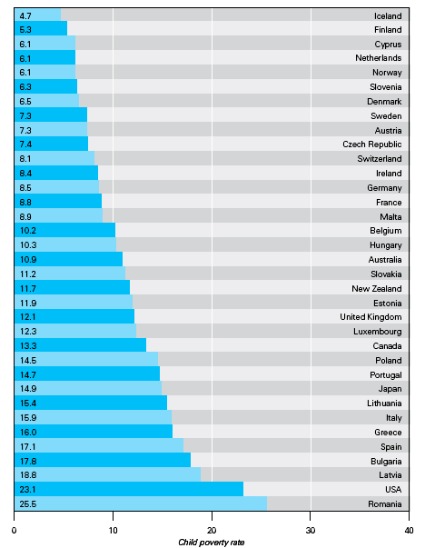
Rich Countries, Poor Children: Child Poverty in the Developed World

Tens of milllions of children in rich countries live in poverty. Tens of millions. And it's utterly avoidable. This 15-min interview is a full overview of the situation and solutions from Report Card 10 - the latest study from UNICEF's Office of Research. Interview with Report's author, Peter Adamson.


Read about it here...

Report: US Has One Of The Highest Child Poverty Rates In The Developed World

Child poverty at a time of crisis


When asked what he thought of modern civilization, Gandhi replied, "That would be a good idea."
~~~

Stop the Testing Insanity!


~~~
Thursday, May 24, 2012

Test Pressure and its Impact in the Classroom

WTHR, Indianapolis' NBC affiliate sent out an non scientific survey to teachers earlier this month. In it they asked about the pressures that standardized testing has put on their students, themselves, their classrooms and their ability to teach.

The survey was released just days after news of a cheating scandal at North Central High School in Indianapolis hit the news.

According to the survey many (10%) of the 2000 teachers who responded to the survey knew of students who have cheated...and a similar number (11%) knew about other teachers who have cheated.

No one condones cheating on the tests, but the fact remains that when the pressure to succeed overwhelms the available resources people will game the system and figure out ways to succeed, even if those ways are unethical. Campbell's Law states that
The more any quantitative social indicator is used for social decision-making, the more subject it will be to corruption pressures and the more apt it will be to distort and corrupt the social processes it is intended to monitor.
Donald Campbell, an experimental social science reseacher, also said,
...achievement tests may well be valuable indicators of general school achievement under conditions of normal teaching aimed at general competence. But when test scores become the goal of the teaching process, they both lose their value as indicators of educational status and distort the educational process in undesirable ways.
It's clear, under No Child Left Behind and Race to the Top, that test scores have become the goal of the teaching process. The fact that standardized tests are now so important has made the tests themselves less valid.

In an article about the survey, WTHR mentioned the additional key findings.
  • 81% of teachers said they feel pressure related to their students' achievement on standardized tests.
  • 80% of teachers said pressure related to standardized tests has a negative impact on the learning environment in their classroom.
  • 78% of teachers said pressure related to standardized tests has a negative impact on their ability to teach effectively.
Pressure related to student achievement is not always bad. Teachers should be pressured to help their students achieve. That's the point of schools and public education, after all. However, when pressure overwhelms reality then things need to change. The fact that so many teachers feel that the pressure has a negative impact on their classrooms and on their ability to teach is significant. The tests are making it harder to teach and that's backwards. As a society, we need to do everything we can to make it easier for teachers to teach and for students to learn, not the opposite. In the video accompanying the story, Theresa Meredith, Vice President of the Indiana State Teachers Association said,
I think when you push for competition in a school setting, when we're all supposed to be heading toward the same goal, we're all supposed to be working to help our students achieve as much as they possibly can...when you change that dynamic and you put so much pressure on schools and you force them to compete, literally compete, against each other, teachers feel tremendous pressure.
The education reformers are convinced (and have been for decades) that competition is what's needed to improve our public schools. The fact that it doesn't work doesn't seem to matter to them. It hasn't worked in Milwaukee, where a voucher system has been "in competition" with the public schools for two decades. It hasn't worked in thousands of charter schools around the country whose scores and results are no better than regular, neighborhood public schools (see HERE, HERE and HERE). Competition yields winners and losers and, when it comes to public education, we shouldn't accept any loss.

Diane Ravitch, in The Death and Life of the Great American School System, wrote,
Our schools will not improve if we entrust them to the magical powers of the market. Markets have winners and losers...Our goal must be to establish school systems that foster academic excellence in every school and every neighborhood.
Every child must be given the opportunity to develop to the highest level of their ability and motivation. That is, after all, why we have a public school system.

In a telling comment about the survey, Stephanie Sample, The Indiana DOE Communcations director said,
Do you really think parents care if their kids' teachers are feeling pressure? I don't. I think most parents just want them to teach.
Of course Indiana parents want their children's teachers to "teach." Sample's condescending comment seems to ignore the fact that the atmosphere of the classroom has an impact on student learning. I think most parents would, indeed, care if their child's teachers felt that pressure from the state had a negative impact on their classroom.

And that's just what the results of the survey show. When asked where the pressure comes from the teachers responded in this manner...
Does that pressure come from (check all that apply)

  • Yourself 57.1%
  • Your school administrators 74.7%
  • Your school board 34.6%
  • The State Department of Education 93.4%
  • Parents 17.6%
This is the pressure that 80% of respondents said had a negative impact on the learning environment of their classroom and 78% said interfered with their ability to teach effectively....so yes, Ms. Sample, I think parents would care about the pressure teachers feel. What are you and the Indiana Department of Education doing to help improve the atmosphere in the public schools of Indiana?

The unspoken implication in Ms. Sample's comment is that teachers don't care about parents...and by extension their children. She might think differently if she and the Indiana Department of Education collaborated with and worked together with the state's teachers instead of against them in the current push to privatize education in Indiana and the US.

Click here to see the complete results of the survey.

~~~

Stop the Testing Insanity!


~~~

Sunday, May 13, 2012

2012 Medley #10

Education and Poverty, School Libraries, Fox Bashes Teachers, Parent Power, Duncan, "Opportunity Culture," Common Core.

I'd like to again urge everyone to take a look at Linda Darling-Hammond's article (and the links) about Education and the income gap.

This is (IMHO) one of the most important pieces I've ever entered on these pages. Linda Darling-Hammond reports on the Capitol Hill briefing on the impact of poverty on education and what we can do about it which was sponsored jointly by the Broader Bolder Approach to Education and the Stanford Center for Opportunity Policy in Education.


D.C. cutting school librarians
No "payoff" so D.C. cuts "investment" in school libraries

There's a fundamental difference between the way "reformers" look at public schools and the way supporters do. The bottom line for "reformers" is the score on the test. That attitude has seeped into all aspects of public schools...including school libraries. Stephen Krashen has taught us how important libraries are to students, especially students in poverty. Facts don't matter, though...it's test scores that count.
We have invested in full-time librarians for the last three or four years and we haven't seen the kind of payoff we'd like” with reading test scores, Henderson countered, adding she is not disparaging librarians. "We have pulled away from programs where we haven't received a return on our investment.
Yes, that's right. The "return on the investment" is not students developing a life-long love of reading and literature, not an increased interest in books, not the opportunity to explore new ideas and interests. The "return on the investment" is the test scores.


"Stupid in America"? Fox's contribution to National Teacher Appreciation Week
...John Stossel, courtesy of Fox, gave us teachers a little token of his appreciation last night.

The "report"...was titled "Stupid in America." Who was he calling stupid? You might assume he was referring to the people who would accept at face value his incredibly one-sided presentation, no questions asked. But no, he wasn't calling his viewers stupid--at least not to their faces. He was calling me stupid...along with my roughly 20,000 colleagues here in Miami-Dade County, and 3.6 million colleagues across the country.

Just to make sure his viewers didn't miss his point, he wrapped up his "report," by chirping that, if students stop being bored in school and start learning math, "it will be thanks to those online classes. Or the charter schools. Or other experiments that break out of the union-dominated government monopoly."

550 Parents Opt Out in Snohomish, Washington

Parents are the key.
More than 550 Snohomish School District students did not take state exams in the past two weeks, a revolt staged by parents who question whether the tests are worth the money. The parents also hoped to get the attention of state lawmakers.

The ironies of Teacher Appreciation Week

The real irony is that the largest teachers union in the country has, for all practical purposes, signed on to Obama/Duncan's plan to destroy public education. Yes, the Romney plan is worse (if that's possible), but an endorsement for president should be worth more than simply a "seat at the table."
One of the official events on Education Secretary Arne Duncan’s schedule this week, as he goes around honoring teachers, is to appear at Teach for America’s second annual gala. Of course he did; the Education Department has showered millions of dollars on the organization in the last few years, and last September, Duncan said at an event with Teach for America founder Wendy Kopp and National Education Association President Dennis Van Roekel: “I don’t think anyone in the country has done more over the past 15 to 20 years than Wendy Kopp to identify the talents and characteristics that lead to great teaching.”

That was news to many teachers and education researchers in this field.

Opportunity Knocks
Here's a new one for the ol' Reformy Thesaurus: the "Opportunity Culture" in education.

Sure sounds good, doesn't it? Who doesn't want our American kids to have more opportunities in life? Except--oops--this campaign, rolled out by Public Impact, is actually about opportunities for "teacherpreneurs" to make more money by teaching oversized classes--and of course, for school districts to seize that same opportunity to save money through "innovative" staffing models.

The Common Core

Finally, Anthony Cody has been exploring the Common Core (READ: more testing). This is excellent information and I'm sure there will be more to come.


~~~

Stop the Testing Insanity!


~~~