"The whole people must take upon themselves the education of the whole people and be willing to bear the expenses of it. There should not be a district of one mile square, without a school in it, not founded by a charitable individual, but maintained at the public expense of the people themselves." -- John Adams

"No money shall be drawn from the treasury, for the benefit of any religious or theological institution." -- Indiana Constitution Article 1, Section 6.

"...no man shall be compelled to frequent or support any religious worship, place, or ministry whatsoever, nor shall be enforced, restrained, molested, or burthened in his body or goods, nor shall otherwise suffer on account of his religious opinions or belief; but that all men shall be free to profess, and by argument to maintain, their opinion in matters of religion, and that the same shall in no wise diminish enlarge, or affect their civil capacities." – Thomas Jefferson

Monday, March 10, 2014

What's the Alternative?

As if to prove my point, a friend of a friend on FaceBook (who we'll call TM) responded to my post, An Open Letter to Indiana Educators on the Occasion of ISTEP 2014 by saying...
TM: I've read this article several times, and I just don't get it. What's his point? That he doesn't like testing? That he doesn't like to be evaluated? What's his alternative?
"I JUST DON'T GET IT"

I write my blog for myself. It gives me a place to vent about the abuse and misuse of testing and about the privatization of public education and public educators. It gives me a place to "find my voice."

I'm a former musician and while I don't play musical instruments any longer, I still think of myself as a musician at heart. I'm a retired teacher...and for me that means that I'm not employed by a local school system any longer. I still teach a few hours a week as a volunteer at a local elementary school, but I'm no longer earning a living at it. Because of that, I still think of myself as a teacher.

But I'm not a professional writer.

So maybe TM doesn't "get it" because my post was written poorly. I can accept that. I'll be the first to admit that my punctuation isn't always correct...that my wording isn't always clear...that words are sometimes misspelled...and that I'm more than a bit verbose.

"WHAT'S HIS POINT? THAT HE DOESN'T LIKE TESTING?"

Perhaps what TM doesn't "get" is how teachers actually feel about the intrusion of testing into the classroom. We're not talking about one standardized test a year...though, IMHO, even that would be too much in today's testing environment. It's the fact that the tests aren't being used in the way that they were designed. To quote Linda Darling-Hammond in Rise Above the Mark,
The problem we have in this country with testing today is that, number 1 -- we're using the wrong kinds of tests, and number 2 -- we're using the tests in the wrong kinds of ways.
That's a great summary statement of what's wrong with the standardized testing mania in the U.S. today.

So, to TM, I answer -- I'm not against testing. I don't hate testing. Teachers use testing all the time. What I'm against is the incorrect and inappropriate use of testing.

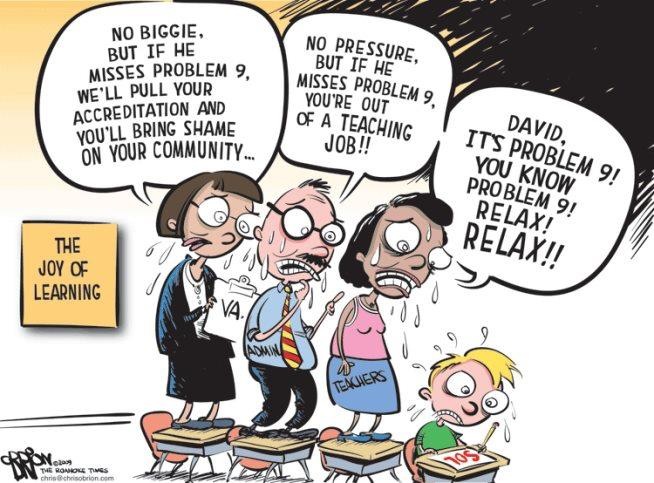
Teachers use tests to see if our lessons are effective and if students are learning. Standardized tests were developed to be diagnostic, but that original and somewhat legitimate use has been perverted beyond all recognition. Standardized tests are now used to determine curriculum, rank and retain students, grade and punish schools, and evaluate educators. Tests should not be used for things that they weren't intended for. As someone once said, that's like measuring temperature with a teaspoon.

There are so many more issues with testing in the U.S. public schools and I really don't want to go into all of them in this post. There's a reason that the topic cloud in the right-hand column of this blog shows that there are nearly 200 posts about testing. I would suggest that you read some of those if you want a deeper understanding of my objections to the way testing is used. Click the link below.

bloom-at.blogspot.com/search/label/Testing

"WHAT'S HIS POINT? THAT HE DOESN'T LIKE TO BE EVALUATED?"

I was paid to teach for 35 years. During that time I was evaluated at least a dozen times. I also served on evaluation committees consisting of teachers and administrators. We worked on developing good evaluation tools for evaluating teachers' performance. Since I'm a teacher I understand that constructive feedback is important for all learners (and teachers are or ought to be life-long learners). The best evaluations I had were those in which my performance as a teacher was analyzed and evaluated by someone (most often a principal) who understood the act of teaching. The best evaluations were not criticism free, (and not all my evaluations were stellar) but they were filled with comments which made me aware of how I came across as a teacher and how I could improve.

So, again, to TM, -- Evaluation helped me grow as an educator...it wasn't simply a grade on a page. Good evaluations were detailed and substantive...with suggestions and analysis.

Furthermore, standardized test scores are influenced by much more than what goes on in the classroom. There are out of school factors which carry much more weight in the scores of standardized tests than teaching does. The teacher is the most important in-school influence on student learning, but that influence is not as great as are out of school factors. Read Poverty and Potential: Out-of-School Factors and School Success by David C. Berliner, Arizona State University. Using standardized tests to evaluate teachers doesn't take into consideration all the outside influences which have a greater effect on student achievement than the teacher does.

...and no, VAM is not currently a valid way of incorporating outside factors into a teacher's evaluation.

"WHAT'S HIS ALTERNATIVE?"

I'm not going to make any assumptions about TM's motives in asking his questions, however, it's common for "transformers" (*definition below) to claim that those of us who are against the current test and punish status quo don't have any alternatives. That's wrong.

What we don't have is a large enough platform. The "transformers" own the media and the political system.

The amount of tax revenue redistributed from public schools to private enterprise through charter schools and vouchers is enormous. The amount of money dumped into the support and promotion of charters and private schools by private investors like Bill Gates, the Walton Family Foundation, the Broad Foundation and others, is huge compared to the amount of money teachers and supporters of public education have to spend on the defense of public education.


The "transformers" pay for privately run schools, they invest in politicians who then do their bidding in the executive offices and legislatures of the states and the nation. Teachers don't have those kinds of resources. Most of us are too busy trying to keep our heads above water in the classroom.

However, let's just assume that money wasn't an object and the "transformers" and their minions in state and national government gave me the power to change things. What's my alternative?

So, once more to TM, here's what I would do to improve education in the U.S. This includes my preferences for testing and evaluation.

1. Lower class sizes...with the lowest class sizes in the schools where students need the most help. We know that class size matters.

2. Children need a well rounded curriculum. The last few years have seen math and reading push out other subjects like social studies, health, physical education and the arts. Those things, as well as libraries, are being pushed out to a greater degree in the lowest performing schools. If they weren't important then high performing schools, and elite private schools wouldn't have them as part of their curriculum. Chicago Mayor Rahm Emanuel sends his children to the University of Chicago Lab School -- the same school that he and Secretary of Education Arne Duncan attended. Take a look at their fine arts program as an example.

3. Good schools need to provide services to their students. Students who live in poverty (and the U.S. has those in abundance -- around 23% of our children) need services to counteract the effects of that poverty. Things like full time social workers, school nurses, counselors, and psychologists are essential. If we're going to allow almost a quarter of our children to live in poverty then we need to support them in the classroom.

4. Public schools need to provide age-appropriate early childhood education. Children in Kindergarten don't need to take standardized tests. They need to play, to be read to, to engage in physical activity appropriate to their age. Read about developmentally appropriate educational practices for young children at the National Association for the Education of Young Children.

5. Public schools need to be supported. Right now we are one of only three "advanced" nations who spend more money on our wealthy students than our poor students. Instead, we should be investing more money where it's needed the most.
No more leaky roofs, asbestos-lined bathrooms, or windows that refuse to shut. Students need to be taught in facilities that are well-maintained and show respect for those who work and go to school there.
6. Use tests sparingly and in the manner for which they were developed. You don't get a blood test to determine if your bone is broken...achievement tests, such as they are, should be used for measuring student achievement. Period. They should not be used to determine student placement. They should not be used to determine the fate of schools. They should not be used to determine the pay of educators. That's not why they were developed.

Additionally, student achievement can be evaluated in other ways.
Good teacher observation, documentation of student work, and performance-based assessment, all of which involve the direct evaluation of real learning tasks, provide useful material for teachers, parents, and the public. Many nations that do the best in international comparisons, like Finland, use these techniques instead of large-scale standardized testing.
7. Teacher evaluation should be a joint venture between a school's administration and it's teachers. Montgomery County (MD) Peer Assistance and Review Program is an example of an evaluation system which works. It was developed and run by professionals. Fortunately it's being explored and introduced in other places. See:
8. Fully fund Pre-K through 12 education. There's no reason for a nation as wealthy as the U.S. to underfunded schools. Where will the money come from? Eliminate most of the standardized tests and all of the money spent on test-prep. Instead of a competition for funds -- with winners and losers -- like Race to the Top, distribute the $5 billion federal dollars to schools/school systems based on need.


You want more alternatives to obsessive testing and the "transformation" of America's public schools? Read chapters 21 through 33 of Reign of Error: The Hoax of the Privatization Movement and the Danger to America's Public Schools by Diane Ravitch.

---
*transformers - In her book, Reign of Error: The Hoax of the Privatization Movement and the Danger to America's Public Schools Diane Ravitch says that privatizers and so-called "reformers" don't actually want to "reform" public education but to "transform it into an entrepreneurial sector of the economy." She says that corporate executives "believe in transformative change and disruptive innovation" which might work for business (though that is debatable) but not for education. The "reformers," politicians, pundits and policy makers who seem hell-bent on destroying America's public schools are "transformers" not reformers.

~~~

All who envision a more just, progressive and fair society cannot ignore the battle for our nation’s educational future. Principals fighting for better schools, teachers fighting for better classrooms, students fighting for greater opportunities, parents fighting for a future worthy of their child’s promise: their fight is our fight. We must all join in.
~~~

Stop the Testing Insanity!


~~~

Saturday, March 8, 2014

2014 Medley #7 - For the Public Good

Public Education: For the Public Good

PUBLIC EDUCATION: FOR THE PUBLIC GOOD

President John Adams was crystal clear in his desire to see a public system of education. The public, he said, was responsible for educating the public.
The whole people must take upon themselves the education of the whole people and be willing to bear the expenses of it. There should not be a district of one mile square, without a school in it, not founded by a charitable individual, but maintained at the public expense of the people themselves. -- John Adams
Adams's political arch-foe, Jefferson, agreed and even tried to set up a system of public schools in Virginia.
People generally have more feeling for canals and roads than education. However, I hope we can advance them with equal pace. -- Thomas Jefferson
These two men, along with a good number of their colleagues supported public schools paid for and supported by the public. Education is a public good...something that the public benefits from...an informed citizenry.

It was about 60 years later, however, when the nation finally began the process of setting up public schools, paid for by the public, and controlled by the public.

Those same public schools, scorned and debased throughout history by sectarians, privatizers, and elitists, helped build the nation. Those same three groups of people have, once again, joined together to dismantle America's public school systems.

The religious right has been trying to do away with the public schools for decades.
I hope I live to see the day when, as in the early days of our country, we won't have any public schools. The churches will have taken them over again and Christians will be running them. What a happy day that will be! -- Jerry Falwell
Today's privatizers stand with Alexander Hamilton in the belief that the wealthy are superior by virtue of their wealth. Graduates and supporters of elite private schools like Bill Gates, Arne Duncan and Michelle Rhee are co-opting the language of civil rights and claiming that privatization -- through vouchers and/or charter schools -- will provide true equality of opportunity. The fact that the privatization movement is increasing segregation, and that privately run schools regularly screen out difficult to educate students doesn't seem to matter to them.

Vouchers are the privatizers' answer to Brown vs. Board of Education. Vouchers don't segregate children by race or economic status, they just give all parents a "choice." The fact that vouchers don't provide enough money to allow the very poor to attend private schools doesn't matter. The fact that the vouchers don't guarantee that the corporate-school-board will accept all students doesn't matter. The fact that vouchers don't prevent private schools from dumping hard to educate children back into the now underfunded public school system doesn't matter.

It's the nation's -- and by extension, the state's and the community's -- responsibility to raise up an educated populace. It's good for everyone. That's why tax money for public schools is so important. Everyone benefits from educated citizens.

SELFISH RESPONSES

‘What’s In It For Me?’: Public Schools, Public Taxes And The Public Good

How do you respond to voucher supporters who claim that they should be allowed to take "their tax money" out of the public school system and use it to send their children to private schools? What good are public schools to people who don't have any children or whose children have grown?

Consider:
  • What would happen if citizens withdrew the portion of their tax money used for public libraries because they wanted to buy their own books instead?
  • What would happen if citizens withdrew the portion of their tax money used for fire departments because they had purchased a fire suppressant system?
  • What would happen if citizens withdrew the portion of their tax money used for roads because they didn't drive a car?
  • What would happen if citizens withdrew the portion of their tax money used for parks because they never used them?
  • What would happen if citizens withdrew the portion of their tax money used for police departments because they hired their own, private security force?
The government -- local, state and national -- is responsible for various aspects of our lives, from safety to clean air to public parks. Public money is spent for these "public goods" because everyone benefits -- even those who never use the services.

Public education is a public good. An educated citizenry benefits the entire nation. Every state constitution provides for a system of free, public schools because they know that increased education improves the lives of their citizens.

Public education benefits all of us...but we, as a people, must choose to support it.
Parent Michael Charney, whose two children attend a Catholic school, remarked, “I pay my taxes every year and do not get anything from the state other than receiving this check, and now they’re thinking about taking even that away?”

Charney’s attitude is unfortunate – and it’s all too common these days. He asserts that he doesn’t get anything from those public school taxes. Mr. Charney, you could not be more wrong.

Let me tell you what you get: You get an educated public. You get kids who learn things and go on to contribute to society. You get literacy and numeracy. You get an appreciation for science. You get a school system, subject to local control and in most parts of the country governed by a democratically elected board, which educates 90 percent of our young people.
The unwillingness of Americans to pay their fair share of taxes...the unwillingness of Americans to support the public infrastructure of the country...the unwillingness of Americans to pay forward our civilization and our national security...is an indication of our selfishness. The "what's in it for me" attitude is a selfish sacrifice of our children's and our nation's economic future.


PUBLIC EDUCATION: FOR THE PUBLIC GOOD

Bad math: Equating public schools and welfare

Dr. Wendy Robinson, Superintendent of Fort Wayne Community Schools, put a privatizer in his place. When you believe that everything should be privatized you assume that everyone is a selfish and greedy as you are. They just can't believe that public schools help everyone.
Enlow responded by noting that food stamp recipients are allowed to choose where they can go to use their assistance.

"I agree we have a civic obligation for public education -- again, like we have a civic obligation for food stamps, right?" he said. "We have to help those who earn less."

It was more than Robinson could take.

"I have to say something -- I'm sorry. It's insulting to equate public education with food stamps," she said, as the audience erupted in thunderous applause. "Here's why: Public education was created for the public good. Food stamps and welfare are created for people who are in need. When you say they are the same, you are assuming all kids in public school are in need."
More on the false choice of school "choice"

Commonly Asked Questions About School Choice and Vouchers
When it comes to public policy and public schools, there is a responsibility to go beyond individual concerns and promote what is best for all children. In the long run, establishing two school systems -- one public and one private, yet both supported with tax dollars -- will only expand the ability of private schools to pick and choose the most desirable students and will only widen the gap between the haves and have-nots.
What’s wrong with school ‘choice’? Here’s what.
Rather than being sidetracked by school choice ploys, we must focus on our community public schools. We must ensure that our school leaders have the means to make every public school a great school, for the sake of all of our students...
What's Wrong with School Vouchers?
...when one factors in the differences between the socioeconomic backgrounds of students in the two types of schools, the private school advantage disappears. Studies that take this background factor into account have found a public school advantage in achievement.
“Bring Enough for Everyone”: What We Lose When We Lose Public Education
It’s no coincidence that the TV airwaves are stuffed with winner-take-all shows. This is our model for school and society now: enormous windfalls for the winner; frenzied fruitless efforts for the rest.


...and more...


POVERTY

This Is Your Brain on Poverty: What Science Tells Us About Poverty

Poverty matters.
If you're a child born into a poor household, you're more likely to exhibit psychological symptoms than if you were born to a non-poor household - symptoms that are a direct result of being born poor...the children from poor families were found to have problems, about 60 percent more than their middle-class counterparts.

TEACHER EVALUATIONS

I'm One of the Worst Teachers in My State

How did the "reformers" convince the nation that student test scores provided an accurate evaluation of their teachers?

Here's a teacher whose students scored so high on the standardized tests that she is labeled a poor teacher because they didn't improve from one year to the next. If a runner breaks a world record one day, does his coach get blamed if he doesn't break it again on another day?

Telling a teacher, "you're a failure because your incredibly high achievers haven't scored even higher" is breathtakingly stupid.
...my name will be printed in newspapers and posted online as an inferior teacher in need of serious improvement.

Last year, many of my students had had the highest scores on the state tests possible the year prior—a 5 out of 5. That’s how they get in to my class of gifted and high achieving students. Except, last year, they raised the bar so that the same 5th graders who scored 5s in 4th grade were much less likely to earn 5s in math and reading in 5th grade. Some still DID score 5s in math AND reading, yet were still deemed not to have made sufficient progress because they did not score as high within the 5 category as they had the year before.


"REFORM" CAUSES ADHD?

The Disturbing Link Between ADHD and Conservative Education Reform

Do developmentally inappropriate educational practices exacerbate ADHD?
What the team found was that high rates of ADHD diagnoses correlated closely with state laws that penalize schools when students fail. Nationally, this approach to education was enacted into law in 2001 with No Child Left Behind, which makes funding contingent on the number of students who pass standardized tests. In more recent years, similar testing-based strategies have been championed by education reformers such as Michelle Rhee. But many states passed these accountability laws as early as the 1980s, and within a few years of passage, ADHD diagnoses started going up in those states, the authors found, especially for kids near the poverty line...

It doesn’t mean that ADHD isn’t a real thing, with a biological basis. Hinshaw and Scheffler are very clear about that. But it does underscore our worry that misdiagnoses are being handed out by doctors with little time, little training in psychiatric disorders, and a lot of pressure to do something to help kids who are failing.

DEVELOPMENTALLY INAPPROPRIATE PRACTICE COMPOUNDED BY RETENTION

Youngest kindergarteners most likely to be held back, study finds

We push down the curriculum and expect kindergarteners to learn what first graders learned a generation ago -- and then we blame the children (and their teachers) for not learning. Retention is an ineffective practice, and it's made even worse when students can't achieve in a developmentally inappropriate environment.
"Research on retention has been somewhat more consistent in suggesting that holding children back a year is not the most effective practice," said Francis Huang, assistant professor in the MU College of Education. "Requiring children to repeat a grade is not only expensive for parents and school districts, but it also can affect children's self-esteem and their ability to adjust in the future."


~~~

All who envision a more just, progressive and fair society cannot ignore the battle for our nation’s educational future. Principals fighting for better schools, teachers fighting for better classrooms, students fighting for greater opportunities, parents fighting for a future worthy of their child’s promise: their fight is our fight. We must all join in.
~~~

Stop the Testing Insanity!


~~~

Tuesday, March 4, 2014

An Open Letter to Indiana Educators on the Occasion of ISTEP 2014

DEAR INDIANA EDUCATORS,

As most of you know, the next three weeks are going to be stressful for Hoosier students in grades three through eight. That's because the window for administering the first part of the Indiana Statewide Testing for Educational Progress-Plus (ISTEP+) begins this week.

Not only does this testing system assign a score to your students, it also is the basis for your school's A-F Ranking, your evaluation, and in some cases, the evaluations of teachers who don't even teach tested grades.

Third grade teachers have the added prospect of administering the IREAD-3 test during the last week of the ISTEP+ testing window.

Sadly, this is only the first of two parts of the ISTEP+ assessment regimen. This month's tests are the Applied Skills. The Multiple Choice assessment takes place in the Spring.

ISTEP+ and IREAD-3 are not the only tests that Indiana teachers are required to administer. There's also...
  • CoreLink
  • ECAs
  • IMAST
  • ISTAR
  • LAS Links
  • NAEP
  • mCLASS
  • Acuity
In addition there are tests chosen by local school boards which teachers are obligated to use...things like DIBELS and NWEA. Finally, teachers still design and administer their own chapter tests, midterm and final exams and other in-class quizzes.

Some tests are administered multiple times during a year (like mCLASS). Some tests are only used for certain grade levels (like IREAD-3), certain subject areas (like ECAs), and certain groups of students (like ISTAR and LAS Links). Not all students take all the tests, however every student is required to take at least some of the tests each year.


THE COST OF TESTING

Testing occurs frequently in Indiana schools. Some would say too frequently. How much time is spent on test prep and actual testing?

As an example, this year the third grade ISTEP+ tests (Applied Skills) takes about an hour a day for three days. That's not so much, until you factor in things like
  • time spent on test prep before the tests
  • time spent on rearranging the room before each test and again after each test (an arrangement needed for testing is not necessarily the best arrangement for teaching)
  • time allowed for the students to "wind down" after the tests
  • time spent by teachers in meetings before and after the tests
  • time spent by teachers gathering and returning tests daily during the testing days
  • time spent by administrators, counselors, and other support personnel in unpacking, sorting, distributing, processing additional materials (like #2 pencils), securing the tests, more sorting, and finally repackaging the tests at the building and corporation level.
[And don't forget those same third graders will take IREAD-3 at the end of the month, and then the multiple choice portion of the ISTEP+ later in the Spring.]

There is more cost to testing than just the cost of the test booklets. Personnel costs...the loss of instructional time...the cost of paying teachers, administrators and others to fiddle around with testing chores instead of actually working with students...and the cost in emotional and physical stress related to the tests.

If you've been teaching for more than a year in Indiana, then you probably know all this, so let's move on.


EVALUATE THAT

We all have stories...some more dramatic than others...that demonstrate how important we are as professionals. Here's one of mine...

I taught in Indiana's public schools for 35 years. Over the years a number of my former students have contacted me to tell me that something I did was helpful to them...from reading aloud to their own children, to remembering a classroom event or incident.

One student, Joe (*not his real name), wrote to me more than a decade after spending his third grade year in my classroom. I remembered him as an average, quiet student who worked hard.

The adult Joe wrote to tell me that his father had recently died. He said that, at the end of the year in third grade, I had helped him create a Father's Day card. I remembered that. It was common for us to make Mother's Day cards in May each year, but Father's Day takes place after school ends for the summer. For some reason, I decided that particular year, that I would have my class make Father's Day cards as well. I don't think I had ever done it before...and I don't remember doing it again. I told the students to save the cards after they got home for the summer...and to give them to their fathers (or another important male relative) on Father's Day.

Joe's letter reminisced about the Father's Day card. He wrote how I had helped him think of things to write, spell words he didn't know, and illustrate the card. Then he told me that the card he made that day was the last contact he ever had with his father. For that young man the fact that I had decided to make Father's Day cards with my class became a significant life fact a few years later.

He didn't write to thank me for teaching him how to multiply. He didn't write to thank me for teaching him enough so that he scored well on the standardized tests we took. He wrote to tell me about the impact that short activity had made on him as a 9 year old.

What Joe experienced on that day in my third grade classroom never showed up on my "performance evaluations" nor did it ever show up on any standardized test he took. We can't measure the importance of that event. How important is it to have a memory of contact with an absent parent? How important is it when we consider that the letter Joe wrote was from his cell in the state penitentiary where he is serving a life sentence for killing someone during an armed robbery?

#evaluatethat


TESTING IS NOT TEACHING
Don't tell us that the only way to teach a child is to spend too much of a year preparing him to fill out a few bubbles in a standardized test...You didn't devote your lives to testing. You devoted it to teaching, and teaching is what you should be allowed to do." -- Candidate Barack Obama, 2007
Testing is not teaching and a child (or a school/state/nation) is more than a test score.

Here are some things to keep in mind when you're administering tests this month -- or at any time during the school year.

1. You have already prepared them as much as you can. No matter what you do you can't (legally) add more to their knowledge once a testing session begins.

2. Standardized tests measure knowledge, but you have provided your students with growth opportunities, experiences and skills which aren't (and can't be) tested such as (but not limited to):
creativity, critical thinking, resilience, motivation, persistence, curiosity, endurance, reliability, enthusiasm, empathy, self-awareness, self-discipline, leadership, civic-mindedness, courage, compassion, resourcefulness, a sense of beauty, a sense of wonder, honesty, integrity
3. Understand that the increased importance of standardized tests -- the fact that they are used to rate schools and teachers, as well as measure student knowledge accumulation -- is based on invalid assumptions. As a professional your job is to teach your students. Standardized tests add nothing to that task. Standardized tests measure knowledge. If knowledge were all that were important in education then an understanding of child development, pedagogy, and psychology wouldn't be necessary to teach (and yes, I know, there are people in the state who actually believe that). We know that's not true. We know that one of the most important aspects of teaching and learning is the relationship between teacher and child. We know that well trained, caring teachers are better educators than computers.

4. People who make rules and laws about teaching, from legislators to billionaires to presidents, don't understand the teaching and learning process. For most of them, their understanding of teaching comes from the point of view of a learner.

They don't understand what it means to be a teacher in a classroom. They learned about teaching by watching their teachers.

They don't know the planning that takes place before the first day of school. They don't understand the thought behind creating an entire year's worth of lesson plans. They don't know the emotional responses a teacher feels when a class leaves her care at the end of a school year. They don't know all the time and effort spent preparing at night, on weekends, and during "vacations."

They have never helped a child decide to remain in school only to lose him to a drive-by shooting. They have never gotten a letter from a former student thanking them for supporting her during a family crisis. They have never tried to explain to a class of Kindergartners why their classmate who had cancer is not coming back. They have never felt the joy of watching a student who they helped all year long walk across the stage to accept a diploma.

State legislators who come from jobs as attorneys, florists, or auctioneers don't know what preparing for a class -- or half a dozen classes -- of students, day after day, for 180 days, is like. They have an image of what a classroom teacher does based on their childhood and youthful memories, but they don't know how it really works.

Understand that. Remember that you are much more valuable to your students than what is reflected on "the test."

5. Do what you have to do to survive in today's classroom. Make sure your students are, to the extent that you are able, ready to take "the test." Then, let it go and return to being the best teacher you can be. Keep in mind that the most important thing you will do for your students is to be a person they can respect, learn from, look up to, emulate, and care about.


One looks back with appreciation to the brilliant teachers, but with gratitude to those who touched our human feelings. The curriculum is so much necessary raw material, but warmth is the vital element for the growing plant and for the soul of the child. -- Carl Jung

~~~

All who envision a more just, progressive and fair society cannot ignore the battle for our nation’s educational future. Principals fighting for better schools, teachers fighting for better classrooms, students fighting for greater opportunities, parents fighting for a future worthy of their child’s promise: their fight is our fight. We must all join in.
~~~

Stop the Testing Insanity!


~~~

Monday, March 3, 2014

Doubling Down on Privatization

RISE ABOVE THE MARK

Last Friday night I traveled to Butler University in Indianapolis and attended a presentation of Rise Above the Mark, a documentary developed by the West Lafayette Schools Education Foundation, which shines a light on the damage that privatization is doing to public education in Indiana and the nation. [Sponsors of the film's presentation were Butler University, Kappa Delta Pi, International Honor Society in Education and Kroger.]

After the movie we listened to a panel discussion about the privatization movement. Upon her introduction Diane Ravitch, who was one of the interviewees in the film, received a standing ovation from the obviously partisan crowd. In it's report of event, the Indianapolis Star wrote,
It was a two-sided debate in front of an audience hooting for one side.
That's true. The crowd was strongly biased against the privatizers and during the evening comments from Ravitch and Fort Wayne Community Schools Superintendent Wendy Robinson were received with cheers and whistles.

Here's the first of three videos containing the entire discussion. View them all at Rise Above the Mark -- February 28, 2014, Butler University


One of the last comments of the evening came from "reformer" David Harris, founder and CEO of The Mind Trust. He said,
One of the reasons that [reform] initiatives have gained so much currency, particularly charter schools, is that they are bipartisan issues. No one did more to launch charter schools in this country than Bill Clinton and no one has been a bigger advocate for charter schools than Barack Obama. This is an issue that is...the education reform community is actually an area where Republicans and Democrats are coming together. The Washington Post did an editorial shortly after [New York City] Mayor [Bill] de Blasio's election that said nothing is less progressive than the efforts against education reform. [emphasis added]
That's absolutely, and unfortunately true.

PRESIDENT OBAMA'S SUPPORT FOR PRIVATIZATION

When he was running for his first term (2007), candidate Obama spoke about NCLB and told the NEA,
Don't label a school as failing one day and then throw your hands up and walk away from it the next. Don't tell us that the only way to teach a child is to spend too much of a year preparing him to fill out a few bubbles in a standardized test...You didn't devote your lives to testing. You devoted it to teaching, and teaching is what you should be allowed to do.

Four years later he spoke at a town hall and said,
Too often what we have been doing is using these tests to punish students or to, in some cases, punish schools...

One thing I never want to see happen is schools that are just teaching the test because then you're not learning about the world, you're not learning about different cultures, you're not learning about science, you're not learning about math. All you're learning about is how to fill out a little bubble on an exam and little tricks that you need to do in order to take a test and that's not going to make education interesting.
When he was running for president he consistently criticized "teaching to the test" and supported a well rounded curriculum.

Yet throughout his first term and continuing into the second, he has, under the leadership of his Secretary of Education, Arne Duncan, pushed the national education debate in favor of the corporate education reform industry.

In the Duncan Department of Education, standardized testing has been given even more weight than under the McGraw-Hill friendly Bush administration. Not only are students ranked and schools rewarded and punished based on test scores, but the Obama/Duncan administration has pushed the concept of evaluating teachers based on student test scores.

If anything was designed specifically to encourage teaching to the test, then Race to the Top is it...despite President Obama's words.

President Obama, as a candidate, gave us the impression that he didn't favor the excessive testing which has done so much damage to America's public schools over the last 30 years. His actions, however, haven't matched his words and, as President, he has done as much damage to public education as any Republican would have.

A FOX IN THE HEN HOUSE

So it's disappointing, but not surprising that he has doubled down on his damaging policy and announced the appointment of a leading privatizer to be second in command at the U.S. Department of Education.


In her article, Obama Picks Leader of Privatization Movement to be #2 in U.S. Department of Education, Diane Ravitch says of the nominee, Ted Mitchell...
He is a key figure in the corporate reform movement to transform public education and transfer public funds to private management, as well as to spur entrepreneurial activity and the involvement of the for-profit sector in public education.

President Obama has nominated him to be Undersecretary of Education, the second most powerful job in the department.
The article quoted by Ravitch, The Education of Ted Mitchell, says...
In many ways, the Mitchell nomination reflects the ongoing battle being fought in Washington and in school districts across the country. It’s a battle that pits the views of teachers, their unions and community groups against a movement that is backed by wealthy philanthropists and corporations...

...critics like Ravitch say that Mitchell and NewSchools Venture Fund are in the forefront of a movement to privatize public education, a radical transformation that would benefit technology, testing and textbook companies such as Pearson, the London-headquartered multinational publishing and education giant.

Furthermore, the website of Students Matter names NewSchools Venture Fund as a supporter of Vergara v. California. This lawsuit, currently being tried in Los Angeles Superior Court, is aimed at scrapping teacher seniority protections in California. Vergara’s sponsor, Students Matter, is a nonprofit created by Silicon Valley entrepreneur David Welch – whom Business Week identified as a NewSchools investment partner...

Jeffrey Henig, a political science and education professor at Teachers College, Columbia University and an expert on the dynamics of education policy, says that the Mitchell nomination appears to send a strong message about the direction of education policy.

“This does look like a signal that President Obama is continuing to place more bets with the reform crowd,” he says.
See also HERE for Ted Mitchell's (and NewSchools Venture Fund) ties to Pearson, Khan Academy, the National Alliance for Public Charter Schools, and other for-profit, and online education companies.

Late last year, I wrote,
...[the] two major party politicians are like members of the canine family. Republicans, he said, are wolves: it's clear where they stand on the issues. Their disdain for public education is open and vicious. On the other hand, the Democrats are like foxes: they smile at you to make you think they're your friends – and then, when you least expect it, they devour you.

I'm not suggesting to those who are fighting the privatization of public education that they ignore what their local politicians have done when election time rolls around next November. However, we must remember that no matter what the partisan label a politician has next to his or her name the campaign contributions from the Broads, Gates, Waltons and other school "reformers" will go a long way towards corporatizing politicians of both parties.

The corporate takeover of public education is bipartisan. Work for the defeat of the "wolves," but beware of the "foxes."
It's time to get the foxes out of the hen house...
"There is a place in America to take a stand: it is public education. It is the underpinning of our cultural and political system. It is the great common ground. Public education after all is the engine that moves us as a society toward a common destiny... It is in public education that the American dream begins to take shape." -- Tom Brokaw
~~~

All who envision a more just, progressive and fair society cannot ignore the battle for our nation’s educational future. Principals fighting for better schools, teachers fighting for better classrooms, students fighting for greater opportunities, parents fighting for a future worthy of their child’s promise: their fight is our fight. We must all join in.
~~~

Stop the Testing Insanity!


~~~