"The whole people must take upon themselves the education of the whole people and be willing to bear the expenses of it. There should not be a district of one mile square, without a school in it, not founded by a charitable individual, but maintained at the public expense of the people themselves." -- John Adams

"No money shall be drawn from the treasury, for the benefit of any religious or theological institution." -- Indiana Constitution Article 1, Section 6.

"...no man shall be compelled to frequent or support any religious worship, place, or ministry whatsoever, nor shall be enforced, restrained, molested, or burthened in his body or goods, nor shall otherwise suffer on account of his religious opinions or belief; but that all men shall be free to profess, and by argument to maintain, their opinion in matters of religion, and that the same shall in no wise diminish enlarge, or affect their civil capacities." – Thomas Jefferson

Wednesday, November 2, 2016

Random Quotes – November 2016

SHARED ACCOUNTABILITY

What’s Scary to Kids: Having Dyslexia and Being Held Back in Third Grade!

In my post last week, Taking Responsibility for "Failure", I discussed the fact that policy makers have an impact on student achievement, but are rarely, if ever, held accountable for how poorly or how well students achieve in public schools.

"Reformers," like Secretaries of Education Margaret Spellings, Arne Duncan, and John King, have little (King) or no (Spellings and Duncan) experience teaching in a public school. Yet these same people have no problem dictating policies which affect students, teacher, schools, and school systems.

Local "reformers" are no different. Here in Indiana, legislators and politicians like Mitch Daniels (an attorney), Mike Pence (an attorney/radio talk show host), Robert Behning (a florist), David Long (an attorney) and Dennis Kruse (an auctioneer), have set the same sorts of policies.

Teachers are given directions as to what to teach, how much to teach, how to test, what to test, and are not allowed to deviate from assigned roles, yet they and the schools they work in are given complete responsibility for the achievement of our children.

When a large number of children in a particular public school fail to achieve academically (so-called "failing" schools), all stakeholders in the community must share in the responsibility. Attention must be paid to out of school factors which affect academic achievement, such as
  • infant birth weight
  • drug and alcohol abuse
  • environmental pollutants
  • medical care
  • nutrition
  • community and domestic violence
  • mental health care
  • housing
  • absenteeism
  • pre-school availability
Schools and teachers have no control over a child's environment, medical care, and medical history. Those who do must accept their share of the responsibility for children's education.

by Nancy Bailey
Politicians and those from business, and other outsiders who know little about children and how they learn, have taken control of public schools, including the classroom, for the last thirty years. Isn’t it time they be held accountable for student failure? Why should they be allowed to continually “trick” the American people with policies that fail?


THE REAL PROBLEM

Three Years Is All It Takes

In this article, John Merrow discusses the research that led to the "three great teachers" theory which claims that three great teachers in a row can make the difference between achieving academic success and falling further behind. New research shows that, when the effects of poverty are overcome, achievement improves.

by John Merrow
Three consecutive years of quality nutrition, medical care, housing, clothing, and emotional support at home and in school does even more than having three great teachers.


PRIVATIZATION: CHARTERS

Charters are on the ballot this election year in Massachusetts. Here are some items arguing against turning over public education to charter "edupreneurs."

The voting public should read carefully about what has happened in Chicago. Public funding ought to go to public schools.

We should worry about where chips will fall once charter cap is lifted

by Michael Zilles, President, Newton (MA) Teachers Association
When the veil is lifted, we could find ourselves among those children with severe special needs, those with social or emotional disorders, or those who are just learning English — precisely those children underserved or rejected by charters. We would find that, once this cruel experiment in market competition has played itself out, we are left with chronically underfunded public schools, school closures, disrupted lives, and an ever more unbreakable pattern of segregation, inequality, and poverty.

Vote ‘no’ on charter schools

by Jonathan Kozol
...setting up this kind of competition, in which parents with the greatest social capital are encouraged to abandon their most vulnerable neighbors, is rotten social policy. What this represents is a state-supported shriveling of civic virtue, a narrowing of moral obligation to the smallest possible parameters. It isn’t good for Massachusetts, and it’s not good for democracy.


PA: State Rep Compares School Boards to Hitler

by Peter Greene
Education seems to be the only field in which people suggest that when you don't have enough money to fund one facility, you should open more facilities. Charters are in fact a huge drain on public schools in the state. If my district serves 1,000 students and 100 leave for a charter school, my operating costs do not decrease by 10% even if my student population does. In fact, depending on which 100 students leave, my costs may not decrease at all. On top of that, I have to maintain capacity to handle those students because if some or all come back (and many of them do) I have to be able to accommodate them.

an analysis of student performance in chicago’s charter schools

by Myron Orfield and Thomas Luce from Education Policy Analysis Archives at Arizona State University
...after controlling for the mix of students and challenges faced by individual schools, Chicago’s charter schools underperform their traditional counterparts in most measurable ways. Reading and math pass rates, reading and math growth rates, graduation rates, and average ACT scores (in one of the two years) are lower in charters all else equal, than in traditional neighborhood schools.


PRIVATIZATION: VOUCHERS

This is an argument against vouchers, but works equally well against all forms of privatization.

Voucher Schemers Show Their Contempt for Public Schools

By Charles Johnson of Pastors for Texas Children
Market forces such as competition and cost benefit analysis simply do not apply in the formation of a human being. A classroom is a holy place of learning—not a marketplace of financial gain. To make commodities of our kids and markets of our classrooms is to misunderstand—and profane—the spirituality of education.


INVESTING IN OUR FUTURE

Who will be running our nation in twenty-five years (assuming it lasts that long)? How are we as a nation preparing for our future? How does it help us if we under invest in our schools...especially those schools with low income students?

What lessons do we teach in devaluing our schools?

by Eva G. Merkel, Superintendent of Lakeland School Corporation, Indiana
Good public education comes at a cost, but it is an investment in our future. If we don’t want to kill public education, it is time to understand how it is being undermined. It is time we demand that our schools are funded well, that public dollars remain public, and that those who chose the noble profession of teaching our children are treated as the precious resources they are. We don’t need a study commission to tell us that we have beaten public education to the ground. Do we want our local public schools to die?
See also


STRESS ON TEACHERS AFFECTS STUDENTS

Teachers working conditions are the same as student learning conditions. Improving the treatment of teachers will increase student achievement.

The Disproportionate Stress Plaguing American Teachers

by Timothy D. Walker in The Atlantic
“High levels of stress,” said a 2016 research brief by Pennsylvania State University, “are affecting teacher health and well-being, causing teacher burnout, lack of engagement, job dissatisfaction, poor performance, and some of the highest turnover rates ever.” Does teacher stress affect students? "When teachers are highly stressed,” the authors noted, “children show lower levels of both social adjustment and academic performance.” They identified, amidst other findings, that high turnover rates have been to linked to lower student-achievement and increased financials costs for schools.

###

Saturday, October 29, 2016

Taking Responsibility for "Failure"

"STUDENT LEARNING OUTCOMES"

This October, while public school teachers across the country were engaged in the daily work of educating the nation's children, the U.S. Education Department released new rules governing teacher preparation programs which guarantee to continue the abuse and misuse of those same children's test scores.

The report on the new rules claims that some teacher preparation programs "report statistically significant differences in the student learning outcomes of their graduates." "Student learning outcomes" means, of course, standardized test scores. The new regulations, the report says,
...address shortcomings in the current system by defining the indicators of quality that a State must use to assess the performance of its teacher preparation programs, including more meaningful indicators of program inputs and program outcomes, such as the ability of the program’s graduates to produce gains in student learning (understanding that not all students will learn at the same rate) [emphasis added].
How does one measure "gains in student learning?" By standardized tests. The new regulations encourage states to grade teacher preparation programs on the test scores of their student's students. In other words, for example, Indiana University would have been held responsible for the test scores of my students throughout my 35 year teaching career.


A DIFFERENT STANDARD

Teachers, and now, the teachers of teachers, are held to a different standard than any other profession. Do Driver Education Schools get blamed for drivers who break traffic laws or have accidents? Do Dental Schools get evaluated on the dental health of their graduate's patients? Do Business Schools get graded on the number of widgets their graduates sell? Are Harvard and Columbia getting low marks because John King, the U.S. Secretary of Education, is making insane rules for public schools yet has minimal knowledge about teaching and learning in the nation's public schools?

This doubling down on the standardized testing insanity plaguing our students and schools is partially based on the false assumption that "America's public schools are failing." The last 15 years of federal legislation has put the blame for this "failure" on America's teachers and students through a series of test and punish programs which have destroyed the foundational institution of public schools in municipalities around the country. Only it didn't work. There are still "failing" schools.

Now, policy makers who have little to no practical experience in public schools, are frantically searching for a new scapegoat and have grabbed on to the teachers of the teachers.

The ultimate result of this will be that those schools of education which send their graduates to public schools filled with low-income students are the preparation programs which will be deemed failures.


THE FAILURE MUST BE SHARED

There is a direct correlation between family income and student achievement. Students living in poverty come to school with a vastly different background than wealthier students. Economic and racial isolation, lack of resources, and lower parental achievement levels, all contribute to the differences in student achievement levels. No amount of blame assigned to teachers, or teachers of teachers, will change that.

Furthermore, using standardized achievement tests as the basis of grading these professionals – even when other factors are included – is inadequate because the tests themselves are flawed due to cultural and racial biases, and the limitations of the tests to measure that which is immeasurable.

For information about the relationship between poverty and achievement, see the following articles


Where does the poverty, which is the main cause of low student achievement, begin? It stems from the racism and economic polarization which is rampant in American society. "Failing" schools are not the cause of low student achievement, they're the result of a failing society. Eliminating poverty and inequity will improve education.
"...we are likely to find that the problems of housing and education, instead of preceding the elimination of poverty, will themselves be affected if poverty is first abolished." – Martin Luther King Jr.
We are one of only three nations in the O.E.C.D. to spend more money on our wealthy students than on our poor students. In the political arena partisan stubbornness rather than cooperative compromise prevents us from dealing with the poverty which overwhelms nearly one fourth of the nation's children.

Why isn't the label of "failure" branded on our legislatures? Legislators have failed to raise employment to 100%. They have failed to provide adequate food, shelter, and health care for all children. They have failed to ensure that all schools have sufficient resources. They send teachers "into congressional districts that are rife with poverty, rife with crime, drug abuse and poor health care," but never take on the label of "failure" themselves.

Why is the label, "failure," only reserved for teachers, schools, and now schools of education?

Who has failed to raise the achievement of our lowest achieving public school students? Teachers? Teacher preparation programs? Or policy makers who refuse to accept their own share of responsibility?


OTHER RESPONSES TO THE U.S. ED RULES ON TEACHER PREPARATION

Holding Ed Schools Accountable For The Teachers They Teach

by Anya Kamenetz for NPR
...imagine that law schools were rated by states based on the percentage of their graduates' clients who won their cases in the first three years. Or imagine medical schools required to report the vital statistics of the patients of their newly-minted doctors.
Fed's Stupid Teacher Prep Program Rules

By Peter Greene
...we could also use test results to evaluate the work of officials who set education policy, and if test results fail to go up annually, we could simply fire all those officials, whether they are officially appointed ones like John King or unofficially self-appointed ones like Bill Gates. But that would just be crazy talk. Almost as crazy as doing an actual evaluation of tests themselves. Those holy instruments may be used to evaluate everything in sight, but the sacred magical tests themselves must never be questioned, remaining in place as the twisted foundation of one wobbly edifice after another.
John King Doubles Down on Importance of Standardized Tests; “Reformers” Cheer

by Diane Ravitch
Secretary of Education John King is releasing regulations that will punish education programs if their graduates teach students whose scores are low. “Reformers” are supposed to be aware of the power of incentives, but not Secretary King. He thinks he can scare education programs to focus more on raising test scores. More likely is that teachers will get the message to avoid teaching in schools that enroll students who are impoverished, and that their preparation programs will encourage them to steer clear of the neediest children.
The big problems with the Obama administration’s new teacher-education regulations

by Valerie Strauss
...the new regulations...require states to issue annual ratings for teacher-prep programs, an effort, supporters say, to separate the successful programs from the failures. They still also require each state to evaluate teacher-training programs based on student learning, but this time leaving it to the states to decide how to measure academic growth and how much it should weigh in an overall rating. That means that the department will permit states to use test scores for evaluation — a method that is not used to evaluate any other professional preparation program...
###

Tuesday, October 25, 2016

2016 Medley #26

Achievement Gap, Privatization: Charters, Politics: K-12, Politics: Indiana,
Politics: Teacher Stereotypes


ACHIEVEMENT GAP

Why The Academic Achievement Gap Is A Racist Idea

Here's an important discussion on the "achievement gap."

Policy makers are still trying to solve poverty by "reforming" schools. It hasn't worked...and it won't work. Students who are raised in middle and high income families do better in school. Do we change schools to try to overcome student poverty? Of course, but schools can't do it alone. Policy makers must take responsibility for the high levels of poverty in the nation.
At 100-years-young this year, standardized tests have come to literally embody the American doors of opportunity, admitting and barring people from the highest ranked schools, colleges, graduate schools, professions, and jobs. Standardized tests have become the most effective racist weapon ever devised to objectively degrade Black minds and legally exclude their bodies. However, some of the greatest defenders of standardized testing are civil rights leaders, who rely on the testing data in their well-meaning lobbying efforts for greater accountability and resources.


PRIVATIZATION: CHARTERS

NAACP calls for moratorium of charter schools until they stop acting like private schools

Charter schools are private schools.

Applause to the NAACP for calling out charter schools for what they really are – private schools taking public funds and rejecting public oversight.

The purpose of the public school system is to prepare the next generation of citizens. The responsibility for such an undertaking – costs, management, and upkeep – ought to belong to us all...for the benefit of the entire community.

If public schools are struggling to educate our children, then it's our obligation, as a community, to improve those schools...not privatize them.

"The whole people must take upon themselves the education of the whole people and be willing to bear the expenses of it. There should not be a district of one mile square, without a school in it, not founded by a charitable individual, but maintained at the public expense of the people themselves." -- John Adams.
On Saturday, the board of directors at the National Association for the Advancement of Colored People ratified a resolution passed this summer at its national convention calling for a moratorium on charter expansion and strengthening charter oversight.

POLITICS: K-12 IN THE CAMPAIGN

What About The Children? Third Presidential Debate Offers No Insight On Issues Like Education

The most unpleasant political campaign in recent memory continues unabated. The level of discourse has dropped to a pathetic level, with one candidate in particular speaking and acting like a spoiled, bullying, adolescent.

The final (thankfully) debate for the presidential campaign took place last week and, like the two previous meetings between the candidates (as well as all the debates during the primaries), nothing was said about K-12 education in the US.

Is that because the two major parties agree on the corporate privatization of public education?
Public education also got overlooked. It’s remarkable to me that this issue, which touches the lives of just about all Americans, never received a full discussion during three debates. I’m sure many people would like to know more about each candidate’s view on what role the federal government should play in education. After all, 90 percent of American children attend public schools.


Trump plans to do away with public school systems

If you want to know where the two major candidates stand on K-12 public education you have to look on their web sites. It's something that's not generally discussed during interviews, news conferences, and debates.

Trump's education plan follows the Republican party line that public schools are "failing" and "choice" will solve everything. Clinton's plan follows the typical Democratic "support our public schools" and "love our teachers" philosophy (in order to get the endorsement of the two large teachers unions, apparently), but is short on actual, working policy.

Questions about child poverty and the test and punish policies of the last 15 years are missing. Valerie Strauss of the Washington Post's Answer Sheet blog published a piece with each candidate's answers to a set of questions (Note: Trump didn't answer the questions, just said he favored "choice").
If there was any doubt, Trump surrogate Carl Paladino made it perfectly clear that if his boss [Donald Trump] is elected his goal will be nothing less than the elimination of public education and complete liquidation of the nation's teacher unions.

...Contrast that with Hillary Clinton's likely approach -- continuing Democrats' expansion of privately-run charters, side-by-side with support for traditional public schools with a common-core standards/curriculum and unionized teachers -- and you get a clear picture of the choice available to voters on Nov. 8th. It's not a great choice, but it's a choice.


POLITICS: INDIANA

Indiana super proposes ISTEP replacement; state panel snubs presentation

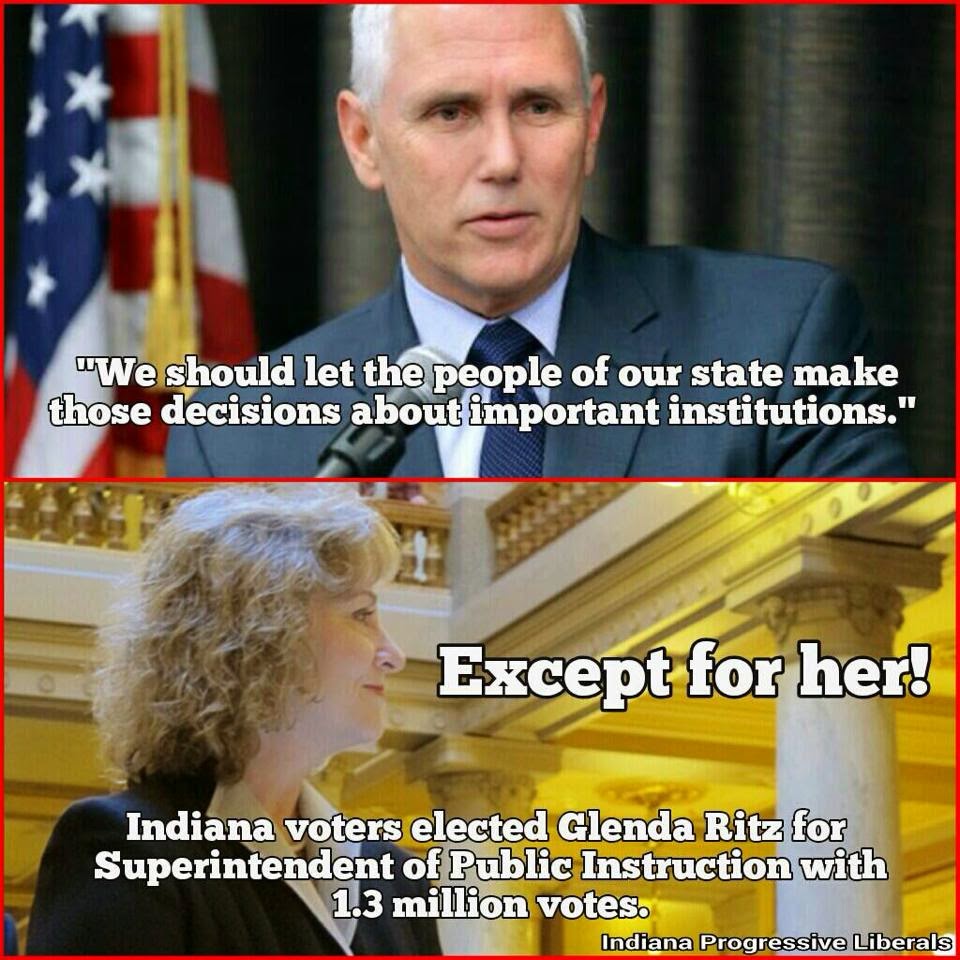
Glenda Ritz, Indiana's State Superintendent of Public Instruction, has been ignored, punished, and abused since the day she took office. Her crime? She's a Democrat in a state with a supermajority of Republicans. The Republican leadership in the legislature has prevented her from doing what she was elected to do and has doubled down on anti-public education legislation. The Republican governor, Mike Pence, has been blatant in his preference for private, parochial, and charter schools. The state Board of Education (whose membership has changed just recently) has also added to the mix by fighting her at every opportunity.

The legislature ordered a committee to oversee the adoption of a new state achievement test to replace the ISTEP for grades 3 through 8. The Governor insisted on assigning his own chair of the committee, bypassing the State Superintendent. The panel, led by members appointed by the Governor and Republican leadership, has prevented Ritz from even presenting her plan for new testing.

The obstruction continues.
Ritz shared the OnTrack proposal with members of the Panel to Study Alternatives to the ISTEP Program Test, but she was denied the opportunity to formally present the plan to panel.
Superintendent of Public Instruction Glenda Ritz Releases Details of Cost Cutting, Time Saving, Student-Centered Assessment System Proposal
This proposal was shared with members of the Panel to Study Alternatives to the ISTEP Program Test prior to today’s meeting along with the results of the Request for Information from assessment vendors regarding the viability of utilizing a new approach to assessment. For the second time, the Superintendent’s request to formally present information to the panel was denied resulting in a sixth meeting of the panel with no substantial decisions made. [emphasis added]
The OnTrack proposal can be viewed HERE.


POLITICS: STEREOTYPES

Donald Trump Jr.: if women can’t handle sexual harassment, they should be “kindergarten teachers”

Stereotypes surrounding teachers are still prevalent, apparently. Donald Trump's son, Jr., has essentially said that teaching Kindergarten is a job that anyone can do because it's so easy. When workplace harassment was brought up in connection with his father's misogynistic behaviors, he unsurprisingly blamed women for being harassed by implying that they ought to just accept it as part of being in "the workforce." If they can't, he said, they should go "teach kindergarten."

I wonder how long Junior would last as a teacher in a kindergarten classroom...
“If you can’t handle some of the basic stuff that’s become a problem in the workforce today, then you don’t belong in the workforce,” Trump said. “Like, you should go maybe teach kindergarten. I think it’s a respectable position.”


###

Sunday, October 23, 2016

Baseball Interlude: Random Thoughts: Cubs Win!

IT'S "NEXT YEAR"

I saw my first professional baseball game at Wrigley Field in the summer of 1956 – or maybe it was '55...or '57 – in any case, it was sometime in the mid 50's. Ernie Banks was a newcomer, having joined the team in 1953 after playing professional baseball with the Kansas City Monarchs. Ron Santo, Billy Williams, and Ferguson Jenkins were teenagers still in high school. Ryne Sandberg and Greg Maddux hadn't been born yet.

I watched games after school. I got on the 'el' after high school and rode to Wrigley. I followed the team in the newspaper when I didn't have TV or radio access. I joined the Die-Hard Cubs Fan Club in the 80s...and the Cubs Club when the former morphed into the latter.

Here, then, are some random thoughts on an occasion I always hoped to see. The Cubs have won the National League Pennant. "Next year" is now.
  • In 1969 I was in college and only followed the Cubs in the newspaper (IDS). There were TVs in the dorm (I even had a roommate with a TV for a while), but that was before cable or satellite and WGN didn't broadcast to Bloomington, Indiana. I'm glad I didn't see that season on TV or in person. It was too painful.


  • My dad saw (or more likely listened to) the Cubs win the National League in 1929, 1932, 1935, 1938, and 1945, but never saw a World Championship. I was born three years after the Cubs' last trip to the World Series.
  • All the years the Cubs were in the post season for the National league pennant...and came up short...1984, 1989, 1998, 2003, 2007, 2008, 2015..."Wait till next year!"
  • "So the Cubs haven't won a pennant in nearly forty years. Why not look at it this way? Take it in terms of eternity. That's not even a fly speck. Just tell yourself that sometime in the next thousand years the Cubs will get their share of the pie." – Jack Brickhouse*


  • Since 1876, and before 2016, the Cubs have won two World Series, sixteen National League pennants, and six division championships. The last pennant win (until last night) was 1945. The last World Series win was 1908.
  • Hey! Peanuts! Cubs peanuts here!
  • "I have always been an optimist and even though sometimes you lose more than you win with that type of attitude, still and all there are enough great moments, thrills and excitement to make it all beautiful. You know that tomorrow will be a better day." – Jack Brickhouse*


  • When Dexter Fowler walks to the plate in the top of the first inning in Cleveland on Tuesday, October 25, he will be the first African-American in a Cubs uniform ever to play in a World Series.
  • For decades I've said that all I want is a National League Pennant...even if they lost in the World Series. Now that the Cubs have finally won a National League Pennant, a World Series win would be nice...
  • Baseball is the perfect metaphor for life. Some teams, often those with the most money, win more times than others. But money doesn't always buy success just like money doesn't buy happiness. For that, you have to rely on family and friends (teamwork), hard work, a positive attitude, and some luck. Getting knocked down doesn't make one weak. Strength is better measured by the ability to get up after being knocked down. Courage is not the opposite of fear...it is being afraid, yet still persevering in the face of certain defeat. A hero isn't the one who wins the game, but the one who keeps swinging till the final out.


"Don't let anyone say that it's just a game
For I've seen other teams and it's never the same
When you're born in Chicago you're blessed and you're healed
The first time you walk into Wrigley Field
...Someday we'll go all the way, yeah, someday we'll go all the way" – Eddie Vedder

  • Perseverance. Perseverance. Perseverance.
  • "Cub fans will take winning in stride. With enthusiasm, with tears of joy, perhaps, but in stride...When it happens you will find us, like our ancestors in 1908, sensitive enough to know how to be humble in the face of a miracle." – Jim Langford*

THE TWO GREATEST CUB FANS IN HISTORY

I wish you could have been here to see this...


###

*from The Cub Fan's Guide to Life by Jim Langford.