"The whole people must take upon themselves the education of the whole people and be willing to bear the expenses of it. There should not be a district of one mile square, without a school in it, not founded by a charitable individual, but maintained at the public expense of the people themselves." -- John Adams

"No money shall be drawn from the treasury, for the benefit of any religious or theological institution." -- Indiana Constitution Article 1, Section 6.

"...no man shall be compelled to frequent or support any religious worship, place, or ministry whatsoever, nor shall be enforced, restrained, molested, or burthened in his body or goods, nor shall otherwise suffer on account of his religious opinions or belief; but that all men shall be free to profess, and by argument to maintain, their opinion in matters of religion, and that the same shall in no wise diminish enlarge, or affect their civil capacities." – Thomas Jefferson

Monday, May 15, 2017

Instead of Equity

Inequity, both economic and racial, in the U.S. is so common, so embedded in our society that no one in America should be surprised to hear what John Green has to say about life expectancy in the video below.

In the doobly doo, below his video, Green links to a study – Inequalities in Life Expectancy Among US Counties, 1980 to 2014, wherein we learn...
Much of the variation in life expectancy among [U.S.] counties can be explained by a combination of socioeconomic and race/ethnicity factors, behavioral and metabolic risk factors, and health care factors.
So, life expectancies, like test scores, are correlated to ZIP codes...


SCHOOL IS ABOUT FINDING YOUR HAPPINESS...

In contrast to the inequity in the U.S., Finland is one of the most equitable societies on the planet. This equity is reflected in Finland's education system. In his 2015 documentary, Where to Invade Next, Michael Moore asked the Finnish Minister of Education, "If you don't have standardized tests here in Finland, how do you know which schools are the best?" She responded...
The neighborhood school is the best school. It is not different than the school which can be, for example, situated in the town center, because all the schools in Finland, they are equal.
Equity.

In Finland, the richest families send their children to the same schools as the poorest families. That means, as Moore says,
...the rich parents have to make sure that the public schools are great. And by making the rich kids go to school with everyone else, they grow up with those other kids as friends. And when they become wealthy adults, they have to think twice before they screw them over.
Equity.

Equity in the nation yields equity in education. Equity in education yields high achievement and reinforces equity in the nation. If we were actually interested in improving American education we would do what the Finns have done...and, as Moore said elsewhere in the documentary, the Finnish education system is based on ideas from the United States. We just have to do what we already know.


But, whine the contrarians, "Finland is not the U.S. We can't just import their whole education system. They're a smaller country...not so diverse!"

True.

In order to do what Finland has done we would have to support and invest in our children, eliminate the inequity in our society, and...
  • end the racism inherent in America. We would have to heal the damage done by Jim Crow and the nation's slave past. We can't build an educationally equitable nation until we have a racially equitable nation.
  • stop dismantling our public schools. When a school system, riddled with poverty, inevitably fails, the solution in the United States is to privatize...to close the schools and replace them with charter schools...instead of working to change the environment and support the schools. Charter schools, however, aren't the cure to low achievement.
See also...
  • quit trying to fund two or three parallel school systems. We need one public school system for all Americans, poor and wealthy, black and white. As long as there are multiple school systems divided and ranked by economic and racial privilege, there will be "haves" and "have nots." There will be inequity.

...INSTEAD WE BLAME TEACHERS

A school is not a factory; teaching is a process

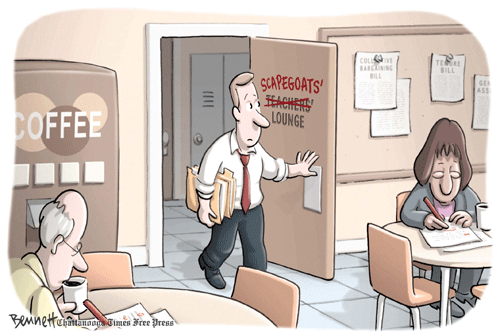
Instead of increasing educational equity we point fingers and try to find someone to blame. "Reformers" love to blame teachers.

Instead of giving teachers the professional responsibility of teaching, politicians and policy makers make decisions for public schools. They decide what should be taught and how it should be taught. Then, when their ignorant and inappropriate interference doesn't result in higher test scores, they blame the teachers.
On every occasion possible, they talk about incompetent and ineffective teachers as if they are the norm instead of the rare exception. They create policies that tie teachers' hands, making it more and more difficult for them to be effective. They cut budgets, eliminate classroom positions, overload classrooms, remove supports, choose ineffective and downright useless instructional tools, set up barriers to providing academic assistance, and then very quickly stand up and point fingers at teachers, blaming them for every failure of American society, and washing their own hands of any blame.


...INSTEAD WE LOWER STANDARDS FOR TEACHERS

In Arizona, teachers can now be hired with absolutely no training in how to teach

We pass legislation damaging the teaching profession. Then, when fewer young people want to become teachers and a teacher shortage is wreaking havoc on public schools, we claim that "we have to get more 'good people' into the classroom," so we remove licensing restrictions and let anyone teach...
New legislation signed into law in Arizona by Republican Gov. Doug Ducey (R) will allow teachers to be hired with no formal teaching training, as long as they have five years of experience in fields “relevant” to the subject they are teaching. What’s “relevant” isn’t clear.

The Arizona law is part of a disturbing trend nationwide to allow teachers without certification or even any teacher preparation to be hired and put immediately to work in the classroom in large part to help close persistent teacher shortages. It plays into a misconception that anyone can teach if they know a particular subject and that it is not really necessary to first learn about curriculum, classroom management and instruction.

ALEC: ALTERNATIVE CERTIFICATION ACT

ALEC is a voice for lowering standards for teaching. They say, "certification requirements prevent many individuals from entering the teaching profession." That's true, and that's as it should be.

They say, "comprehensive alternative certification programs improve teacher quality by opening up the profession to well-educated, qualified, and mature individuals." What is their definition of "improved teacher quality?" What is their definition of "qualified?"

Teachers need to understand and know their subject area, of course, but they also need to understand educational methods, theory, and style (whatever that means) which ALEC so disrespectfully dismisses.

Why should teachers know anything about education methods, learning theory, classroom management, or child development? If you're ALEC, the answer is "they don't."
Teacher quality is crucial to the improvement of instruction and student performance. However, certification requirements that correspond to state-approved education programs in most states prevent many individuals from entering the teaching profession. To obtain an education degree, students must often complete requirements in educational methods, theory, and style rather than in-depth study in a chosen subject area. Comprehensive alternative certification programs improve teacher quality by opening up the profession to well-educated, qualified, and mature individuals. States should enact alternative teacher certification programs to prepare persons with subject area expertise and life experience to become teachers through a demonstration of competency and a comprehensive mentoring program.

Paul Lauter: Why Do Dentists Need to be Licensed?

In response to ALEC...
I think we should propose doing away with dental licenses. After all, there’s nothing that can’t be fixed with a piece of string and a door knob.

...INSTEAD WE OBSESS OVER TESTING

An advertisement from Facebook.

Is this what we ought to be focusing on...better test-prep? In America the purpose of education has become the tests.


Don’t Use Kindergarten Readiness Assessments for Accountability

I'm afraid we have completely lost any valid use of tests in the U.S. Now there's a move to use Kindergarten Readiness Assessments (KRAs) in order to grade schools and children.

Tests should only be used for the purpose for which they were developed. Any other use is educational malpractice.
...there are also several tempting ways to misuse the results. The Ounce delves into three potential misuses. First, the results should not be used to keep children from entering kindergarten. Not only were these assessments not designed for this purpose, but researchers have cautioned against this practice as it could be harmful to children’s learning.

Another misuse of KRA results is for school or program accountability. According to the Ounce report, some states have begun using these results to hold early learning providers accountable. One example the report highlights is Florida. While Florida has since made changes, the Florida State Board of Education previously used the results from its Kindergarten Readiness Screener to determine how well a state Voluntary Prekindergarten Program (VPK) provider prepared 4-year-olds for kindergarten...

...Finally, the Ounce report raised issues with using KRA results for pre-K and kindergarten teacher evaluation. Once again, the assessments are not designed for this purpose...[emphasis added]

INSTEAD...

...of making excuses and blaming school systems, schools, teachers, and students, policy makers should take responsibility for low achievement caused by the nation's shamefully high rate of child poverty.

...of wasting tax dollars on a second (charters) and third (vouchers) set of schools of dubious quality, trying to duplicate our already neglected public schools, we should invest in our children, in our future, and fully fund a single, free, equitable, public school system.

🚌🚌🚌

Thursday, May 11, 2017

2017 Medley #15

Poverty, Lead, The Onion

Chapter 10: The Family Begins to Starve
"Slowly but surely, everybody in the house began to starve.

"...And every day, Charlie Bucket grew thinner and thinner. His face became frighteningly white and pinched. The skin was drawn so tightly over the cheeks that you could see the shapes of the bones underneath. It seemed doubtful whether he could go on much longer like this without becoming dangerously ill.

"And now, very calmly, with that curious wisdom that seems to come so often to small children in times of hardship, he began to make little changes here and there in some of the things that he did, so as to save his strength. In the mornings, he left the house ten minutes earlier so that he could walk slowly to school, without ever having to run. He sat quietly in the classroom during break, resting himself, while the others rushed outdoors and threw snowballs and wrestled in the snow. Everything he did now, he did slowly and carefully, to prevent exhaustion..."
In fiction, children who are suffering find ways to compensate. In Roald Dahl's popular novel, Charlie and the Chocolate Factory, Charlie Bucket slows down and somehow manages to survive on a daily diet of a piece of potato and a slice of bread. In real life, the results of poverty have lifelong implications and there is no Magical Chocolate Maker to shower riches on needy children. In real life, the only magic that will help is the magic of economic equity, infrastructure investment, and hard work.

In his 2009 paper, Poverty and Potential: Out-of-School Factors and School Success, David C. Berliner describes out-of-school-factors affecting school achievement which are often permanent and life-altering.
(1) low birth-weight and non-genetic prenatal influences on children; (2) inadequate medical, dental, and vision care, often a result of inadequate or no medical insurance; (3) food insecurity; (4) environmental pollutants; (5) family relations and family stress; and (6) neighborhood characteristics.
Each of these factors has an impact on the ability of children to achieve in school. Education can't heal the effects of poverty alone.


POVERTY

Education Can’t Fix Poverty. So Why Keep Insisting that It Can?

Instead of blaming teachers, students, families, schools, and school systems for low achievement and "failing" schools, policy makers need to take responsibility for the central cause of low achievement – poverty and its accompanying damage. Until that happens all the policies dealing with charter schools, vouchers, test and punish, and higher standards will be a waste of time and money. They will do nothing to improve the education of our children.
One of the consequences of making education so central to social policy has been that we’ve ended up taking the pressure off of the state for the kinds of policies that would be more effective at addressing poverty and economic inequality. Instead we’re asking education to do things it can’t possibly do. The result has been increasing support for the kinds of market-oriented policies that make inequality worse.

If we really want to address issues of inequality and economic insecurity, there are a lot of other policies that we have to pursue besides or at least in addition to education policies, and that part of the debate has been totally lost. Raising the minimum wage, or providing a guaranteed income, which the last time we talked seriously about that was in the late 1960’s, increasing workers’ bargaining power, making tax policies more progressive—things like that are going to be much more effective at addressing inequality and economic security than education policies.

School Lunch Quality and Academic Performance

School lunches (and breakfasts) can have an impact on children's school performance. Children who are hungry will have trouble learning no matter who the teacher is, how great the curriculum, or how much money is spent on technology. The sooner we learn that, the better off our children will be.
Students at schools that contract with a healthy school lunch vendor score higher on CA state achievement tests, with larger test score increases for students who are eligible for reduced price or free school lunches.


LEAD

Lead and Juvenile Delinquency: New Evidence from Linked Birth, School and Juvenile Detention Records

Berliner's out-of-school-factor number four, environmental pollutants, can destroy a child's potential before he or she even begins school, and lead is a leading environmental problem for families living in poverty.

Eliminating lead in the environment will go a long way to increasing achievement, decreasing violence, and keeping children in school so they can learn. Punishing children because adults have subjected them to a poisonous environment is cruel and abusive. The only cure for lead poisoning is prevention. The only way to prevent lead poisoning is to invest more money in lead eradication.
Using a unique dataset linking preschool blood lead levels (BLLs), birth, school, and detention data for 120,000 children born 1990-2004 in Rhode Island, we estimate the impact of lead on behavior: school suspensions and juvenile detention. We develop two instrumental variables approaches to deal with potential confounding from omitted variables and measurement error in lead. The first leverages the fact that we have multiple noisy measures for each child. The second exploits very local, within neighborhood, variation in lead exposure that derives from road proximity and the de-leading of gasoline. Both methods indicate that OLS considerably understates the negative effects of lead, suggesting that measurement error is more important than bias from omitted variables. A one-unit increase in lead increased the probability of suspension from school by 6.4-9.3 percent and the probability of detention by 27-74 percent, though the latter applies only to boys.
See also Freddie Gray’s life a study on the effects of lead paint on poor blacks

THE ONION – SATIRE

The Onion is a satire site, but this article from 2011 has enough truth to make it a valuable study on the challenges schools face. Money, properly invested, is the answer. The only people who deny that are those who can afford to send their well nourished, healthy, and well cared for children to elite private schools.

Budget Mix-Up Provides Nation's Schools With Enough Money To Properly Educate Students
"Obviously, we did not intend for this to happen, and we are doing everything in our power to right the situation and discipline whoever is responsible," said House Budget Committee chairman Paul Ryan (R-WI), expressing remorse for the error. "I want to apologize to the American people. The last thing we wanted was for schools to upgrade their technology and lower student-to-teacher ratios in hopes of raising a generation of well-educated, ambitious, and skilled young Americans."

"That's the type of irresponsible misspending that I've been focused on eliminating for my entire political career," Ryan added.

💲🚰👩‍🎓

Tuesday, May 9, 2017

Teacher Appreciation Day: Read Aloud

Charlotte's Web has been a favorite read aloud of third grade teachers for decades...probably since 1952, the year it was published.

I first heard the book when my third grade teacher, Mrs. Gilbert (Philip Rogers School in Chicago) read it out loud during the 1956-57 school year. It was the first novel I remember hearing a teacher read aloud in school, and it had a significant effect on me and my future.
  • I remembered it when I was a student in the education department at IPFW.
  • I remembered it when I became a father and began reading aloud to my children.
  • I remembered it once I started teaching and began reading aloud to my own classes.
  • I remembered it when I discovered the Read Aloud Handbook, by Jim Trelease.
  • I still remember it as I read aloud to a friend's third grade class when I volunteer.
For Teacher Appreciation Day, 2017, I'm reposting an entry, with some minor changes, from 2013 about reading aloud.

In appreciation of three of my favorite teachers, and the three who most influenced my growth as a teacher – Mrs. Gilbert, Dr. Lowell Madden, and Jim Trelease – who taught me that reading aloud is still the most important part of reading instruction...


July 1, 2013

JIM TRELEASE

In 2008 I wrote that Jim Trelease was going to retire. This year, just about a week ago in fact, he released the seventh and final edition of The Read Aloud Handbook. The first Penguin edition of his book was published in 1982, but I was already familiar with The Read Aloud Handbook three years before it was published by Penguin.

In 1979 I ordered a pamphlet on reading aloud from the Weekly Reader Book Club. I had earned my teaching certificate before the 1976-77 school year and had been reading to my third graders every day...just like Dr. Madden (Lowell E. Madden, education professor at Indiana/Purdue Fort Wayne) taught me to do.

Dr. Madden impressed upon us the importance of reading aloud...and for the 19 years (out of 35) I spent in a general education classroom it was my favorite part of the day. I read to all my classes...kindergarten through 6th grade...Where the Wild Things Are and Junie B. Jones through The Island of the Blue Dolphins. I can't remember ever missing a day. It was my belief -- and it still is -- that reading aloud to children is the most important thing that a teacher (or parent) can do to help their child(ren) succeed in reading.

The Read Aloud Handbook, Weekly Reader edition, was my first introduction to Jim Trelease and from that point on, reading aloud, which was already an important part of my reading instruction time, became even more important.
The single most important activity for building the knowledge required for eventual success in reading is reading aloud to children...It is a practice that should continue throughout the grades. [emphasis added]
That quote from Becoming a Nation of Readers published some years later (1985) reinforced my desire and my determination to read aloud to my students every day.

As new editions of The Read Aloud Handbook were published I would buy them. When friends and family members had new babies, I would give copies of the book as gifts. When Jim Trelease visited Fort Wayne, which he did several times, I'd go hear him speak. I even started gathering a few autographs from the author.

[I took the Weekly Reader edition of the Read Aloud Handbook to one of his lectures. I stood in line for an autograph after the presentation and was delighted at his response. He acted like he just had a visit from a long lost friend.]


WHY READ ALOUD

According to the newest edition reading aloud helps a person become proficient at reading in two ways...
  • The more you read, the better you get at it; the better you get at it, the more you like it; and the more you like it, the more you do it.
  • The more you read, the more you know; the more you know, the smarter you grow. [citation here]
Why does it work? Because having someone read to you is fun...humans like fun...they want that fun to continue so they are motivated to learn to do it on their own.

Trelease talks about reading achievement in the US compared to the rest of the world. We have, he says, some of the best nine-year old readers in the world, second only to Finland. By the time American kids are 14 however, they drop to eighth place. Would reading aloud to older students help?


READING ALOUD TO OLDER STUDENTS

Most primary teachers read to their students every or almost every day. As the children get older, however, the frequency of teacher read aloud diminishes. Part of this is because the curriculum is so much heavier in upper grades, and part of it is, of course, the pervasive and time consuming influence of testing and test-prep. By the time students are 14, barely half of their reading/English/literature teachers read to them...and almost no teachers of other subjects do.

An article titled Why Reading Aloud to Older Children Is Valuable argues that reading aloud to older students is still valuable.
“Research indicates that motivation, interest, and engagement are often enhanced when teachers read aloud to middle school students,” wrote research authors Lettie K. Albright and Mary Ariail. Teachers surveyed for the study cited modeling as their number-one reason for reading aloud.
The article also refers to Jim Trelease...
For Trelease, the power of shared words is a big reason to keep on reading aloud after children are able to read for themselves. Students might interject questions, comfortably wading into complicated or difficult subjects because they are happening to the characters in the story, and not to themselves. “Why do you think so many children’s stories have orphans as characters? Because every child either worries or fantasizes about being orphaned.”

While Trelease maintained that read-alouds can happen through any device (“Look at all the truckers listening to books on CD,” he said), and Lahey reads from a physical paper book, dogeared and scrawled with all her notes in the margins, both emphasized how students recall read-alouds with fond memories. Trelease recently received a letter from a retired teacher who reconnected online with former students some 30 years later. She wanted to know the one thing her former students remembered about her class.

“Without fail, it was the books she read to them.”

THEY REMEMBER

A few years before I retired I met a couple of my former third graders at a school function. They were in their early 20s, out of college, starting on their own careers. I asked them if they remembered being in third grade. They said the same thing that most of us say when we return to our elementary schools after becoming adults..."The school looks a lot smaller now." Then one of them added...
I remember you were the one who read all those books to us...
...and he proceeded to name off half a dozen of his favorites. Over the years I've gotten notes from former students telling me that they were reading a book to their children or their class which I had read to them when they were in my class. Reading aloud makes an impression...a positive one.

Wouldn't it be nice if teachers at all grades could eliminate some of the test prep and spend more time reading to their students?

Wouldn't it be nice if all parents read aloud to their children? (Parent hint: Start when your baby is an infant...day one. Don't stop till they leave home for good.)

📚📚📚

Sunday, May 7, 2017

Listen to This (Random Quotes) #6

REMINDER

John Kuhn is a strong voice in the fight for public schools. He understands that public education is not just for parents and children who participate in the public school system...public education exists to enrich and preserve our nation, just like public parks, museums, roads, street lights, and water systems.

This is one of my favorite quotes...


POVERTY

Can Schools Cure Poverty?

In order to heal the plague of poverty in America, schools would have to be equipped with medical facilities, counseling services, social workers, and psychologists, as well as all the necessities of a fully funded school like libraries staffed with trained librarians, specialists for students with special needs, specialists in the arts and physical education, nutritionists providing healthy food offerings, administrators with experience in the classroom and in management, and highly trained professional educators in every classroom.

Schools can't be expected to solve a problem which politicians and policy makers have either failed or ignored for centuries. Even with all the amenities listed in the above paragraph (and any others I might have forgotten), schools would find it difficult to heal the national illness of poverty. Poverty has roots in racism, class structure, economics, a financially ruinous health care system, and a ubiquitous drug culture. Schools can't repair this societal affliction alone.

Until we, as a people, develop the skill and desire to provide a decent standard of living to all our citizens, poverty will continue to be a major cause of school failure.

From Diane Ravitch
Poverty should be addressed by reducing poverty. No matter how high the standards, no matter how many tests, no matter how swell the curriculum is, those are not cures for homelessness, joblessness, and lack of access to decent medical care. This realization explains why I changed my mind about the best way to reform schools. It is not by turning schools over to the free market but by seeing them as part of a web of social supports for families and children. [emphasis added]


WHY TEACHERS QUIT

Teacher: I love my job, but the chaos of urban school reform is wearing me out

I recently took part in a discussion with my Indiana State Senator. This man is not a friend to public education and regularly promotes bills which
  • divert funds from public to private and privately run schools
  • support sectarian practices in public schools such as school sponsored prayer or anti-science legislation
  • support abusive or excessive testing practices
  • encourage the de-professionalization of teaching
During the discussion (which was with other educators), the Senator stated that, "The Senate is suffering from education reform fatigue."

His point, which I agreed with, was that education reform in Indiana needs to pause and reflect on the changes made. I would, of course, take it a step further and eliminate the damage that "reform" has caused in this state.

In any case, he indicated that members of his branch of the government were tired of focusing on ways to hurt public schools. He blamed the excesses on the Republicans in the State House of Representatives.

My response to him was something along the lines of, "Imagine what it must be like for teachers."

I wish I had said, "If it's tiring for you in the Senate to dump all these damaging changes on public education, imagine what it must be like to be a teacher at the end of the dumping."

From Ryan Heisinger in The Answer Sheet
Lasting relationships with teachers and peers aren’t forged over just a few months. An amazing arts program takes years to build. It takes a long time to develop a wide variety of student-led extracurricular opportunities. School pride comes when students feel they are a part of a community in which they’re able to express themselves and show off their talents. But in a marketplace in which schools compete for test scores, narrowed priorities and school closures erode the stable soil teachers and administrators need to put roots down and grow an enduring culture of success and school community and pride.


TEACHING CAREER

Teacher photographed completing lesson plans while in labor

Every teacher knows the drill...it's sometimes harder to miss a day at school than to go to school when you're sick. I remember getting up at 4 AM to get to school and make up lesson plans in order to go back home and collapse into the bed waiting for the pain of some illness to pass.

Naturally, I've never been pregnant, but I'm not surprised that a teacher would do this...

From Jennifer Pope of Burleson, Texas
"Really, I'm no different than any teacher that I know," Pope told ABC News. "They would've done the same thing. We think about our students like our own children. I'm grateful [people] are celebrating all teachers and working moms. Being a working mom is hard, but it's also fulfilling. I can't imagine not being a teacher."


CHOICE

Testing Opt Out: Parent Wants Conference; School Calls Police *Just in Case*

The "choice" crowd of "reformers" are adamant that parents know best and should have the tax-funded choice to send their children to any school they want – religious, corporate, or otherwise. They claim that it's only fair that parents have "choice" in everything having to do with their children...

EXCEPT...testing.

No one should get to "choose" to opt out of state mandated testing.

How many ways can you spell hypocrisy?

From Mercedes Schneider
One of the great contradictions within corporate ed reform is the promoting of a “parental choice” that stops short of the parent’s choice to opt his or her children out of federal- and state-mandated standardized testing.


TESTING: INAPPROPRIATE USES

Anger doesn’t describe it

From rlratto at Opine I Will
Anger doesn’t describe my feelings. Our society is being driven over a cliff by an extreme ideology that will destroy our nation. When we look the other way when children are being forced to fulfill an agenda, when we allow school children to go hungry, when we refuse to provide health care, when we demonize a segment of our population, we are heading for a fall.


AHCA

Despicable and Inexcusable

Sheila Kennedy

Every Republican who voted for this abomination must be held accountable

Paul Waldman

The quote below is from Paul Waldman. He's quoted in the excellent post by Sheila Kennedy. I've included both links.
Perhaps this bill will never become law, and its harm may be averted. But that would not mitigate the moral responsibility of those who supported it. Members of Congress vote on a lot of inconsequential bills and bills that have a small impact on limited areas of American life. But this is one of the most critical moments in recent American political history. The Republican health-care bill is an act of monstrous cruelty. It should stain those who supported it to the end of their days.


🎤🎧🎤