"The whole people must take upon themselves the education of the whole people and be willing to bear the expenses of it. There should not be a district of one mile square, without a school in it, not founded by a charitable individual, but maintained at the public expense of the people themselves." -- John Adams
"...no man shall be compelled to frequent or support any religious worship, place, or ministry whatsoever, nor shall be enforced, restrained, molested, or burthened in his body or goods, nor shall otherwise suffer on account of his religious opinions or belief; but that all men shall be free to profess, and by argument to maintain, their opinion in matters of religion, and that the same shall in no wise diminish enlarge, or affect their civil capacities." – Thomas Jefferson
When I was in middle school and high school, Asimov was one of my most important teachers. This isn't to say that my Chicago Public Schools teachers didn't do their best to get this difficult-to-educate student motivated to learn...but Asimov did it better.
It was his science, not his science fiction that started me on the road to Asimov fanhood. I began reading his science essays some time in the early 1960s.
I had discovered science fiction when I was in middle school and started buying pulp sci-fi magazines. One of them, The Magazine of Fantasy and Science Fiction (which has been in continuous publication since 1949), had science articles by Asimov. After I read one I searched the magazine monthly for Asimov, not science fiction.
I learned science from this reading, and as the years passed, I also learned more about Asimov the writer, and Asimov the person. He was a Renaissance man...a voracious reader and writer, knowledgable in dozens of academic areas, not just science. He taught me sociology, psychology, literature, history, philosophy, and religion. His books and articles were the ones which kept my interest...not my textbooks.
When I took science classes, especially biology and chemistry, I remember thinking that I was a real scientist, like Asimov. It's interesting that in my generally unsuccessful high school career, the science classes were the only ones I consistently did well in. [It's also likely that my father, with his Ph.D in Chemistry from the University of Chicago, influenced my interest and ability in science as well.]
Here then, in honor of his 96th birthday, are some of Isaac Asimov's quotes.
~~~
In 1988, Asimov, along with Jason Shulman, wrote, Isaac Asimov's Book of Science and Nature Quotations. In it, he wrote
The true delight is in the finding out rather than in the knowing.
Preschoolers and Kindergarteners know this. The wonder of learning is in discovery.
Even as a professional, Asimov knew that discovery did not always follow expected paths. New discoveries sometimes just happen. The "teachable moment" is not something teachers plan. It, also, just happens.
In an interview with Bill Moyers, Asimov asserted that people think of education as something you finish. Good teachers understand that learning is something that needs to continue throughout one's life.
Asimov made his statement as a criticism of the current education system. Graduation makes education a "rite of passage" and many think that once they graduate, they're done. In contrast, Asimov considered learning to be a life-long pursuit.
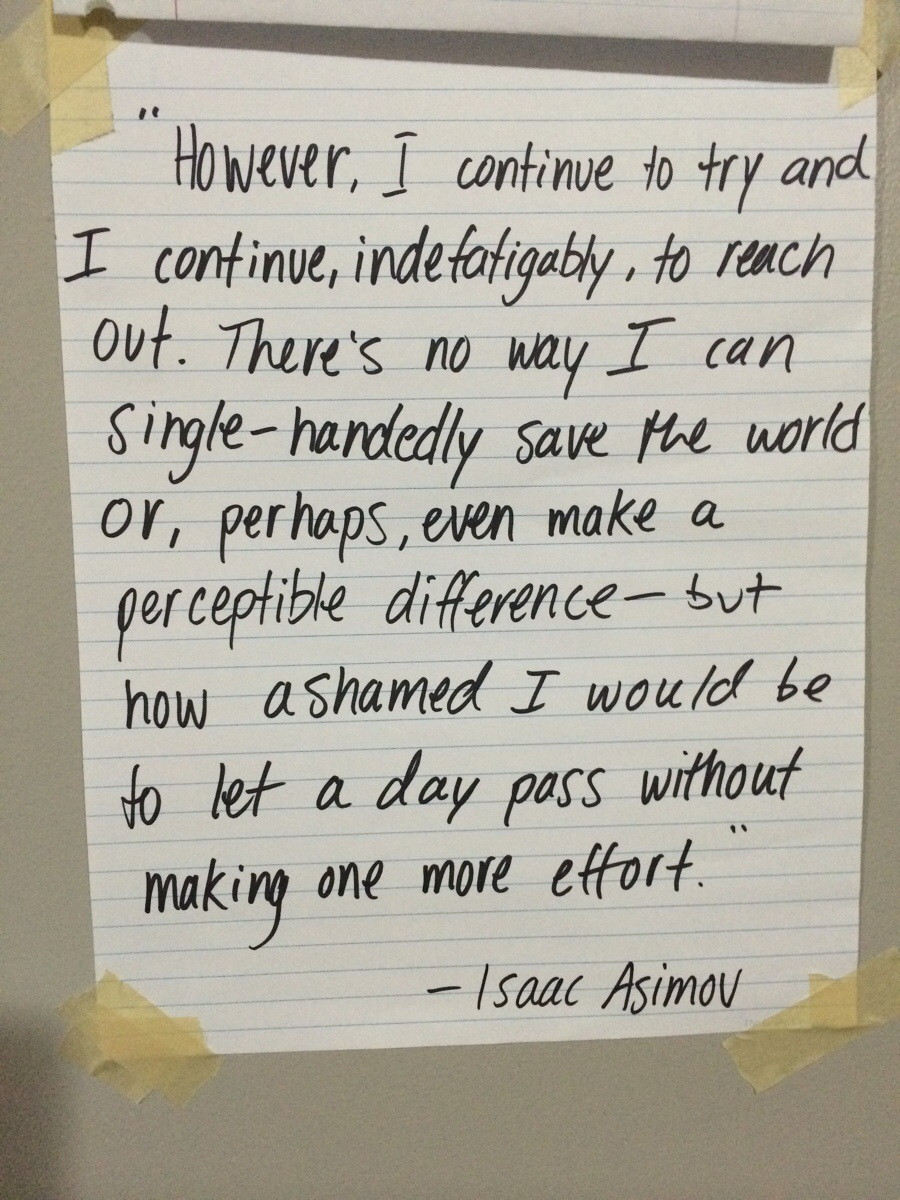
The teacher reaches out, continuing to try to reach his students...day after day, year after year. There's no way that one teacher, working alone, can do it all. But we keep trying...
In 1989 Asimov spoke about the greenhouse effect and how it can have an impact on the Earth. Listen starting about 1:30...[to about 7:00].
We are facing problems that transcend nations...
Asimov taught himself to read before he went to school...and he graduated from high school at age 15. He went on to earn a B.S., an M.A. and a Ph.D. in chemistry from Columbia University. He left us with more than 500 volumes filled with his ideas, imagination and knowledge.
The saddest aspect of life right now is that science gathers knowledge faster than society gathers wisdom.
For more on Asimov...
My favorite non-fiction works by Asimov were his articles in The Magazine of Fantasy and Science Fiction. Those have been collected into quite a few books. My favorite Asimovian fiction writings are two short stories which later grew into novels: Nightfall, and The Ugly Little Boy.
The New York Times printed this editorial today. It's all the teachers unions' fault.
Teachers unions and other critics of federally required standardized tests have behaved in recent years as though killing the testing mandate would magically remedy everything that ails education in the United States. In reality, getting rid of the testing requirement in the early grades would make it impossible for the country to know what if anything children were learning from year to year.
This makes sense only if you believe, as the NYT editorial board apparently does, that yearly standardized testing is the only way to know if our students are learning.
"Teachers unions and other critics" don't claim that reduced testing would magically remedy everything that ails education. I'm a member of a teachers union as well as a critic of yearly standardized testing and I, for one, have never claimed that no-testing would solve everything. Neither have I heard anyone else suggest that, from the bloggers who write against so-called "education reform" to the leaders of America's largest teachers unions. Most, like me, blame a great deal of our education struggles on the high levels of child poverty in the U.S. Testing isn't the enemy, but it's being misused and overused. Most standardized testing tells us what we already know...that students who live in poverty achieve at lower levels than students who don't.
"Getting rid of the testing requirement in the early grades" isn't necessary because, federally required testing doesn't begin until third grade, the oldest of the grades traditionally considered "the early grades." Should we get rid of testing in third grade? The Finns don't test third graders and their students seem to do ok. However, simply getting rid of testing is not going to solve all the education problems in America.
Maybe, instead, we ought to fully fund our public schools, provide wraparound services for children who need them, and work to alleviate the effects of childhood poverty. The Chicago Teachers Union, a real union of professionals, not the imaginary "Teachers unions" that the NYT refers to, published ways to actually improve the lives of children. You can learn about the ways to help children by reading a summary of The Schools Chicago's Children Deserve. If you wish, you can read the entire document, HERE. The suggestions work for all children...not just those in my home town of Chicago.
...There are other big chunks of wrong, well-worn and repeatedly gnawed on by commenters, like the old baloney that the teacher unions Common Core (they didn't-- they supported it and continue to do so) and the connected testing because they "did not want to be evaluated based on how much students learned," a statement which ignores the question of whether the Big Standardized Tests actually measure any such thing, and which also ignores the rich and detailed arguments about these points that are all over the interwebs.
So here's the big question? How did the New York Times editorial board get so very much wrong? Does the NYT not have Google? I mean-- here's my New York Times story. One of my oldest friends from here in our small NW PA town now lives in Manhattan, and when he got married years ago, his wedding announcement ran in the NYT. A fact-checker called to verify the name of the business that his mother runs here in our population 7000 town hundreds of miles away. That's the level of commitment to accuracy that I associate with the the NYT.
What's the problem? I think we can find it in these two sentences:
A recent study from Achieve, a nonpartisan organization that works with the states to raise academic standards....
An alarming study by the Education Trust, a nonpartisan foundation...
These are the sources that the NYT relied on? Seriously?
I suppose they are "bi-partisan" in the same way that The Tobacco Institute and most lobbying groups are "bi-partisan." In that sense, the NYT board just stopped short of flat out lying by saying that these two groups are impartial or unbiased. But the Education Trust is a Gates-funded advocacy group from the earliest days of the Core. And Achieve is the organization that "helped" the CCSSO and NGA write the Common Core to begin with-- no organization is more highly invested in the continued support and push of the Core Standards and the tests that are welded to them. And they earlier this month released a report that says-- well, it says pretty much exactly what this editorial says...
In the following text from a story about the new education law, the Every Student Succeeds Act, NPR shows the depth of their misunderstanding.
The arguments for annual student testing come down to accountability and equity. If we have accurate data on the academic progress of each and every student, testing advocates say, we'll be able to compare results and highlight gaps, whether between rich and poor kids or across states. That information, presumably, can spur effective, targeted action to improve.
Note my highlighting in that paragraph...Standardized testing doesn't offer "accurate data on the academic progress of each and every student." Everything which follows based on that assumption is wrong.
Standardized tests tell us which children come from homes with enough money and which children don't. The information based on the results of standardized tests isn't helpful enough to subject students to the annual overuse and abuse of testing. And it won't "spur effective, targeted action to improve" unless that action includes attention to reducing the level of childhood poverty in the U.S.
It has been a high-stakes year for high-stakes standardized tests.
The debate over renewing the big federal education law turned, in part, on whether annual testing would remain a federal mandate. Republicans initially said no, Democrats said yes. Ultimately the overhaul passed with tests still in place.
On the other hand, this fall President Obama addressed parents on Facebook and released a "Testing Action Plan." He wanted states to cut down "unnecessary testing" that consumes "too much instructional time," creating "undue stress for educators and students."
Meanwhile some parents, notably in New York state, opted out of the tests and made a lot of noise about it. The use of test scores in teacher evaluations was a big bone of contention. And many states dropped out of PARCC and Smarter Balanced, the two Common Core test consortia, in favor of giving their own state tests.
The arguments for annual student testing come down to accountability and equity. If we have accurate data on the academic progress of each and every student, testing advocates say, we'll be able to compare results and highlight gaps, whether between rich and poor kids or across states. That information, presumably, can spur effective, targeted action to improve.
GASLIGHTING AS "REFORM"
The term Gaslighting comes from the 1944 classic movie Gaslight, staring Ingrid Bergman and Charles Boyer which is billed as a "psychological thriller" (If you've never seen it, I recommend it). Gaslighting, which is what Boyer's character did to Bergman's character, is described in Wikipedia as,
...a form of mental abuse in which information is twisted or spun, selectively omitted to favor the abuser, or false information is presented with the intent of making victims doubt their own memory, perception, and sanity.[1][2] Instances may range simply from the denial by an abuser that previous abusive incidents ever occurred, up to the staging of bizarre events by the abuser with the intention of disorienting the victim.
In this article Peg with Pen relates Gaslighting to school "reform." It's a disturbing, but accurate story. [my emphasis]
I am currently working in a turnaround school. A turnaround school is a public school that has been deemed "failing" by policy makers. The policy makers inflict draconian, fascist measures on such schools in an effort to turn them around - aka - increase test scores. If they don't increase test scores they bring the hammer down harder by firing teachers, handing the school over to a charter, or closing the school, and so on.
Turnaround schools are not failing. Rather, the truth is that the policies are the failures. The racist, classist, sexist policies are based on lies and false realities meant to create compliant worker bees who do as they are told to increase test scores, while ultimately allowing the corporate reformers to push forward other measures which increase profit, increase the privatization of our public schools, and finally, increase the power of the privileged. That's it in a nutshell.
However, the factual process of turnaround in no way reveals to the public how this brutal takeover goes down. How to articulate the process has been at the forefront of my mind for the last five months as I found myself thrown head first into this madness. And indeed, it is a madness like no other - a combination of insane asylum and prison. As I tried to articulate it to a dear friend of mine, she said, "Peggy, you are being gaslighted." I had never heard the term gaslighting. I immediately began to read about it. I owe much gratitude to this friend who has given me a framework I can use to explain this process.
Indiana State Senator Pete Miller, like many legislators and "reformers," doesn't understand that the "free-market" doesn't work with K-12 education. Education is not a business. Students are not products. Teachers are not the same as "corporate providers" or "sales staff."
Miller maintains that teachers in hard to fill positions ought to be paid more than teachers in positions where staffing isn't a problem because that's what the "market" would dictate.
However, paying teachers different amounts of money based on the relative scarcity of their positions would damage the collegiality needed for a close, collaborative staff. The "highest performing" teachers would want to save their best teaching ideas for themselves in order to be able to bargain higher paying contracts. The truth is, though, that good education comes when teachers collaborate, not compete, with each other.
[Indiana State Senator Pete] Miller's idea is that he wants the invisible hand of the market to control teacher pay, but Indiana, like most states with so-called teacher shortages, already has the invisible hand of the market shoved right in their face-- they have a shortage because they are ignoring what the hand is telling them, which is "Make a better offer!" Miller is involved in some negotiating of his own, telling the invisible hand, "Well, what if we just a make a better offer for only a few of them? What's the absolute minimum the market will let us get away with?"
Teaching, Testing, and Acountability: Poverty and Charters
Every now and then I'll embed a video in my blog. Here I have chosen six – informative and inspiring – from 2015, comprising about 2 hours of video. I've added emphasis with boldface and italics.
What would happen if state and federal legislators actually listened to educators? Notice how many of the legislators in this video talk about "accountability." The assumption is that before "reformist" type accountability (aka standardized tests used to rank students, teachers, and schools) we never knew how our children were doing in school.
So long as public education policy continues to be shaped by the interests of corporate profiteering and not the interests of our public school children we will resist these unjust testing laws.
Jia Lee...the only woman at the hearings, from a female dominated profession...tries to teach legislators about the damage done by runaway testing.
The sad thing is that, despite the fact that NCLB has been replaced, annual, high-stakes testing is still with us.
Jia Lee, a New York special education teacher, said the tests "can only measure right or wrong," not complex questions. "I will refuse to administer a test that reduces my students to a single metric. … Teachers, students and parents find themselves in a position of whether or not to push back or leave."
In February several hundred pro-public education supporters went to Indianapolis to "Rally for Ritz"...a rally in support of Indiana's Superintendent of Public Instruction, Glenda Ritz. Superintendent Ritz was continually at odds with the appointed members of the pro-charter, pro-voucher, "reformist," school board.
My child is not “college and career ready” because HE IS A CHILD
...Accountability is representing your constituents, not your donors
...Accountability is research driven education policy. Standards don't educate kids, teachers do.
Accountability is seeing to it that every child has a school that has enough nurses, social workers, guidance counselors, gym, art, and music teachers, librarians, small class sizes, electives, hands-on projects, science experiments, theater, and band. Every. Single. Indiana. Child.
...no six year old should be on the losing end for equal educational opportunity
Legislators and "reformers" are all for accountability...for others.
John Oliver shows us just how inane and stupid our obsessive focus on standardized testing really is – test-pep rallies, school cheers – trying to convince children that high-stakes tests are "fun."
Yet, we all know that high-stakes tests are inappropriate for our most vulnerable students...and they make the pain of the also inappropriate test-prep-standards-based education even more painful.
Official instructions for test administrators specify what to do if a student vomits on his or her test booklet...and something is wrong with our system when we just assume a certain number of kids will vomit. Tests are supposed to be assessments of skills...
[NOTE: NSFW Some images and language might be offensive...just like Pearson's tests.]
Success Academy procedures hurt children. They are used by charter school chains to get rid of "undesirables" (aka, students who are difficult and/or expensive to educate or whose test scores don't measure up) despite what Moskowitz says in this report.
The fact that the two schools highlighted at the beginning of this report – one public, one charter – share the same building, is part of the problem. "Dual occupancy" – two or more schools sharing one building – is a problem. Public schools and their buildings belong to the community which built them. Taking part of a building away from a public school and turning over part of a building to a privately run charter school is like stealing the community's property for profit. We don't turn over control of certain parts of public parks for privately run athletic teams. We don't close of parts of public libraries and let for-profit book sellers "share the space." Neither should we do that with public schools.
Merrow said it all when he said...
In the end, how charter schools conduct their business is basically their own business.
What kind of future are we building for our nation?
Policy makers regularly talk about how important it is to have good schools, but there's no follow through on their part. They blame schools for low achievement, but don't accept their responsibility for the high levels of poverty in the nation, the main cause of low achievement.
Schools...the education of our citizens...is not a high priority for this nation, despite the rhetoric. Jefferson said, "An educated citizenry is a vital requisite for our survival as a free people." If that's true, then the nation is in jeopardy.
The late Carl Sagan had this to say more than 25 years ago...
...we have permitted the amount of poverty in children to increase. Before the end of this century more than half the kids in America may be below the poverty line.
What kind of a future do we build for the country if we raise all these kids as disadvantaged, as unable to cope with the society, as resentful for the injustice served up to them. This is stupid.
This is the latest and longest of the videos I posted this year. It's an important one because, despite ESSA, many teachers and schools around the nation are still judged by the test scores of their students, a practice which Dr. Berliner says is invalid. He also discusses the fact that outgoing Secretary of Education Arne Duncan wanted to carry the process one step further and evaluate schools of education by the test scores of their students' students.
We're using standardized achievement tests incorrectly. They are invalid as a measure of teacher competence, school quality, and teacher training program effectiveness. The discussion of whether or not to use this year's ISTEP tests to evaluate teachers and schools is irrelevant. We shouldn't be using any standardized student achievement test to evaluate teachers or schools.
Student achievement tests measure only student achievement.
David C Berliner's presentation is titled Teacher evaluation and standardised tests: A policy fiasco. You can read about the video presentation by Dr. Berliner at the Melbourne Graduate School of Education web site and watch the hour-long video below.
Teachers and teacher preparation programs are perfect targets to take legislators minds off of all the poverty and inequality that make some of America's education systems an international embarrassment. Blaming teacher education programs and the teachers they produce for disappointing standardized achievement test scores appears to me to be a diversion, of the type used by successful magicians. Blaming institutions and individual teachers directs our gaze away from the inequality and poverty that actually gives rise to those scores. In the same way a magician can divert attention of an entire audience when they make a person or a rabbit disappear.
Her math mistake in Iowa (misunderstanding the meaning of average) notwithstanding, she believes that closing schools will help...well...somehow. She said,
Now, I wouldn’t keep any school open that wasn’t doing a better than average job. If a school’s not doing a good job, then, you know, that may not be good for the kids.”
Like other politicians, she believes that closing a school solves problems which result in low achievement. For the most part those problems are based on high levels of poverty. Schools with large numbers of high poverty students need more support. More support equals more tax money. Closing public schools to open charters, or diverting money to private schools through vouchers won't solve the problems. Shifting students from one school to another won't solve the problems. Blaming teachers and parents for the low income of families in a school neighborhood won't solve the problems. What Mrs. Clinton should have said was, "Instead of closing schools we need to bring people out of poverty and provide more support for schools with students who struggle."
Arne Duncan, when he was CEO of Chicago Public Schools, closed "failing" schools. He then diverted public funds to charter schools. Some of those newly opened, "Duncan" schools were, in turn, closed by Rahm Emanuel, when he closed "failing schools."
The problem is not that Hillary Clinton made a math mistake or doesn't understand the meaning of average. The problem is that she wants to attack low achievement through closing schools.
Here's a short reading list for her...for all candidates, actually.